Artículo
Hepatitis E virus infection in the United States: Seroprevalence, risk factors and the influence of immunological assays
Pisano, María Belén ; Campbell, Christopher; Anugwom, Chimaobi; Ré, Viviana Elizabeth
; Debes, José D.
; Campbell, Christopher; Anugwom, Chimaobi; Ré, Viviana Elizabeth
; Debes, José D.
; Campbell, Christopher; Anugwom, Chimaobi; Ré, Viviana Elizabeth
; Debes, José D.
Fecha de publicación:
08/2022
Editorial:
Public Library of Science
Revista:
Plos One
ISSN:
1932-6203
Idioma:
Inglés
Tipo de recurso:
Artículo publicado
Clasificación temática:
Resumen
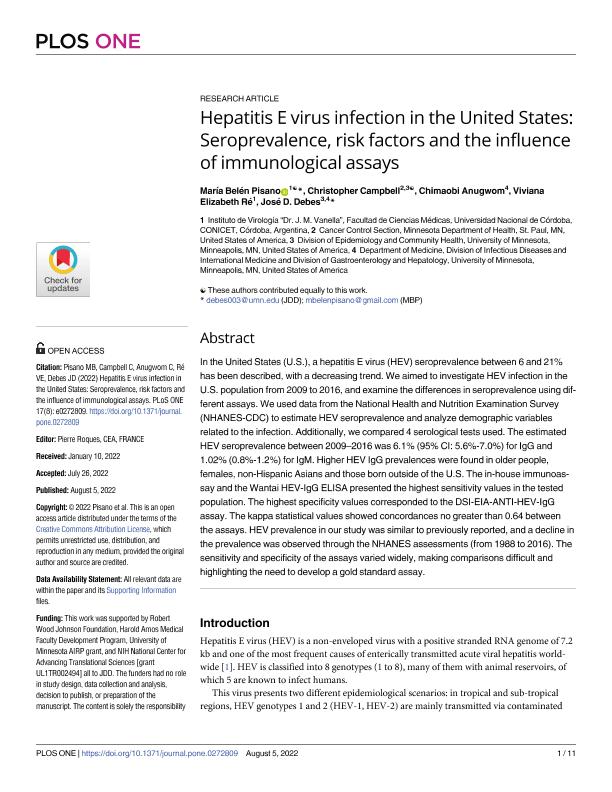
In the United States (U.S.), a hepatitis E virus (HEV) seroprevalence between 6 and 21% has been described, with a decreasing trend. We aimed to investigate HEV infection in the U.S. population from 2009 to 2016, and examine the differences in seroprevalence using different assays. We used data from the National Health and Nutrition Examination Survey (NHANES-CDC) to estimate HEV seroprevalence and analyze demographic variables related to the infection. Additionally, we compared 4 serological tests used. The estimated HEV seroprevalence between 2009?2016 was 6.1% (95% CI: 5.6%-7.0%) for IgG and 1.02% (0.8%-1.2%) for IgM. Higher HEV IgG prevalences were found in older people, females, non-Hispanic Asians and those born outside of the U.S. The in-house immunoassay and the Wantai HEV-IgG ELISA presented the highest sensitivity values in the tested population. The highest specificity values corresponded to the DSI-EIA-ANTI-HEV-IgG assay. The kappa statistical values showed concordances no greater than 0.64 between the assays. HEV prevalence in our study was similar to previously reported, and a decline in the prevalence was observed through the NHANES assessments (from 1988 to 2016). The sensitivity and specificity of the assays varied widely, making comparisons difficult and highlighting the need to develop a gold standard assay.
Palabras clave:
EPIDEMIOLOGY
,
TESTS
,
RISK FACTORS
,
HEV
Archivos asociados

Tamaño:
400.2Kb
Formato:
PDF
Licencia
 Excepto donde se diga explícitamente, este item se publica bajo la siguiente descripción:
Creative Commons Attribution-NonCommercial-ShareAlike 2.5 Unported (CC BY-NC-SA 2.5)
Excepto donde se diga explícitamente, este item se publica bajo la siguiente descripción:
Creative Commons Attribution-NonCommercial-ShareAlike 2.5 Unported (CC BY-NC-SA 2.5)
Identificadores
Colecciones
Articulos(CCT - CORDOBA)
Articulos de CTRO.CIENTIFICO TECNOL.CONICET - CORDOBA
Articulos de CTRO.CIENTIFICO TECNOL.CONICET - CORDOBA
Citación
Pisano, María Belén; Campbell, Christopher; Anugwom, Chimaobi; Ré, Viviana Elizabeth; Debes, José D.; Hepatitis E virus infection in the United States: Seroprevalence, risk factors and the influence of immunological assays; Public Library of Science; Plos One; 17; 8 August; 8-2022; 1-11
Compartir


Altmétricas