Artículo
A New Gnotobiotic Pig Model of P[6] Human Rotavirus Infection and Disease for Preclinical Evaluation of Rotavirus Vaccines
Nyblade, Charlotte; Hensley, Casey; Parreño, Gladys Viviana ; Zhou, Peng; Frazier, Maggie; Frazier, Annie; Ramesh, Ashwin; Lei, Shaohua; Degiuseppe, Juan Ignacio; Tan, Ming; Yuan, Lijuan
; Zhou, Peng; Frazier, Maggie; Frazier, Annie; Ramesh, Ashwin; Lei, Shaohua; Degiuseppe, Juan Ignacio; Tan, Ming; Yuan, Lijuan
Fecha de publicación:
12/2022
Editorial:
MDPI
Revista:
Viruses
ISSN:
1999-4915
Idioma:
Inglés
Tipo de recurso:
Artículo publicado
Clasificación temática:
Resumen
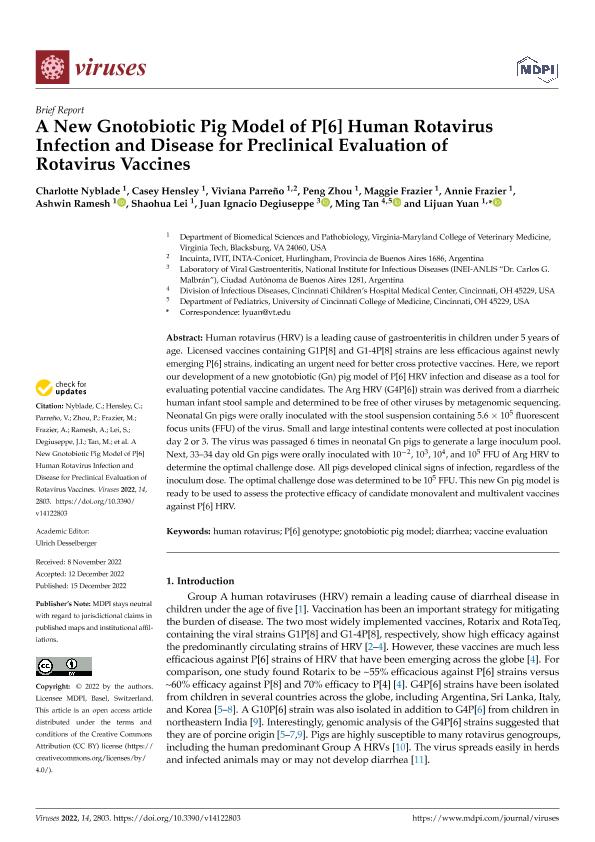
Human rotavirus (HRV) is a leading cause of gastroenteritis in children under 5 years of age. Licensed vaccines containing G1P[8] and G1-4P[8] strains are less efficacious against newly emerging P[6] strains, indicating an urgent need for better cross protective vaccines. Here, we report our development of a new gnotobiotic (Gn) pig model of P[6] HRV infection and disease as a tool for evaluating potential vaccine candidates. The Arg HRV (G4P[6]) strain was derived from a diarrheic human infant stool sample and determined to be free of other viruses by metagenomic sequencing. Neonatal Gn pigs were orally inoculated with the stool suspension containing 5.6 × 10⁵ fluorescent focus units (FFU) of the virus. Small and large intestinal contents were collected at post inoculation day 2 or 3. The virus was passaged 6 times in neonatal Gn pigs to generate a large inoculum pool. Next, 33–34 day old Gn pigs were orally inoculated with 10−2, 103, 104, and 105 FFU of Arg HRV to determine the optimal challenge dose. All pigs developed clinical signs of infection, regardless of the inoculum dose. The optimal challenge dose was determined to be 105 FFU. This new Gn pig model is ready to be used to assess the protective efficacy of candidate monovalent and multivalent vaccines against P[6] HRV.
Archivos asociados

Tamaño:
2.744Mb
Formato:
PDF
Licencia
 Excepto donde se diga explícitamente, este item se publica bajo la siguiente descripción:
Creative Commons Attribution 2.5 Unported (CC BY 2.5)
Excepto donde se diga explícitamente, este item se publica bajo la siguiente descripción:
Creative Commons Attribution 2.5 Unported (CC BY 2.5)
Identificadores
Colecciones
Articulos (IVIT)
Articulos de INSTITUTO DE VIROLOGIA E INNOVACIONES TECNOLOGICAS
Articulos de INSTITUTO DE VIROLOGIA E INNOVACIONES TECNOLOGICAS
Citación
Nyblade, Charlotte; Hensley, Casey; Parreño, Gladys Viviana; Zhou, Peng; Frazier, Maggie; et al.; A New Gnotobiotic Pig Model of P[6] Human Rotavirus Infection and Disease for Preclinical Evaluation of Rotavirus Vaccines; MDPI; Viruses; 14; 12; 12-2022; 1-11
Compartir


Altmétricas