Artículo
The relation between Ashaninka Amazonian Society and cultivated Acanthaceae plants

Fecha de publicación:
15/09/2023
Editorial:
Springer
Revista:
Economic Botany
ISSN:
0013-0001
e-ISSN:
1874-9364
Idioma:
Inglés
Tipo de recurso:
Artículo publicado
Clasificación temática:
Resumen
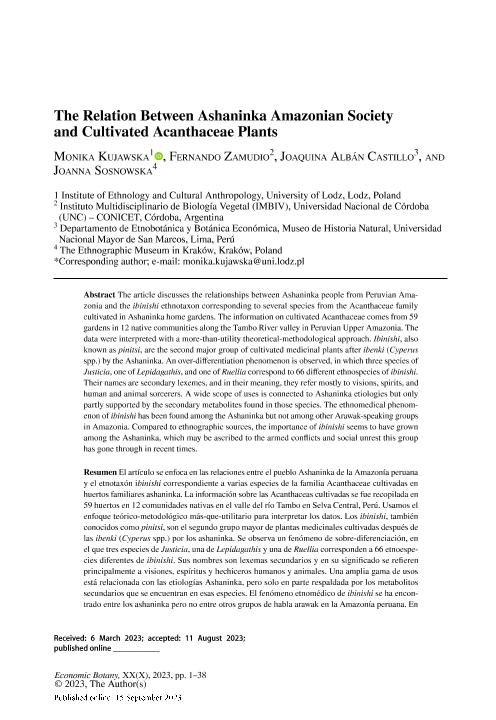
The article discusses the relationships between Ashaninka people from Peruvian Amazonia and the ibinishi ethnotaxon corresponding to several species from the Acanthaceae family cultivated in Ashaninka home gardens. The information on cultivated Acanthaceae comes from 59 gardens in 12 native communities along the Tambo River valley in Peruvian Upper Amazonia. The data were interpreted with a more-than-utility theoretical-methodological approach. Ibinishi, also known as pinitsi, are the second major group of cultivated medicinal plants after ibenki (Cyperus spp.) by the Ashaninka. An over-differentiation phenomenon is observed, in which three species of Justicia, one of Lepidagathis, and one of Ruellia correspond to 66 different ethnospecies of ibinishi. Their names are secondary lexemes, and in their meaning, they refer mostly to visions, spirits, and human and animal sorcerers. A wide scope of uses is connected to Ashaninka etiologies but only partly supported by the secondary metabolites found in those species. The ethnomedical phenomenon of ibinishi has been found among the Ashaninka but not among other Arawak-speaking groups in Amazonia. Compared to ethnographic sources, the importance of ibinishi seems to have grown among the Ashaninka, which may be ascribed to the armed conflicts and social unrest this group has gone through in recent times.
Archivos asociados

Tamaño:
2.418Mb
Formato:
PDF
Licencia
 Excepto donde se diga explícitamente, este item se publica bajo la siguiente descripción:
Creative Commons Attribution-NonCommercial-ShareAlike 2.5 Unported (CC BY-NC-SA 2.5)
Excepto donde se diga explícitamente, este item se publica bajo la siguiente descripción:
Creative Commons Attribution-NonCommercial-ShareAlike 2.5 Unported (CC BY-NC-SA 2.5)
Identificadores
Colecciones
Articulos(IMBIV)
Articulos de INST.MULTIDISCIPL.DE BIOLOGIA VEGETAL (P)
Articulos de INST.MULTIDISCIPL.DE BIOLOGIA VEGETAL (P)
Citación
Kujawska, Monika; Zamudio, Fernando; Castillo, Joaquina Albán; Sosnowska, Joanna; The relation between Ashaninka Amazonian Society and cultivated Acanthaceae plants; Springer; Economic Botany; 77; 3; 15-9-2023; 1-38
Compartir


Altmétricas