Artículo
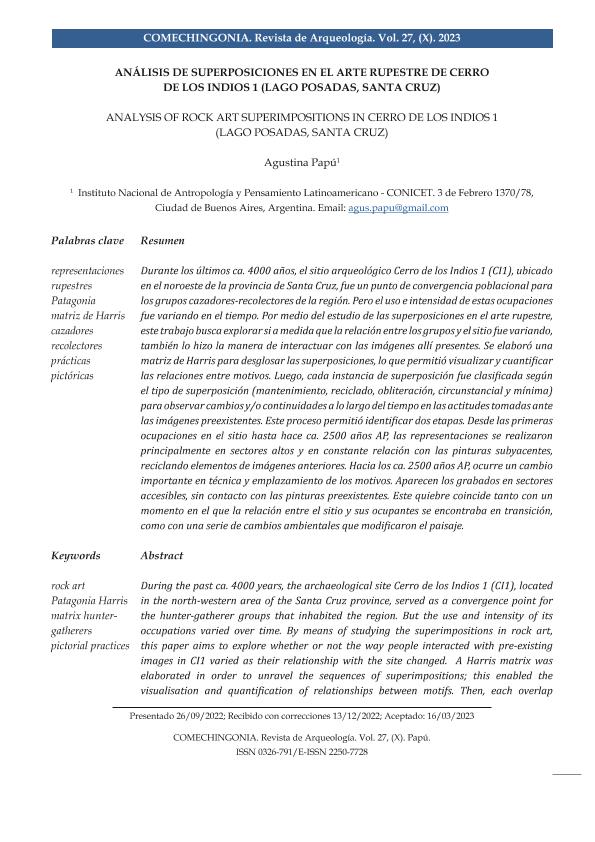
Durante los últimos ca. 4000 años, el sitio arqueológico Cerro de los Indios 1 (CI1), ubicado en el noroeste de la provincia de Santa Cruz, fue un punto de convergencia poblacional para los grupos cazadores-recolectores de la región. Pero el uso e intensidad de estas ocupaciones fue variando en el tiempo. Por medio del estudio de las superposiciones en el arte rupestre, este trabajo busca explorar si a medida que la relación entre los grupos y el sitio fue variando, también lo hizo la manera de interactuar con las imágenes allí presentes. Se elaboró una matriz de Harris para desglosar las superposiciones, lo que permitió visualizar y cuantificar las relaciones entre motivos. Luego, cada instancia de superposición fue clasificada según el tipo de superposición (mantenimiento, reciclado, obliteración, circunstancial y mínima) para observar cambios y/o continuidades a lo largo del tiempo en las actitudes tomadas ante las imágenes preexistentes. Este proceso permitió identificar dos etapas. Desde las primeras ocupaciones en el sitio hasta hace ca. 2500 años AP, las representaciones se realizaron principalmente en sectores altos y en constante relación con las pinturas subyacentes, reciclando elementos de imágenes anteriores. Hacia los ca. 2500 años AP, ocurre un cambio importante en técnica y emplazamiento de los motivos. Aparecen los grabados en sectores accesibles, sin contacto con las pinturas preexistentes. Este quiebre coincide tanto con un momento en el que la relación entre el sitio y sus ocupantes se encontraba en transición, como con una serie de cambios ambientales que modificaron el paisaje. During the past ca. 4000 years, the archaeological site Cerro de los Indios 1 (CI1), located in the north-western area of the Santa Cruz province, served as a convergence point for the hunter-gatherer groups that inhabited the region. But the use and intensity of its occupations varied over time. By means of studying the superimpositions in rock art, this paper aims to explore whether or not the way people interacted with pre-existing images in CI1 varied as their relationship with the site changed. A Harris matrix was elaborated in order to unravel the sequences of superimpositions; this enabled the visualisation and quantification of relationships between motifs. Then, each overlap episode was classified according the type of superimposition (maintenance, recycling, obliteration, circumstantial, and minimal) in order to observe changes and /or continuities throughout time in terms of the attitudes taken towards pre-existing images. This process enabled the identification of two stages. From the earliest occupations in the site up until ca. 2500 years BP, the representations were made out of reach, and in constant interaction with earlier images, recycling elements of underlying paintings. However, around ca. 2500 years BP, an important change in technique and placement occurred. Carvings appear in accessible areas of the site, without contact with the existing paintings. This rupture coincides with a time in which the relationship between the site and its occupants was amidst a transition, as well as a period of environmental changes modifying the landscape.
Análisis de superposiciones en el arte rupestre de Cerro de los Indios 1 (Lago Posadas, Santa Cruz)
Título:
Analysis of rock art superimpositions in Cerro de los Indios 1 (Lago Posadas, Santa Cruz)

Fecha de publicación:
06/2023
Editorial:
Universidad Nacional de Córdoba. Centro de Estudios Históricos
Revista:
Comechingonia
ISSN:
0326-7911
e-ISSN:
2250-7728
Idioma:
Español
Tipo de recurso:
Artículo publicado
Clasificación temática:
Resumen
Archivos asociados

Tamaño:
4.453Mb
Formato:
PDF
Licencia
 Excepto donde se diga explícitamente, este item se publica bajo la siguiente descripción:
Creative Commons Attribution-ShareAlike 2.5 Unported (CC BY-SA 2.5)
Excepto donde se diga explícitamente, este item se publica bajo la siguiente descripción:
Creative Commons Attribution-ShareAlike 2.5 Unported (CC BY-SA 2.5)
Identificadores
Colecciones
Articulos(SEDE CENTRAL)
Articulos de SEDE CENTRAL
Articulos de SEDE CENTRAL
Citación
Papú, Agustina; Análisis de superposiciones en el arte rupestre de Cerro de los Indios 1 (Lago Posadas, Santa Cruz); Universidad Nacional de Córdoba. Centro de Estudios Históricos; Comechingonia; 27; 2; 6-2023; 91-110
Compartir


Altmétricas