Artículo
Hyperconjugation: the electronic mechanism that may underlie the Karplus curve of vicinal NMR indirect spin couplings

Fecha de publicación:
06/2004
Editorial:
American Chemical Society
Revista:
Journal of Physical Chemistry A
ISSN:
1089-5639
Idioma:
Inglés
Tipo de recurso:
Artículo publicado
Clasificación temática:
Resumen
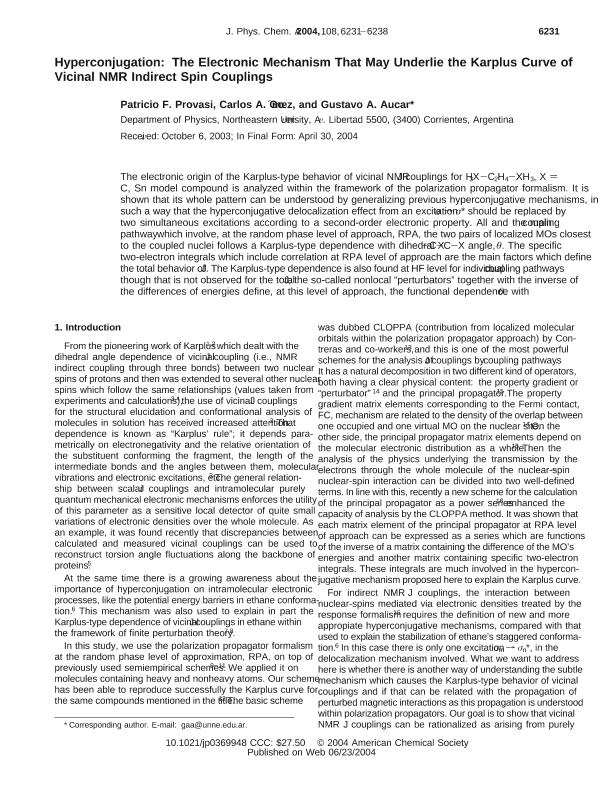
The electronic origin of the Karplus-type behavior of vicinal NMR J couplings for H3X−C2H4−XH3, X = C, Sn model compound is analyzed within the framework of the polarization propagator formalism. It is shown that its whole pattern can be understood by generalizing previous hyperconjugative mechanisms, in such a way that the hyperconjugative delocalization effect from an excitation σ → σ* should be replaced by two simultaneous excitations according to a second-order electronic property. All and the main coupling pathway which involve, at the random phase level of approach, RPA, the two pairs of localized MOs closest to the coupled nuclei follows a Karplus-type dependence with dihedral X−C−C−X angle, θ. The specific two-electron integrals which include correlation at RPA level of approach are the main factors which define the total behavior of J. The Karplus-type dependence is also found at HF level for individual coupling pathways though that is not observed for the total J; the so-called nonlocal “perturbators” together with the inverse of the differences of energies define, at this level of approach, the functional dependence with θ.
Palabras clave:
Nmr
,
Spin-Spin Coupling Constant
,
Karplus Curve
,
Hyperconjugation
Archivos asociados

Tamaño:
135.9Kb
Formato:
PDF
Licencia
 Excepto donde se diga explícitamente, este item se publica bajo la siguiente descripción:
Creative Commons Attribution-NonCommercial-ShareAlike 2.5 Unported (CC BY-NC-SA 2.5)
Excepto donde se diga explícitamente, este item se publica bajo la siguiente descripción:
Creative Commons Attribution-NonCommercial-ShareAlike 2.5 Unported (CC BY-NC-SA 2.5)
Identificadores
Colecciones
Articulos(IMIT)
Articulos de INST.DE MODELADO E INNOVACION TECNOLOGICA
Articulos de INST.DE MODELADO E INNOVACION TECNOLOGICA
Citación
Provasi, Patricio Federico; Gómez, Carlos Anselmo; Aucar, Gustavo Adolfo; Hyperconjugation: the electronic mechanism that may underlie the Karplus curve of vicinal NMR indirect spin couplings; American Chemical Society; Journal of Physical Chemistry A; 108; 29; 6-2004; 6231-6238
Compartir


Altmétricas