Artículo
The impact of baryons on dark matter haloes

Fecha de publicación:
05/2009
Editorial:
Oxford University Press
Revista:
Monthly Notices of the Royal Astronomical Society
ISSN:
0035-8711
Idioma:
Inglés
Tipo de recurso:
Artículo publicado
Clasificación temática:
Resumen
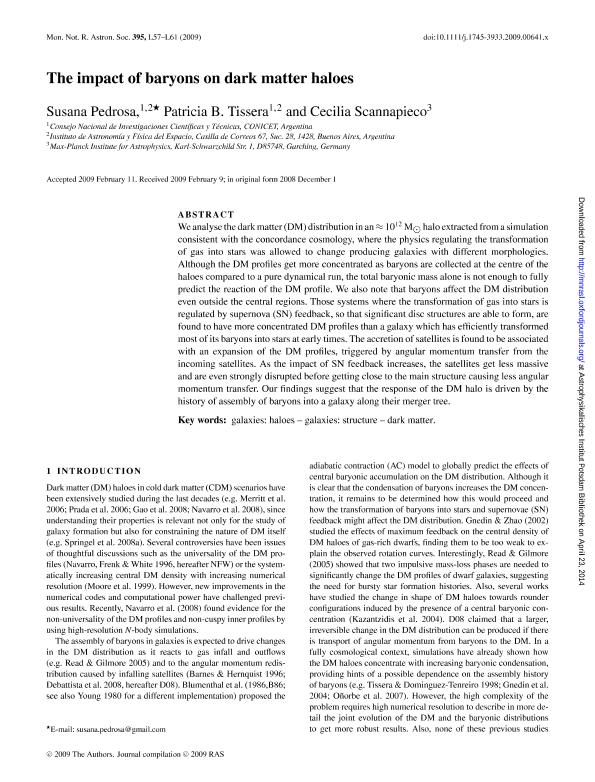
We analyse the dark matter (DM) distribution in an ≈1012 M halo extracted from a simulation consistent with the concordance cosmology, where the physics regulating the transformation of gas into stars was allowed to change producing galaxies with different morphologies. Although the DM profiles get more concentrated as baryons are collected at the centre of the haloes compared to a pure dynamical run, the total baryonic mass alone is not enough to fully predict the reaction of the DM profile. We also note that baryons affect the DM distribution even outside the central regions. Those systems where the transformation of gas into stars is regulated by supernova (SN) feedback, so that significant disc structures are able to form, are found to have more concentrated DM profiles than a galaxy which has efficiently transformed most of its baryons into stars at early times. The accretion of satellites is found to be associated with an expansion of the DM profiles, triggered by angular momentum transfer from the incoming satellites. As the impact of SN feedback increases, the satellites get less massive and are even strongly disrupted before getting close to the main structure causing less angular momentum transfer. Our findings suggest that the response of the DM halo is driven by the history of assembly of baryons into a galaxy along their merger tree.
Palabras clave:
Galaxies Haloes
,
Galaxies Structure
,
Dark Matter
Archivos asociados

Tamaño:
2.422Mb
Formato:
PDF
Licencia
 Excepto donde se diga explícitamente, este item se publica bajo la siguiente descripción:
Creative Commons Attribution-NonCommercial-ShareAlike 2.5 Unported (CC BY-NC-SA 2.5)
Excepto donde se diga explícitamente, este item se publica bajo la siguiente descripción:
Creative Commons Attribution-NonCommercial-ShareAlike 2.5 Unported (CC BY-NC-SA 2.5)
Identificadores
Colecciones
Articulos(IAFE)
Articulos de INST.DE ASTRONOMIA Y FISICA DEL ESPACIO(I)
Articulos de INST.DE ASTRONOMIA Y FISICA DEL ESPACIO(I)
Citación
Pedrosa, Susana Elizabeth; Tissera, Patricia Beatriz; Scannapieco, Cecilia; The impact of baryons on dark matter haloes; Oxford University Press; Monthly Notices of the Royal Astronomical Society; 395; 1; 5-2009; L57-L61
Compartir


Altmétricas