Artículo
Factors influencing appropriate use of interventions for management of women experiencing preterm birth: A mixed-methods systematic review and narrative synthesis
Zahroh, Rana Islamiah; Hazfiarini, Alya; Eddy, Katherine E.; Vogel, Joshua P.; Tunçalp, Özge; Minckas, Nicole; Althabe, Fernando ; Oladapo, Olufemi T.; Bohren, Meghan A.
; Oladapo, Olufemi T.; Bohren, Meghan A.
Fecha de publicación:
08/2022
Editorial:
Public Library of Science
Revista:
Plos Medicine
ISSN:
1549-1277
Idioma:
Inglés
Tipo de recurso:
Artículo publicado
Clasificación temática:
Resumen
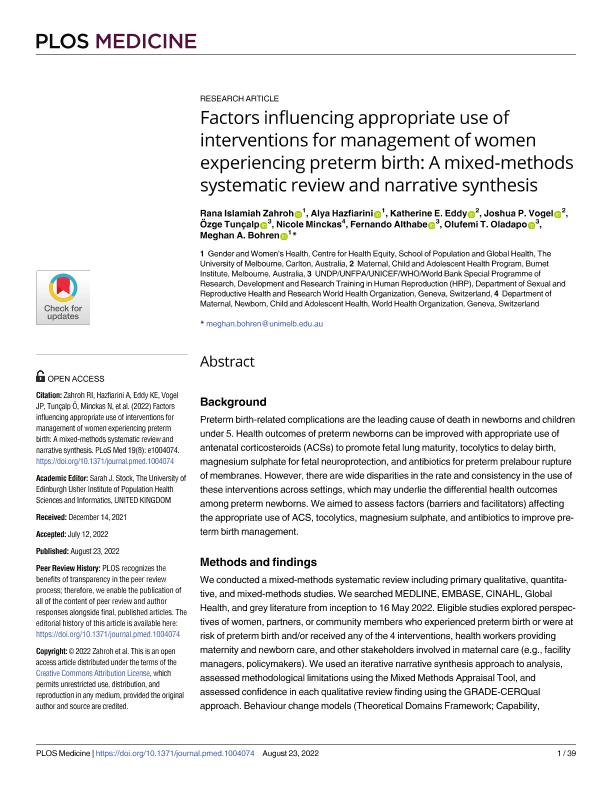
Background Preterm birth-related complications are the leading cause of death in newborns and children under 5. Health outcomes of preterm newborns can be improved with appropriate use of antenatal corticosteroids (ACSs) to promote fetal lung maturity, tocolytics to delay birth, magnesium sulphate for fetal neuroprotection, and antibiotics for preterm prelabour rupture of membranes. However, there are wide disparities in the rate and consistency in the use of these interventions across settings, which may underlie the differential health outcomes among preterm newborns. We aimed to assess factors (barriers and facilitators) affecting the appropriate use of ACS, tocolytics, magnesium sulphate, and antibiotics to improve preterm birth management. Methods and findings We conducted a mixed-methods systematic review including primary qualitative, quantitative, and mixed-methods studies. We searched MEDLINE, EMBASE, CINAHL, Global Health, and grey literature from inception to 16 May 2022. Eligible studies explored perspectives of women, partners, or community members who experienced preterm birth or were at risk of preterm birth and/or received any of the 4 interventions, health workers providing maternity and newborn care, and other stakeholders involved in maternal care (e.g., facility managers, policymakers). We used an iterative narrative synthesis approach to analysis, assessed methodological limitations using the Mixed Methods Appraisal Tool, and assessed confidence in each qualitative review finding using the GRADE-CERQual approach. Behaviour change models (Theoretical Domains Framework; Capability, Opportunity, and Motivation (COM-B)) were used to map barriers and facilitators affecting appropriate use of these interventions. We included 46 studies from 32 countries, describing factors affecting use of ACS (32/46 studies), tocolytics (13/46 studies), magnesium sulphate (9/46 studies), and antibiotics (5/46 studies). We identified a range of barriers influencing appropriate use of the 4 interventions globally, which include the following: inaccurate gestational age assessment, inconsistent guidelines, varied knowledge, perceived risks and benefits, perceived uncertainties and constraints in administration, confusion around prescribing and administering authority, and inadequate stock, human resources, and labour and newborn care. Women reported hesitancy in accepting interventions, as they typically learned about them during emergencies. Most included studies were from highincome countries (37/46 studies), which may affect the transferability of these findings to low- or middle-income settings. Conclusions In this study, we identified critical factors affecting implementation of 4 interventions to improve preterm birth management globally. Policymakers and implementers can consider these barriers and facilitators when formulating policies and planning implementation or scale-up of these interventions. Study findings can inform clinical preterm birth guidelines and implementation to ensure that barriers are addressed, and enablers are reinforced to ensure these interventions are widely available and appropriately used globally.
Archivos asociados

Tamaño:
3.659Mb
Formato:
PDF
Licencia
 Excepto donde se diga explícitamente, este item se publica bajo la siguiente descripción:
Creative Commons Attribution-NonCommercial-ShareAlike 2.5 Unported (CC BY-NC-SA 2.5)
Excepto donde se diga explícitamente, este item se publica bajo la siguiente descripción:
Creative Commons Attribution-NonCommercial-ShareAlike 2.5 Unported (CC BY-NC-SA 2.5)
Identificadores
Colecciones
Articulos(CIESP)
Articulos de CENTRO DE INVESTIGACIONES EN EPIDEMIOLOGIA Y SALUD PUBLICA
Articulos de CENTRO DE INVESTIGACIONES EN EPIDEMIOLOGIA Y SALUD PUBLICA
Citación
Zahroh, Rana Islamiah; Hazfiarini, Alya; Eddy, Katherine E.; Vogel, Joshua P.; Tunçalp, Özge; et al.; Factors influencing appropriate use of interventions for management of women experiencing preterm birth: A mixed-methods systematic review and narrative synthesis; Public Library of Science; Plos Medicine; 19; 8; 8-2022; 1-39
Compartir


Altmétricas