Artículo
Unifying turbulent dynamics framework distinguishes different brain states
Escrichs, Anira; Sanz Perl Hernandez, Yonatan ; Uribe, Carme; Camara, Estela; Türker, Basak; Pyatigorskaya, Nadya; López González, Ane; Pallavicini, Carla
; Panda, Rajanikant; Annen, Jitka; Gosseries, Olivia; Laureys, Steven; Naccache, Lionel; Sitt, Jacobo D.; Laufs, Helmut; Tagliazucchi, Enzo; Kringelbach, Morten L.; Deco, Gustavo
; Uribe, Carme; Camara, Estela; Türker, Basak; Pyatigorskaya, Nadya; López González, Ane; Pallavicini, Carla
; Panda, Rajanikant; Annen, Jitka; Gosseries, Olivia; Laureys, Steven; Naccache, Lionel; Sitt, Jacobo D.; Laufs, Helmut; Tagliazucchi, Enzo; Kringelbach, Morten L.; Deco, Gustavo
; Uribe, Carme; Camara, Estela; Türker, Basak; Pyatigorskaya, Nadya; López González, Ane; Pallavicini, Carla
; Panda, Rajanikant; Annen, Jitka; Gosseries, Olivia; Laureys, Steven; Naccache, Lionel; Sitt, Jacobo D.; Laufs, Helmut; Tagliazucchi, Enzo; Kringelbach, Morten L.; Deco, Gustavo
Fecha de publicación:
12/2022
Editorial:
Nature
Revista:
Communications Biology
ISSN:
2399-3642
Idioma:
Inglés
Tipo de recurso:
Artículo publicado
Clasificación temática:
Resumen
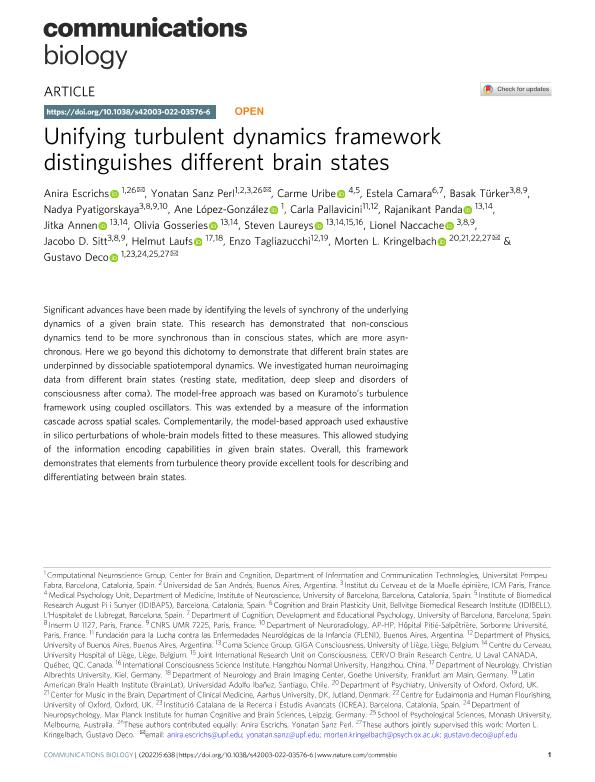
Significant advances have been made by identifying the levels of synchrony of the underlying dynamics of a given brain state. This research has demonstrated that non-conscious dynamics tend to be more synchronous than in conscious states, which are more asynchronous. Here we go beyond this dichotomy to demonstrate that different brain states are underpinned by dissociable spatiotemporal dynamics. We investigated human neuroimaging data from different brain states (resting state, meditation, deep sleep and disorders of consciousness after coma). The model-free approach was based on Kuramoto’s turbulence framework using coupled oscillators. This was extended by a measure of the information cascade across spatial scales. Complementarily, the model-based approach used exhaustive in silico perturbations of whole-brain models fitted to these measures. This allowed studying of the information encoding capabilities in given brain states. Overall, this framework demonstrates that elements from turbulence theory provide excellent tools for describing and differentiating between brain states.
Palabras clave:
Brain states
,
Consciousness
,
turbulent dynamics
,
whole brain models
Archivos asociados

Tamaño:
2.162Mb
Formato:
PDF
Licencia
 Excepto donde se diga explícitamente, este item se publica bajo la siguiente descripción:
Creative Commons Attribution 2.5 Unported (CC BY 2.5)
Excepto donde se diga explícitamente, este item se publica bajo la siguiente descripción:
Creative Commons Attribution 2.5 Unported (CC BY 2.5)
Identificadores
Colecciones
Articulos (INEU)
Articulos de INSTITUTO DE NEUROCIENCIAS
Articulos de INSTITUTO DE NEUROCIENCIAS
Citación
Escrichs, Anira; Sanz Perl Hernandez, Yonatan; Uribe, Carme; Camara, Estela; Türker, Basak; et al.; Unifying turbulent dynamics framework distinguishes different brain states; Nature; Communications Biology; 5; 1; 12-2022; 1-13
Compartir


Altmétricas