Artículo
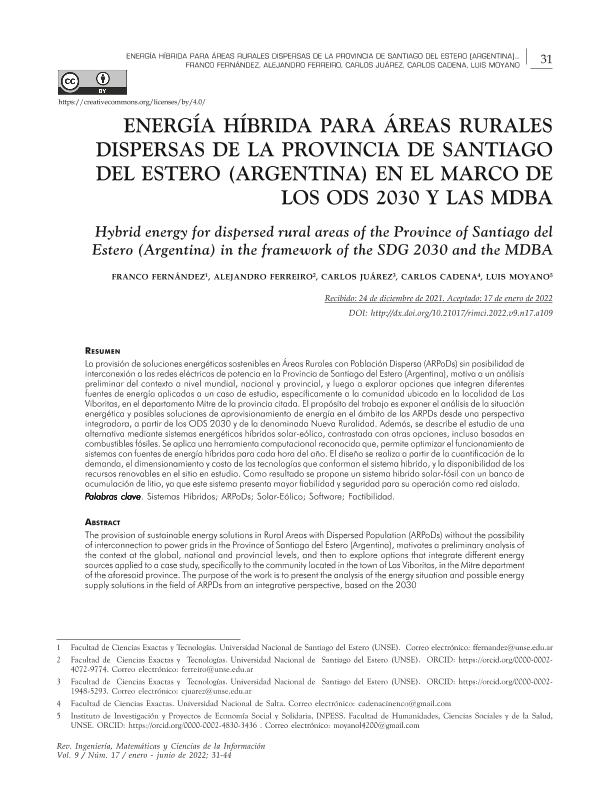
La provisión de soluciones energéticas sostenibles en Áreas Rurales con Población Dispersa (ARPoDs) sin posibilidad de interconexión a las redes eléctricas de potencia en la Provincia de Santiago del Estero (Argentina), motiva a un análisis preliminar del contexto a nivel mundial, nacional y provincial, y luego a explorar opciones que integren diferentes fuentes de energía aplicadas a un caso de estudio, específicamente a la comunidad ubicada en la localidad de Las Viboritas, en el departamento Mitre de la provincia citada. El propósito del trabajo es exponer el análisis de la situación energética y posibles soluciones de aprovisionamiento de energía en el ámbito de las ARPDs desde una perspectiva integradora, a partir de los ODS 2030 y de la denominada Nueva Ruralidad. Además, se describe el estudio de una alternativa mediante sistemas energéticos híbridos solar-eólico, contrastada con otras opciones, incluso basadas en combustibles fósiles. Se aplica una herramienta computacional reconocida que, permite optimizar el funcionamiento de sistemas con fuentes de energía híbridas para cada hora del año. El diseño se realiza a partir de la cuantificación de la demanda, el dimensionamiento y costo de las tecnologías que conforman el sistema hibrido, y la disponibilidad de los recursos renovables en el sitio en estudio. Como resultado se propone un sistema hibrido solar-fósil con un banco de acumulación de litio, ya que este sistema presenta mayor fiabilidad y seguridad para su operación como red aislada. The provision of sustainable energy solutions in Rural Areas with Dispersed Population (ARPoDs) without the possibility of interconnection to power grids in the Province of Santiago del Estero (Argentina), motivates a preliminary analysis of the context at the global, national and provincial levels, and then to explore options that integrate different energy sources applied to a case study, specifically to the community located in the town of Las Viboritas, in the Mitre department of the aforesaid province. The purpose of the work is to present the analysis of the energy situation and possible energy supply solutions in the field of ARPDs from an integrative perspective, based on the 2030 ODS and the so-called New Rurality. In addition, the study of an alternative using solar-wind hybrid energy systems is described, contrasted with other options, even based on fossil fuels. A recognized computational tool is applied that allows optimizing the operation of systems with hybrid energy sources for each hour of the year. The design is carried out from the quantification of the demand, the dimensioning and cost of the technologies that make up the hybrid system, and the availability of renewable resources at the site under study. As a result, a solar-fossil hybrid system with a lithium accumulation bank is proposed, since this system presents greater reliability and safety for its operation as an isolated network.
Energía híbrida para áreas rurales dispersas de la Provincia de Santiago del Estero (Argentina) en el marco de los ODS 2030 y las MDBA
Título:
Hybrid energy for dispersed rural areas of the Province of Santiago del Estero (Argentina) in the framework of the SDG 2030 and the MDBA

Fecha de publicación:
01/2022
Editorial:
Corporación Universitaria Republicana
Revista:
Revista Ingeniería, Matemáticas y Ciencias de la Información
e-ISSN:
2357-3716
Idioma:
Español
Tipo de recurso:
Artículo publicado
Clasificación temática:
Resumen
Palabras clave:
SISTEMAS HÍBRIDOS
,
ARPODS
,
SOLAR-EÓLICO
,
SOFTWARE-FACTIBILIDAD
Archivos asociados

Tamaño:
1.606Mb
Formato:
PDF
Licencia
 Excepto donde se diga explícitamente, este item se publica bajo la siguiente descripción:
Creative Commons Attribution 2.5 Unported (CC BY 2.5)
Excepto donde se diga explícitamente, este item se publica bajo la siguiente descripción:
Creative Commons Attribution 2.5 Unported (CC BY 2.5)
Identificadores
Colecciones
Articulos(INENCO)
Articulos de INST.DE INVEST.EN ENERGIA NO CONVENCIONAL
Articulos de INST.DE INVEST.EN ENERGIA NO CONVENCIONAL
Citación
Fernandez, Franco; Ferreiro, Alejandro; Juárez, Carlos; Cadena, Carlos Alberto; Moyano, Luis; Energía híbrida para áreas rurales dispersas de la Provincia de Santiago del Estero (Argentina) en el marco de los ODS 2030 y las MDBA; Corporación Universitaria Republicana; Revista Ingeniería, Matemáticas y Ciencias de la Información; 9; 17; 1-2022; 31-44
Compartir


Altmétricas