Artículo
NICER Monitoring of Supersoft X-Ray Sources
Orio, M.; Gendreau, K.; Giese, M.; Luna, Gerardo Juan Manuel ; Magdolen, J.; Pei, S.; Sun, B.; Behar, E.; Dobrotka, A.; Mikolajewska, J.; Strohmayer, T. E.
; Magdolen, J.; Pei, S.; Sun, B.; Behar, E.; Dobrotka, A.; Mikolajewska, J.; Strohmayer, T. E.
Fecha de publicación:
07/2022
Editorial:
IOP Publishing
Revista:
Astrophysical Journal
ISSN:
0004-637X
Idioma:
Inglés
Tipo de recurso:
Artículo publicado
Clasificación temática:
Resumen
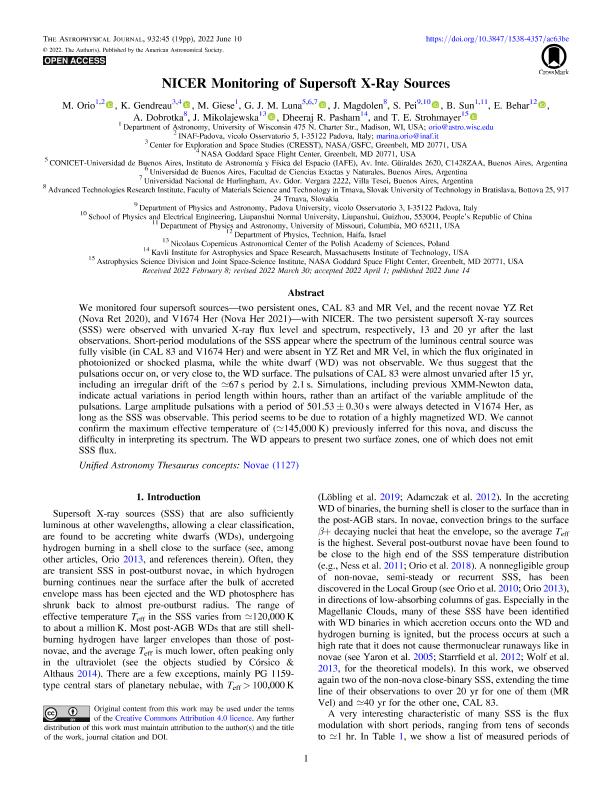
We monitored four supersoft sources - two persistent ones, CAL 83 and MR Vel, and the recent novae YZ Ret (Nova Ret 2020), and V1674 Her (Nova Her 2021) - with NICER. The two persistent supersoft X-ray sources (SSS) were observed with unvaried X-ray flux level and spectrum, respectively, 13 and 20 yr after the last observations. Short-period modulations of the SSS appear where the spectrum of the luminous central source was fully visible (in CAL 83 and V1674 Her) and were absent in YZ Ret and MR Vel, in which the flux originated in photoionized or shocked plasma, while the white dwarf (WD) was not observable. We thus suggest that the pulsations occur on, or very close to, the WD surface. The pulsations of CAL 83 were almost unvaried after 15 yr, including an irregular drift of the ≃67 s period by 2.1 s. Simulations, including previous XMM-Newton data, indicate actual variations in period length within hours, rather than an artifact of the variable amplitude of the pulsations. Large amplitude pulsations with a period of 501.53 ± 0.30 s were always detected in V1674 Her, as long as the SSS was observable. This period seems to be due to rotation of a highly magnetized WD. We cannot confirm the maximum effective temperature of (≃145,000 K) previously inferred for this nova, and discuss the difficulty in interpreting its spectrum. The WD appears to present two surface zones, one of which does not emit SSS flux.
Palabras clave:
novae
Archivos asociados

Tamaño:
2.887Mb
Formato:
PDF
Licencia
 Excepto donde se diga explícitamente, este item se publica bajo la siguiente descripción:
Creative Commons Attribution-NonCommercial-ShareAlike 2.5 Unported (CC BY-NC-SA 2.5)
Excepto donde se diga explícitamente, este item se publica bajo la siguiente descripción:
Creative Commons Attribution-NonCommercial-ShareAlike 2.5 Unported (CC BY-NC-SA 2.5)
Identificadores
Colecciones
Articulos(IAFE)
Articulos de INST.DE ASTRONOMIA Y FISICA DEL ESPACIO(I)
Articulos de INST.DE ASTRONOMIA Y FISICA DEL ESPACIO(I)
Citación
Orio, M.; Gendreau, K.; Giese, M.; Luna, Gerardo Juan Manuel; Magdolen, J.; et al.; NICER Monitoring of Supersoft X-Ray Sources; IOP Publishing; Astrophysical Journal; 932; 1; 7-2022; 45-64
Compartir


Altmétricas