Mostrar el registro sencillo del ítem
dc.contributor.author
Chernicoff, Mariano
dc.contributor.author
Giribet, Gaston Enrique
dc.contributor.author
Rubín de Celis, Emilio
dc.date.available
2023-10-05T10:49:14Z
dc.date.issued
2022-10
dc.identifier.citation
Chernicoff, Mariano; Giribet, Gaston Enrique; Rubín de Celis, Emilio; Extremal surfaces and thin-shell wormholes; American Physical Society; Physical Review D: Particles, Fields, Gravitation and Cosmology; 106; 8; 10-2022; 1-16
dc.identifier.issn
1550-7998
dc.identifier.uri
http://hdl.handle.net/11336/214155
dc.description.abstract
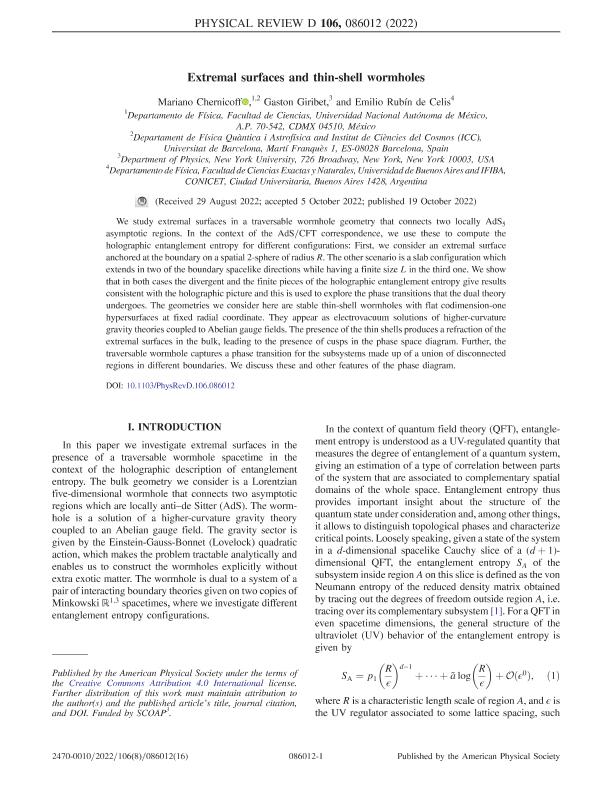
We study extremal surfaces in a traversable wormhole geometry that connects two locally AdS5 asymptotic regions. In the context of the AdS/CFT correspondence, we use these to compute the holographic entanglement entropy for different configurations: First, we consider an extremal surface anchored at the boundary on a spatial 2-sphere of radius R. The other scenario is a slab configuration which extends in two of the boundary spacelike directions while having a finite size L in the third one. We show that in both cases the divergent and the finite pieces of the holographic entanglement entropy give results consistent with the holographic picture and this is used to explore the phase transitions that the dual theory undergoes. The geometries we consider here are stable thin-shell wormholes with flat codimension-one hypersurfaces at fixed radial coordinate. They appear as electrovacuum solutions of higher-curvature gravity theories coupled to Abelian gauge fields. The presence of the thin shells produces a refraction of the extremal surfaces in the bulk, leading to the presence of cusps in the phase space diagram. Further, the traversable wormhole captures a phase transition for the subsystems made up of a union of disconnected regions in different boundaries. We discuss these and other features of the phase diagram.
dc.format
application/pdf
dc.language.iso
eng
dc.publisher
American Physical Society
dc.rights
info:eu-repo/semantics/openAccess
dc.rights.uri
https://creativecommons.org/licenses/by/2.5/ar/
dc.subject
HOLOGRAPHY
dc.subject
ENTANGLEMENT
dc.subject
ENTROPY
dc.subject
WORMHOLES
dc.subject.classification
Física de Partículas y Campos
dc.subject.classification
Ciencias Físicas
dc.subject.classification
CIENCIAS NATURALES Y EXACTAS
dc.title
Extremal surfaces and thin-shell wormholes
dc.type
info:eu-repo/semantics/article
dc.type
info:ar-repo/semantics/artículo
dc.type
info:eu-repo/semantics/publishedVersion
dc.date.updated
2023-07-07T22:22:30Z
dc.identifier.eissn
2470-0029
dc.journal.volume
106
dc.journal.number
8
dc.journal.pagination
1-16
dc.journal.pais
Estados Unidos
dc.journal.ciudad
New York
dc.description.fil
Fil: Chernicoff, Mariano. Universidad Nacional Autónoma de México; México
dc.description.fil
Fil: Giribet, Gaston Enrique. Consejo Nacional de Investigaciones Científicas y Técnicas. Oficina de Coordinación Administrativa Ciudad Universitaria. Instituto de Física de Buenos Aires. Universidad de Buenos Aires. Facultad de Ciencias Exactas y Naturales. Instituto de Física de Buenos Aires; Argentina. University of New York; Estados Unidos
dc.description.fil
Fil: Rubín de Celis, Emilio. Consejo Nacional de Investigaciones Científicas y Técnicas. Oficina de Coordinación Administrativa Ciudad Universitaria. Instituto de Física de Buenos Aires. Universidad de Buenos Aires. Facultad de Ciencias Exactas y Naturales. Instituto de Física de Buenos Aires; Argentina
dc.journal.title
Physical Review D: Particles, Fields, Gravitation and Cosmology
dc.relation.alternativeid
info:eu-repo/semantics/altIdentifier/url/https://journals.aps.org/prd/abstract/10.1103/PhysRevD.106.086012
dc.relation.alternativeid
info:eu-repo/semantics/altIdentifier/doi/https://doi.org/10.1103/PhysRevD.106.086012
Archivos asociados

Tamaño:
1.251Mb
Formato:
PDF