Artículo
Unravelling anaerobic metabolisms in hypersaline sediment

Fecha de publicación:
01/2022
Editorial:
Frontiers Media
Revista:
Frontiers in Microbiology
ISSN:
1664-302X
Idioma:
Inglés
Tipo de recurso:
Artículo publicado
Clasificación temática:
Resumen
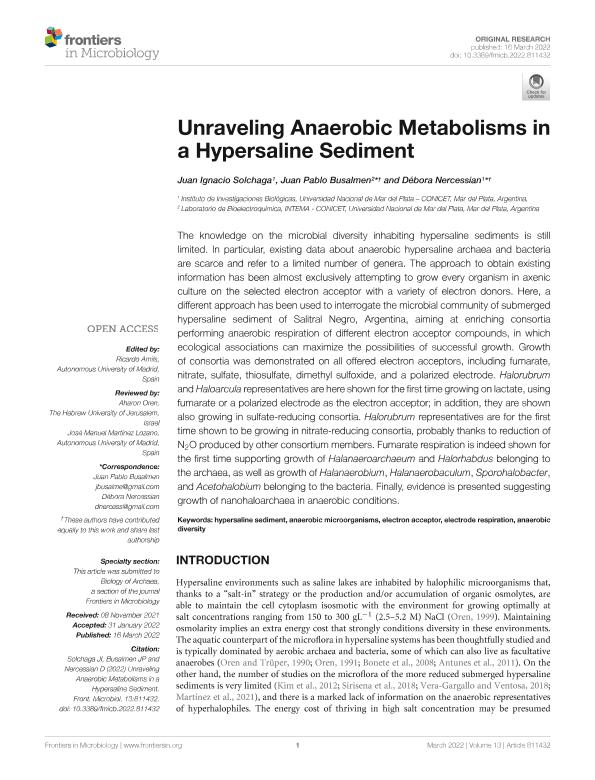
The knowledge on the microbial diversity inhabiting hypersaline sediments is still limited. In particular, existing data about anaerobic hypersaline archaea and bacteria are scarce and refer to a limited number of genera. The approach to obtain existing information has been almost exclusively attempting to grow every organism in axenic culture on the selected electron acceptor with a variety of electron donors. Here, a different approach has been used to interrogate the microbial community of submerged hypersaline sediment of Salitral Negro, Argentina, aiming at enriching consortia performing anaerobic respiration of different electron acceptor compounds, in which ecological associations can maximize the possibilities of successful growth. Growth of consortia was demonstrated on all offered electron acceptors, including fumarate, nitrate, sulfate, thiosulfate, dimethyl sulfoxide, and a polarized electrode. Halorubrum and Haloarcula representatives are here shown for the first time growing on lactate, using fumarate or a polarized electrode as the electron acceptor; in addition, they are shown also growing in sulfate-reducing consortia. Halorubrum representatives are for the first time shown to be growing in nitrate-reducing consortia, probably thanks to reduction of N2O produced by other consortium members. Fumarate respiration is indeed shown for the first time supporting growth of Halanaeroarchaeum and Halorhabdus belonging to the archaea, as well as growth of Halanaerobium, Halanaerobaculum, Sporohalobacter, and Acetohalobium belonging to the bacteria. Finally, evidence is presented suggesting growth of nanohaloarchaea in anaerobic conditions.
Archivos asociados

Tamaño:
3.535Mb
Formato:
PDF
Licencia
 Excepto donde se diga explícitamente, este item se publica bajo la siguiente descripción:
Creative Commons Attribution-NonCommercial-ShareAlike 2.5 Unported (CC BY-NC-SA 2.5)
Excepto donde se diga explícitamente, este item se publica bajo la siguiente descripción:
Creative Commons Attribution-NonCommercial-ShareAlike 2.5 Unported (CC BY-NC-SA 2.5)
Identificadores
Colecciones
Articulos(IIB)
Articulos de INSTITUTO DE INVESTIGACIONES BIOLOGICAS
Articulos de INSTITUTO DE INVESTIGACIONES BIOLOGICAS
Articulos(INTEMA)
Articulos de INST.DE INV.EN CIENCIA Y TECNOL.MATERIALES (I)
Articulos de INST.DE INV.EN CIENCIA Y TECNOL.MATERIALES (I)
Citación
Solchaga, Juan Ignacio; Busalmen, Juan Pablo; Nercessian, Debora; Unravelling anaerobic metabolisms in hypersaline sediment; Frontiers Media; Frontiers in Microbiology; 13; 1-2022; 1-15
Compartir


Altmétricas