Mostrar el registro sencillo del ítem
dc.contributor.author
Klappenbach, Martín
dc.contributor.author
Lara, Agustin Eleazar
dc.contributor.author
Locatelli, Fernando Federico
dc.date.available
2023-09-22T16:36:07Z
dc.date.issued
2022-06
dc.identifier.citation
Klappenbach, Martín; Lara, Agustin Eleazar; Locatelli, Fernando Federico; Honey bees can store and retrieve independent memory traces after complex experiences that combine appetitive and aversive associations; Company of Biologists; Journal of Experimental Biology; 225; 11; 6-2022; 1-13
dc.identifier.issn
0022-0949
dc.identifier.uri
http://hdl.handle.net/11336/212737
dc.description.abstract
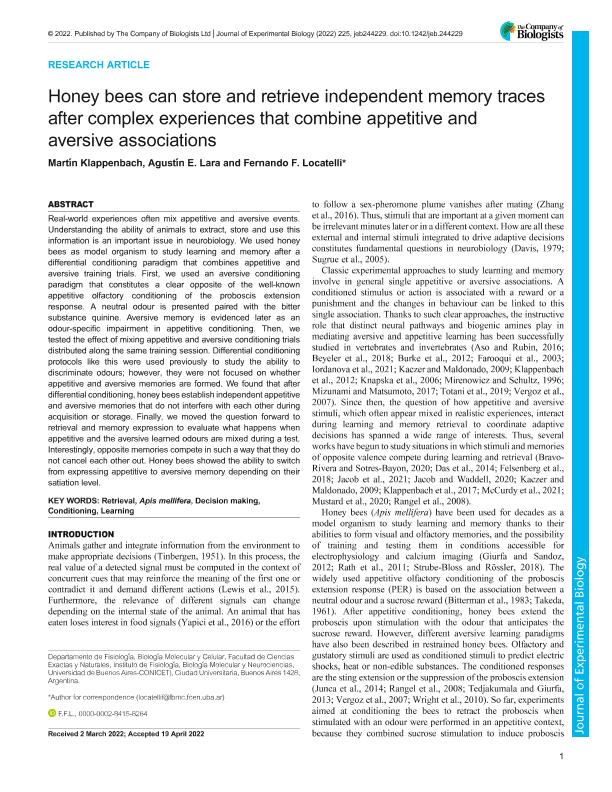
Real-world experiences often mix appetitive and aversive events. Understanding the ability of animals to extract, store and use this information is an important issue in neurobiology. We used honey bees as model organism to study learning and memory after a differential conditioning paradigm that combines appetitive and aversive training trials. First, we used an aversive conditioning paradigm that constitutes a clear opposite of the well-known appetitive olfactory conditioning of the proboscis extension response. A neutral odour is presented paired with the bitter substance quinine. Aversive memory is evidenced later as an odour-specific impairment in appetitive conditioning. Then, we tested the effect of mixing appetitive and aversive conditioning trials distributed along the same training session. Differential conditioning protocols like this were used previously to study the ability to discriminate odours; however, they were not focused on whether appetitive and aversive memories are formed. We found that after differential conditioning, honey bees establish independent appetitive and aversive memories that do not interfere with each other during acquisition or storage. Finally, we moved the question forward to retrieval and memory expression to evaluate what happens when appetitive and the aversive learned odours are mixed during a test. Interestingly, opposite memories compete in such a way that they do not cancel each other out. Honey bees showed the ability to switch from expressing appetitive to aversive memory depending on their satiation level.
dc.format
application/pdf
dc.language.iso
eng
dc.publisher
Company of Biologists
dc.rights
info:eu-repo/semantics/openAccess
dc.rights.uri
https://creativecommons.org/licenses/by-nc-sa/2.5/ar/
dc.subject
APIS MELLIFERA
dc.subject
CONDITIONING
dc.subject
DECISION MAKING
dc.subject
LEARNING
dc.subject
RETRIEVAL
dc.subject.classification
Otras Ciencias Biológicas
dc.subject.classification
Ciencias Biológicas
dc.subject.classification
CIENCIAS NATURALES Y EXACTAS
dc.title
Honey bees can store and retrieve independent memory traces after complex experiences that combine appetitive and aversive associations
dc.type
info:eu-repo/semantics/article
dc.type
info:ar-repo/semantics/artículo
dc.type
info:eu-repo/semantics/publishedVersion
dc.date.updated
2023-06-30T10:36:03Z
dc.journal.volume
225
dc.journal.number
11
dc.journal.pagination
1-13
dc.journal.pais
Reino Unido
dc.description.fil
Fil: Klappenbach, Martín. Consejo Nacional de Investigaciones Científicas y Técnicas. Oficina de Coordinación Administrativa Ciudad Universitaria. Instituto de Fisiología, Biología Molecular y Neurociencias. Universidad de Buenos Aires. Facultad de Ciencias Exactas y Naturales. Instituto de Fisiología, Biología Molecular y Neurociencias; Argentina
dc.description.fil
Fil: Lara, Agustin Eleazar. Consejo Nacional de Investigaciones Científicas y Técnicas. Oficina de Coordinación Administrativa Ciudad Universitaria. Instituto de Fisiología, Biología Molecular y Neurociencias. Universidad de Buenos Aires. Facultad de Ciencias Exactas y Naturales. Instituto de Fisiología, Biología Molecular y Neurociencias; Argentina
dc.description.fil
Fil: Locatelli, Fernando Federico. Consejo Nacional de Investigaciones Científicas y Técnicas. Oficina de Coordinación Administrativa Ciudad Universitaria. Instituto de Fisiología, Biología Molecular y Neurociencias. Universidad de Buenos Aires. Facultad de Ciencias Exactas y Naturales. Instituto de Fisiología, Biología Molecular y Neurociencias; Argentina
dc.journal.title
Journal of Experimental Biology
dc.relation.alternativeid
info:eu-repo/semantics/altIdentifier/doi/http://dx.doi.org/10.1242/jeb.244229
Archivos asociados

Tamaño:
568.8Kb
Formato:
PDF