Artículo
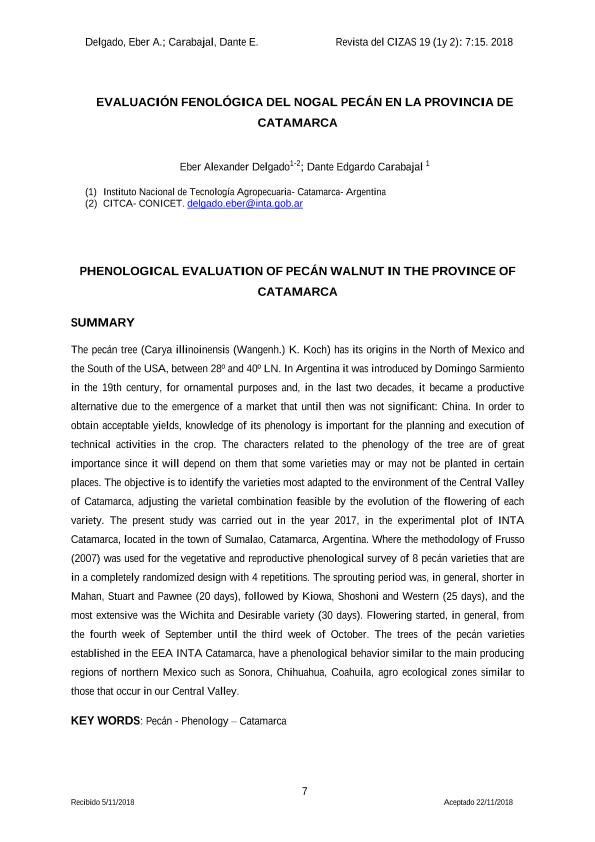
El nogal pecanero (Carya illinoinensis (Wangenh.) K. Koch) tiene sus orígenes en el Norte de México y el sur de EUA, entre los 28º y40º LN. En la Argentina fue introducido por Domingo Sarmiento en el siglo XIX, con fines ornamentales y, en las últimas dos décadas, se convirtió en una alternativa productiva debido a que surge un mercado que hasta entonces no era significativo: China. Para obtener rendimientos aceptables es importante el conocimiento de su fenología para la planeación y ejecución de actividades técnicas en el cultivo. Los caracteres relacionados con la fenología del árbol son de gran importancia puesto que de ellos dependerá que unas variedades se puedan o no plantar en determinados sitios. El objetivo es identificar las variedades más adaptadas al ambiente del Valle Central de Catamarca, ajustando la combinación varietal factible por la evolución de la floración propia de cada variedad. El presente estudió se realizó en el año 2017, en la parcela experimental del INTA Catamarca, ubicada en la localidad de Sumalao, Catamarca, Argentina. Donde se utilizóla metodología de Frusso (2007) para el relevamiento fenológico vegetativo y reproductivo de 8 variedades de pecán que se encuentran en un diseño completamente al azar con 4 repeticiones. El período de brotación fue, en general, más corto en Mahan, Stuart y Pawnee (20 días), seguido porKiowa, Shoshoni y Western (25 días), y el más extenso fueron la variedad la Wichita y Desirable (30 días).La floración inició, en general, a partir de la cuarta semana de septiembre hasta la tercera semana de octubre.Los árboles de las variedades de pecán establecidas en la EEA INTA Catamarca, presentan un comportamiento fenológico similar al de las principales regiones productoras del norte de México como Sonora, Chihuahua, Coahuila, zonas agroecológicas semejantes a las que se presentan en nuestro Valle Central. The pecán tree (Caryaillinoinensis (Wangenh.) K. Koch)has its origins in the North of Mexico and the South of the USA, between 28º and 40º LN. In Argentina it was introduced by Domingo Sarmiento in the 19th century, for ornamental purposes and, in the last two decades, it became a productive alternative due to the emergence of a market that until then was not significant: China. In order to obtain acceptable yields, knowledge of its phenology is important for the planning and execution of technical activities in the crop. The characters related to the phenology of the tree are of great importance since it will depend on them that some varieties may or may not be planted in certain places. The objective is to identify the varieties most adapted to the environment of the Central Valley of Catamarca, adjusting the varietal combination feasible by the evolution of the flowering of each variety. The present study was carried out in the year 2017, in the experimental plot of INTA Catamarca, located in the town of Sumalao, Catamarca, Argentina. Where the methodology of Frusso (2007) was used for the vegetative and reproductive phenological survey of 8 pecán varieties that are in a completely randomized design with 4 repetitions. The sprouting period was, in general, shorter in Mahan, Stuart and Pawnee (20 days), followed by Kiowa, Shoshoni and Western (25 days), and the most extensive was the Wichita and Desirable variety (30 days). Flowering started, in general, from the fourth week of September until the third week of October. The trees of the pecán varieties established in the EEA INTA Catamarca, have a phenological behavior similar to the main producing regions of northern Mexico such as Sonora, Chihuahua, Coahuila, agro ecological zones similar to those that occur in our Central Valley.
Evaluación fenológica del nogal pecán en la provincia de Catamarca
Título:
Phenological evaluation of pecán walnut in the province of Catamarca

Fecha de publicación:
11/2018
Editorial:
Universidad Nacional de Catamarca. Facultad de Ciencias Agrarias
Revista:
Revista del Centro de Investigación de Zonas Áridas
ISSN:
1851-4707
Idioma:
Español
Tipo de recurso:
Artículo publicado
Clasificación temática:
Resumen
Palabras clave:
Phenology
,
Pecan
,
Catamarca
Archivos asociados

Tamaño:
287.1Kb
Formato:
PDF
Licencia
 Excepto donde se diga explícitamente, este item se publica bajo la siguiente descripción:
Creative Commons Attribution-NonCommercial-ShareAlike 2.5 Unported (CC BY-NC-SA 2.5)
Excepto donde se diga explícitamente, este item se publica bajo la siguiente descripción:
Creative Commons Attribution-NonCommercial-ShareAlike 2.5 Unported (CC BY-NC-SA 2.5)
Identificadores
Colecciones
Articulos(SEDE CENTRAL)
Articulos de SEDE CENTRAL
Articulos de SEDE CENTRAL
Citación
Delgado, Eber Alexander; Carabajal, Dante Egardo; Evaluación fenológica del nogal pecán en la provincia de Catamarca; Universidad Nacional de Catamarca. Facultad de Ciencias Agrarias; Revista del Centro de Investigación de Zonas Áridas; 19; 2; 11-2018; 7-15
Compartir

