Artículo
Hybrid Films from Blends of Castor Oil and Polycaprolactone Waterborne Polyurethanes

Fecha de publicación:
10/2022
Editorial:
Multidisciplinary Digital Publishing Institute
Revista:
Polymers
ISSN:
2073-4360
Idioma:
Inglés
Tipo de recurso:
Artículo publicado
Clasificación temática:
Resumen
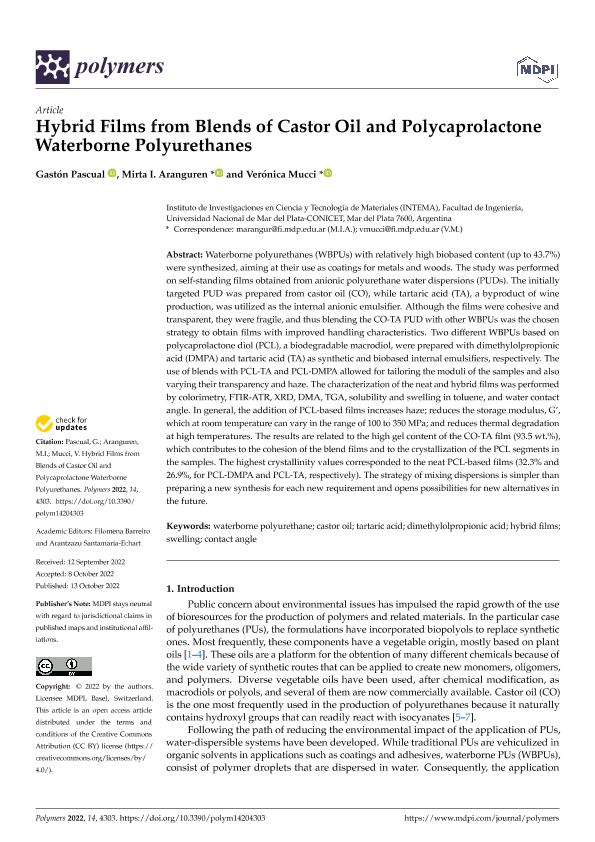
Waterborne polyurethanes (WBPUs) with relatively high biobased content (up to 43.7%) were synthesized, aiming at their use as coatings for metals and woods. The study was performed on self-standing films obtained from anionic polyurethane water dispersions (PUDs). The initially targeted PUD was prepared from castor oil (CO), while tartaric acid (TA), a byproduct of wine production, was utilized as the internal anionic emulsifier. Although the films were cohesive and transparent, they were fragile, and thus blending the CO-TA PUD with other WBPUs was the chosen strategy to obtain films with improved handling characteristics. Two different WBPUs based on polycaprolactone diol (PCL), a biodegradable macrodiol, were prepared with dimethylolpropionic acid (DMPA) and tartaric acid (TA) as synthetic and biobased internal emulsifiers, respectively. The use of blends with PCL-TA and PCL-DMPA allowed for tailoring the moduli of the samples and also varying their transparency and haze. The characterization of the neat and hybrid films was performed by colorimetry, FTIR-ATR, XRD, DMA, TGA, solubility and swelling in toluene, and water contact angle. In general, the addition of PCL-based films increases haze; reduces the storage modulus, G’, which at room temperature can vary in the range of 100 to 350 MPa; and reduces thermal degradation at high temperatures. The results are related to the high gel content of the CO-TA film (93.5 wt.%), which contributes to the cohesion of the blend films and to the crystallization of the PCL segments in the samples. The highest crystallinity values corresponded to the neat PCL-based films (32.3% and 26.9%, for PCL-DMPA and PCL-TA, respectively). The strategy of mixing dispersions is simpler than preparing a new synthesis for each new requirement and opens possibilities for new alternatives in the future.
Archivos asociados

Tamaño:
3.756Mb
Formato:
PDF
Licencia
 Excepto donde se diga explícitamente, este item se publica bajo la siguiente descripción:
Creative Commons Attribution 2.5 Unported (CC BY 2.5)
Excepto donde se diga explícitamente, este item se publica bajo la siguiente descripción:
Creative Commons Attribution 2.5 Unported (CC BY 2.5)
Identificadores
Colecciones
Articulos(INTEMA)
Articulos de INST.DE INV.EN CIENCIA Y TECNOL.MATERIALES (I)
Articulos de INST.DE INV.EN CIENCIA Y TECNOL.MATERIALES (I)
Citación
Pascual, Gastón Mario; Aranguren, Mirta Ines; Mucci, Veronica Lujan; Hybrid Films from Blends of Castor Oil and Polycaprolactone Waterborne Polyurethanes; Multidisciplinary Digital Publishing Institute; Polymers; 14; 20; 10-2022; 1-18
Compartir


Altmétricas