Artículo
Analysis of Virus Sanitization Alternatives and Optimization of a Thermal Air Purifier for SARS-CoV-2

Fecha de publicación:
07/2022
Editorial:
Scientific Research Publishing
Revista:
Open Journal of Applied Sciences
ISSN:
2165-3917
Idioma:
Inglés
Tipo de recurso:
Artículo publicado
Clasificación temática:
Resumen
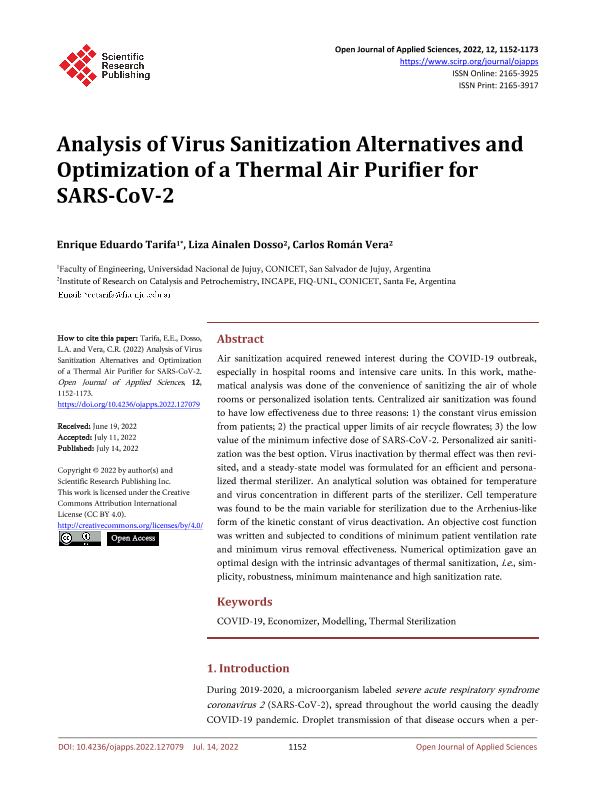
Air sanitization acquired renewed interest during the COVID 19 outbreak, especially for hospital rooms and intensive care units. In this work, a mathematical analysis was done of the convenience of sanitizing the air of whole rooms or personalized isolation tents. Centralized air sanitization was found to have low effectiveness due to three reasons: (i) the constant virus emission from patients; (ii) the practical up-per limits of air recycle flowrates; (iii) the low value of the minimum infective dose of SARS CoV 2. Personalized air sanitization was the best option. Virus inactivation by thermal effect was then revisited, and a steady-state model was formulated for an efficient and personalized thermal sterilizer. An analytical solution was obtained for temperature and virus concentration in different parts of the sterilizer. Cell tempera-ture was found to be the main variable for sterilization due to the Arrhenius-like form of the kinetic constant of virus deactivation. A cost objective function was written and subjected to conditions of minimum patient ventilation rate and mini-mum virus removal effectiveness. Numerical optimization gave an optimal design with the intrinsic advantages of thermal sanitization; i.e., simplicity, robustness, minimum maintenance and high sanitization rate.
Palabras clave:
COVID-19
,
ECONOMIZER
,
MODELLING
,
THERMAL STERILIZATION
Archivos asociados

Tamaño:
1.834Mb
Formato:
PDF
Licencia
 Excepto donde se diga explícitamente, este item se publica bajo la siguiente descripción:
Creative Commons Attribution 2.5 Unported (CC BY 2.5)
Excepto donde se diga explícitamente, este item se publica bajo la siguiente descripción:
Creative Commons Attribution 2.5 Unported (CC BY 2.5)
Identificadores
Colecciones
Articulos(CCT - SALTA-JUJUY)
Articulos de CTRO.CIENTIFICO TECNOL.CONICET - SALTA-JUJUY
Articulos de CTRO.CIENTIFICO TECNOL.CONICET - SALTA-JUJUY
Articulos(INCAPE)
Articulos de INST.DE INVEST.EN CATALISIS Y PETROQUIMICA "ING. JOSE MIGUEL PARERA"
Articulos de INST.DE INVEST.EN CATALISIS Y PETROQUIMICA "ING. JOSE MIGUEL PARERA"
Citación
Tarifa, Enrique Eduardo; Dosso, Liza Ainalen; Vera, Carlos Roman; Analysis of Virus Sanitization Alternatives and Optimization of a Thermal Air Purifier for SARS-CoV-2; Scientific Research Publishing; Open Journal of Applied Sciences; 12; 7; 7-2022; 1152-1173
Compartir

