Artículo
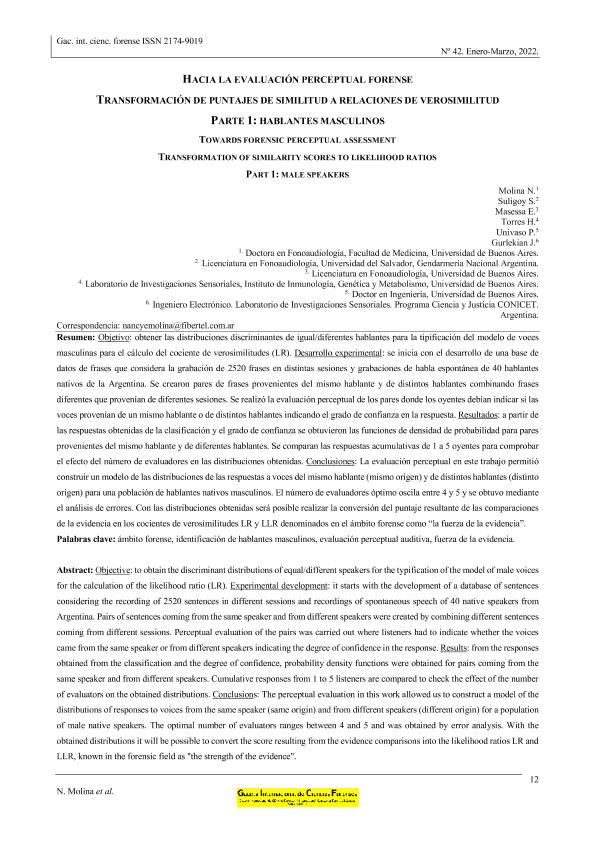
Objetivo: obtener las distribuciones discriminantes de igual/diferentes hablantes para la tipificación del modelo de voces masculinas para el cálculo del cociente de verosimilitudes (LR). Desarrollo experimental: se inicia con el desarrollo de una base de datos de frases que considera la grabación de 2520 frases en distintas sesiones y grabaciones de habla espontánea de 40 hablantes nativos de la Argentina. Se crearon pares de frases provenientes del mismo hablante y de distintos hablantes combinando frases diferentes que provenían de diferentes sesiones. Se realizó la evaluación perceptual de los pares donde los oyentes debían indicar si las voces provenían de un mismo hablante o de distintos hablantes indicando el grado de confianza en la respuesta. Resultados: a partir de las respuestas obtenidas de la clasificación y el grado de confianza se obtuvieron las funciones de densidad de probabilidad para pares provenientes del mismo hablante y de diferentes hablantes. Se comparan las respuestas acumulativas de 1 a 5 oyentes para comprobar el efecto del número de evaluadores en las distribuciones obtenidas. Conclusiones: La evaluación perceptual en este trabajo permitió construir un modelo de las distribuciones de las respuestas a voces del mismo hablante (mismo origen) y de distintos hablantes (distinto origen) para una población de hablantes nativos masculinos. El número de evaluadores óptimo oscila entre 4 y 5 y se obtuvo mediante el análisis de errores. Con las distribuciones obtenidas será posible realizar la conversión del puntaje resultante de las comparaciones de la evidencia en los cocientes de verosimilitudes LR y LLR denominados en el ámbito forense como la fuerza de la evidencia. : Objective: to obtain the discriminant distributions of equal/different speakers for the typification of the model of male voices for the calculation of the likelihood ratio (LR). Experimental development: it starts with the development of a database of sentences considering the recording of 2520 sentences in different sessions and recordings of spontaneous speech of 40 native speakers from Argentina. Pairs of sentences coming from the same speaker and from different speakers were created by combining different sentences coming from different sessions. Perceptual evaluation of the pairs was carried out where listeners had to indicate whether the voices came from the same speaker or from different speakers indicating the degree of confidence in the response. Results: from the responses obtained from the classification and the degree of confidence, probability density functions were obtained for pairs coming from the same speaker and from different speakers. Cumulative responses from 1 to 5 listeners are compared to check the effect of the number of evaluators on the obtained distributions. Conclusions: The perceptual evaluation in this work allowed us to construct a model of the distributions of responses to voices from the same speaker (same origin) and from different speakers (different origin) for a population of male native speakers. The optimal number of evaluators ranges between 4 and 5 and was obtained by error analysis. With the obtained distributions it will be possible to convert the score resulting from the evidence comparisons into the likelihood ratios LR and LLR, known in the forensic field as "the strength of the evidence".
Hacia la evaluación perceptual forense. Transformación de puntajes de similitud a relaciones de verosimilitud. Parte 1: hablantes masculinos
Molina, Nancy Elizabeth; Suligoy, Stefanía; Masessa, Evangelina; Torres, Humberto Maximiliano ; Univaso, Pedro; Gurlekian, Jorge Alberto
; Univaso, Pedro; Gurlekian, Jorge Alberto
Fecha de publicación:
03/2022
Editorial:
Universitat de València
Revista:
Gaceta Internacional de Ciencias Forenses
ISSN:
2174-9019
Idioma:
Español
Tipo de recurso:
Artículo publicado
Clasificación temática:
Resumen
Archivos asociados

Tamaño:
1.125Mb
Formato:
PDF
Licencia
 Excepto donde se diga explícitamente, este item se publica bajo la siguiente descripción:
Creative Commons Attribution-NonCommercial-ShareAlike 2.5 Unported (CC BY-NC-SA 2.5)
Excepto donde se diga explícitamente, este item se publica bajo la siguiente descripción:
Creative Commons Attribution-NonCommercial-ShareAlike 2.5 Unported (CC BY-NC-SA 2.5)
Identificadores
Colecciones
Articulos(INIGEM)
Articulos de INSTITUTO DE INMUNOLOGIA, GENETICA Y METABOLISMO
Articulos de INSTITUTO DE INMUNOLOGIA, GENETICA Y METABOLISMO
Citación
Molina, Nancy Elizabeth; Suligoy, Stefanía; Masessa, Evangelina; Torres, Humberto Maximiliano; Univaso, Pedro; et al.; Hacia la evaluación perceptual forense. Transformación de puntajes de similitud a relaciones de verosimilitud. Parte 1: hablantes masculinos; Universitat de València; Gaceta Internacional de Ciencias Forenses; 42; 3-2022; 12-20
Compartir

