Mostrar el registro sencillo del ítem
dc.contributor.author
Suarez, Maria Fernanda
dc.contributor.author
Piqueras, Carmen
dc.contributor.author
Algeciras, Mabel
dc.contributor.author
Medina, Esteban Roberto
dc.contributor.author
Bhattacharya, Sanjoy K.
dc.contributor.author
Serra, Horacio Marcelo
dc.date.available
2023-08-24T12:11:55Z
dc.date.issued
2021-07
dc.identifier.citation
Suarez, Maria Fernanda; Piqueras, Carmen; Algeciras, Mabel; Medina, Esteban Roberto; Bhattacharya, Sanjoy K.; et al.; Protein profile in pterygium tissue from patients with indoor activities; Academia Publishing; Academia Journal of Scientific Research; 9; 1; 7-2021; 1-8
dc.identifier.issn
2315-7712
dc.identifier.uri
http://hdl.handle.net/11336/209184
dc.description.abstract
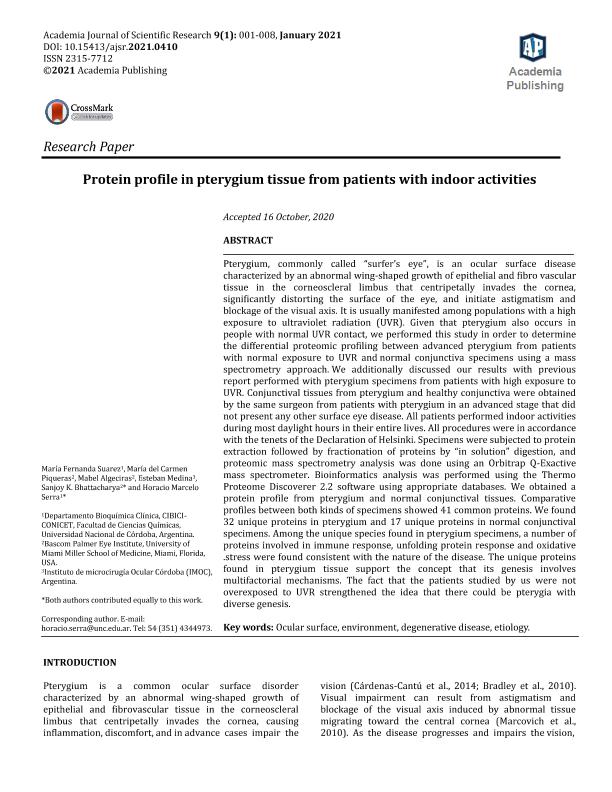
Pterygium, commonly called “surfer’s eye”, is an ocular surface disease characterized by an abnormal wing-shaped growth of epithelial and fibro vascular tissue in the corneoscleral limbus that centripetally invades the cornea, significantly distorting the surface of the eye, and initiate astigmatism and blockage of the visual axis. It is usually manifested among populations with a high exposure to ultraviolet radiation (UVR). Given that pterygium also occurs in people with normal UVR contact, we performed this study in order to determine the differential proteomic profiling between advanced pterygium from patients with normal exposure to UVR and normal conjunctiva specimens using a mass spectrometry approach. We additionally discussed our results with previous report performed with pterygium specimens from patients with high exposure to UVR. Conjunctival tissues from pterygium and healthy conjunctiva were obtained by the same surgeon from patients with pterygium in an advanced stage that did not present any other surface eye disease. All patients performed indoor activities during most daylight hours in their entire lives. All procedures were in accordance with the tenets of the Declaration of Helsinki. Specimens were subjected to protein extraction followed by fractionation of proteins by “in solution” digestion, and proteomic mass spectrometry analysis was done using an Orbitrap Q-Exactive mass spectrometer. Bioinformatics analysis was performed using the Thermo Proteome Discoverer 2.2 software using appropriate databases. We obtained a protein profile from pterygium and normal conjunctival tissues. Comparative profiles between both kinds of specimens showed 41 common proteins. We found 32 unique proteins in pterygium and 17 unique proteins in normal conjunctival specimens. Among the unique species found in pterygium specimens, a number of proteins involved in immune response, unfolding protein response and oxidative .stress were found consistent with the nature of the disease. The unique proteins found in pterygium tissue support the concept that its genesis involves multifactorial mechanisms. The fact that the patients studied by us were not overexposed to UVR strengthened the idea that there could be pterygia with diverse genesis.
dc.format
application/pdf
dc.language.iso
eng
dc.publisher
Academia Publishing
dc.rights
info:eu-repo/semantics/openAccess
dc.rights.uri
https://creativecommons.org/licenses/by-nc-sa/2.5/ar/
dc.subject
PTERIGYUM
dc.subject
HUMAN
dc.subject
MASS SPECTROMETRY
dc.subject.classification
Patología
dc.subject.classification
Medicina Básica
dc.subject.classification
CIENCIAS MÉDICAS Y DE LA SALUD
dc.title
Protein profile in pterygium tissue from patients with indoor activities
dc.type
info:eu-repo/semantics/article
dc.type
info:ar-repo/semantics/artículo
dc.type
info:eu-repo/semantics/publishedVersion
dc.date.updated
2023-08-16T11:12:00Z
dc.journal.volume
9
dc.journal.number
1
dc.journal.pagination
1-8
dc.journal.pais
Estados Unidos
dc.journal.ciudad
Nueva York
dc.description.fil
Fil: Suarez, Maria Fernanda. Universidad Nacional de Córdoba. Facultad de Ciencias Químicas. Departamento de Bioquímica Clínica; Argentina. Consejo Nacional de Investigaciones Científicas y Técnicas. Centro Científico Tecnológico Córdoba. Centro de Investigaciones en Bioquímica Clínica e Inmunología; Argentina
dc.description.fil
Fil: Piqueras, Carmen. University of Miami; Estados Unidos
dc.description.fil
Fil: Algeciras, Mabel. University of Miami; Estados Unidos
dc.description.fil
Fil: Medina, Esteban Roberto. Instituto de microcirugía Ocular Córdoba ; Argentina
dc.description.fil
Fil: Bhattacharya, Sanjoy K.. University of Miami; Estados Unidos
dc.description.fil
Fil: Serra, Horacio Marcelo. Consejo Nacional de Investigaciones Científicas y Técnicas. Centro Científico Tecnológico Córdoba. Centro de Investigaciones en Bioquímica Clínica e Inmunología; Argentina. Universidad Nacional de Córdoba. Facultad de Ciencias Químicas. Departamento de Bioquímica Clínica; Argentina
dc.journal.title
Academia Journal of Scientific Research
dc.relation.alternativeid
info:eu-repo/semantics/altIdentifier/url/https://www.academiapublishing.org/journals/ajsr/pdf/2021/Jan/Suarez%20et%20al.pdf
Archivos asociados

Tamaño:
940.4Kb
Formato:
PDF