Artículo
Xanthomonas wilt of banana drives changes in land-use and ecosystem services across infected landscapes
Ocimati, Walter; Groot, Jeroen J. C.; Tittonell, Pablo ; Taulya, Godfrey; Ntamwira, Jules; Amato, Serge; Blomme, Guy
; Taulya, Godfrey; Ntamwira, Jules; Amato, Serge; Blomme, Guy
Fecha de publicación:
04/2020
Editorial:
MDPI
Revista:
Sustainability
ISSN:
2071-1050
Idioma:
Inglés
Tipo de recurso:
Artículo publicado
Clasificación temática:
Resumen
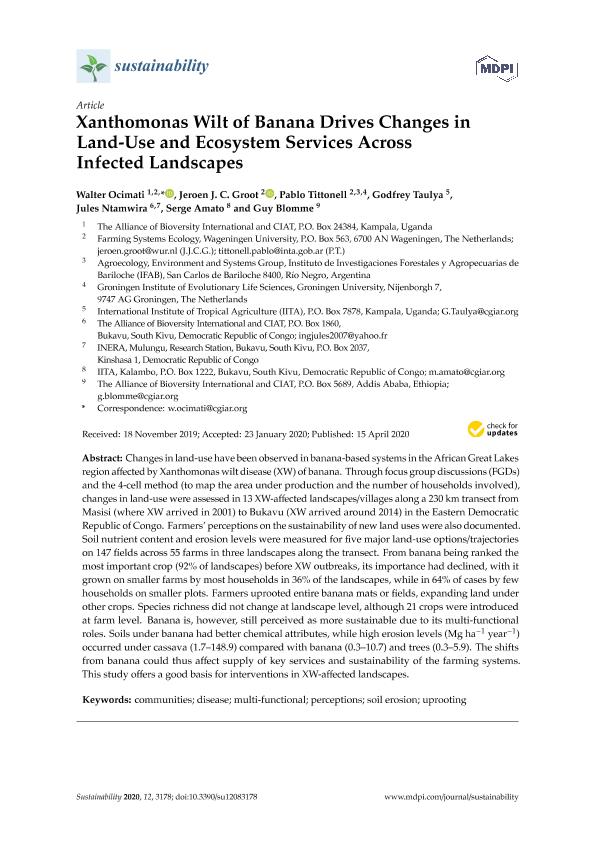
Changes in land-use have been observed in banana-based systems in the African Great Lakes region affected by Xanthomonas wilt disease (XW) of banana. Through focus group discussions (FGDs) and the 4-cell method (to map the area under production and the number of households involved), changes in land-use were assessed in 13 XW-affected landscapes/villages along a 230 km transect from Masisi (where XW arrived in 2001) to Bukavu (XW arrived around 2014) in the Eastern Democratic Republic of Congo. Farmers' perceptions on the sustainability of new land uses were also documented. Soil nutrient content and erosion levels were measured for five major land-use options/trajectories on 147 fields across 55 farms in three landscapes along the transect. From banana being ranked the most important crop (92% of landscapes) before XW outbreaks, its importance had declined, with it grown on smaller farms by most households in 36% of the landscapes, while in 64% of cases by few households on smaller plots. Farmers uprooted entire banana mats or fields, expanding land under other crops. Species richness did not change at landscape level, although 21 crops were introduced at farm level. Banana is, however, still perceived as more sustainable due to its multi-functional roles. Soils under banana had better chemical attributes, while high erosion levels (Mg ha-1 year-1) occurred under cassava (1.7-148.9) compared with banana (0.3-10.7) and trees (0.3-5.9). The shifts from banana could thus affect supply of key services and sustainability of the farming systems. This study offers a good basis for interventions in XW-affected landscapes.
Palabras clave:
COMMUNITIES
,
DISEASE
,
MULTI-FUNCTIONAL
,
PERCEPTIONS
,
SOIL EROSION
,
UPROOTING
Archivos asociados

Tamaño:
2.632Mb
Formato:
PDF
Licencia
 Excepto donde se diga explícitamente, este item se publica bajo la siguiente descripción:
Creative Commons Attribution 2.5 Unported (CC BY 2.5)
Excepto donde se diga explícitamente, este item se publica bajo la siguiente descripción:
Creative Commons Attribution 2.5 Unported (CC BY 2.5)
Identificadores
Colecciones
Articulos (IFAB)
Articulos de INSTITUTO DE INVESTIGACIONES FORESTALES Y AGROPECUARIAS BARILOCHE
Articulos de INSTITUTO DE INVESTIGACIONES FORESTALES Y AGROPECUARIAS BARILOCHE
Citación
Ocimati, Walter; Groot, Jeroen J. C.; Tittonell, Pablo; Taulya, Godfrey; Ntamwira, Jules; et al.; Xanthomonas wilt of banana drives changes in land-use and ecosystem services across infected landscapes; MDPI; Sustainability; 12; 8; 4-2020; 1-20
Compartir


Altmétricas