Artículo
Staphylococcus aureus promotes autophagy by decreasing intracellular cAMP levels

Fecha de publicación:
12/2012
Editorial:
Landes Bioscience
Revista:
Autophagy
ISSN:
1554-8627
Idioma:
Inglés
Tipo de recurso:
Artículo publicado
Clasificación temática:
Resumen
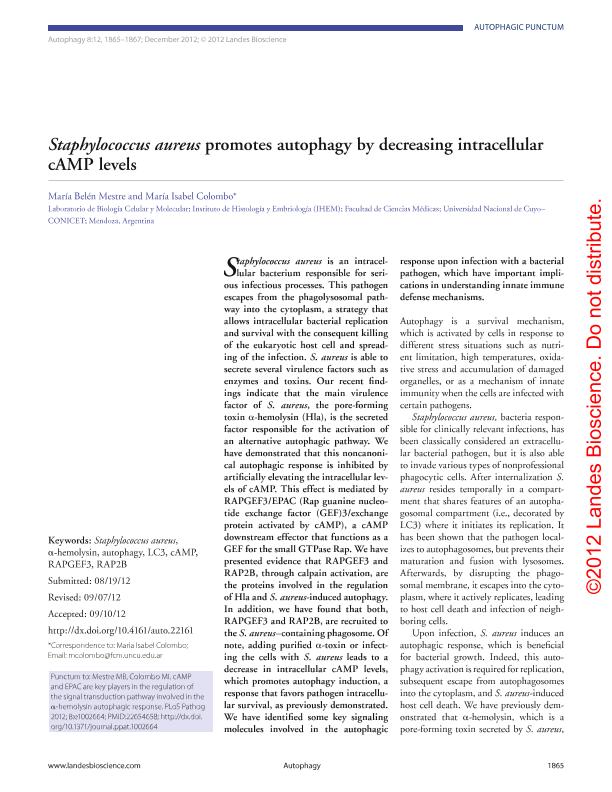
Staphylococcus aureus is an intracellular bacterium responsible for serious infectious processes. This pathogen escapes from the phagolysosomal pathway into the cytoplasm, a strategy that allows intracellular bacterial replication and survival with the consequent killing of the eukaryotic host cell and spreading of the infection. S. aureus is able to secrete several virulence factors such as enzymes and toxins. Our recent findings indicate that the main virulence factor of S. aureus, the pore-forming toxin α-hemolysin (Hla), is the secreted factor responsible for the activation of an alternative autophagic pathway. We have demonstrated that this noncanonical autophagic response is inhibited by artificially elevating the intracellular levels of cAMP. This effect is mediated by RAPGEF3/EPAC (Rap guanine nucleotide exchange factor (GEF)3/exchange protein activated by cAMP), a cAMP downstream effector that functions as a GEF for the small GTPase Rap. We have presented evidence that RAPGEF3 and RAP2B, through calpain activation, are the proteins involved in the regulation of Hla and S. aureus-induced autophagy. In addition, we have found that both, RAPGEF3 and RAP2B, are recruited to the S. aureus-containing phagosome. Of note, adding purified α-toxin or infecting the cells with S. aureus leads to a decrease in intracellular cAMP levels, which promotes autophagy induction, a response that favors pathogen intracellular survival, as previously demonstrated. We have identified some key signaling molecules involved in the autophagic response upon infection with a bacterial pathogen, which have important implications in understanding innate immune defense mechanisms.
Palabras clave:
AUTOPHAGY
,
CAMP
,
LC3
,
RAP2B
,
RAPGEF3
,
STAPHYLOCOCCUS AUREUS
,
Α-HEMOLYSIN
Archivos asociados

Tamaño:
863.0Kb
Formato:
PDF
Licencia
 Excepto donde se diga explícitamente, este item se publica bajo la siguiente descripción:
Creative Commons Attribution-NonCommercial-ShareAlike 2.5 Unported (CC BY-NC-SA 2.5)
Excepto donde se diga explícitamente, este item se publica bajo la siguiente descripción:
Creative Commons Attribution-NonCommercial-ShareAlike 2.5 Unported (CC BY-NC-SA 2.5)
Identificadores
Colecciones
Articulos(CCT - SAN JUAN)
Articulos de CENTRO CIENTIFICO TECNOLOGICO CONICET - SAN JUAN
Articulos de CENTRO CIENTIFICO TECNOLOGICO CONICET - SAN JUAN
Articulos(IHEM)
Articulos de INST. HISTOLOGIA Y EMBRIOLOGIA DE MEND DR.M.BURGOS
Articulos de INST. HISTOLOGIA Y EMBRIOLOGIA DE MEND DR.M.BURGOS
Citación
Mestre Gimenez, Maria Belen; Colombo, Maria Isabel; Staphylococcus aureus promotes autophagy by decreasing intracellular cAMP levels; Landes Bioscience; Autophagy; 8; 12; 12-2012; 1865-1867
Compartir


Altmétricas