Artículo
Bio-Acidification of Cattle Slurry with Whey Reduces Gaseous Emission during Storage with Positive Effects on Biogas Production
Gioelli, Fabrizio; Grella, Marco; Scarpeci, Telma Eleonora ; Rollè, Luca; Dela Pierre, Flavia; Dinuccio, Elio
; Rollè, Luca; Dela Pierre, Flavia; Dinuccio, Elio
Fecha de publicación:
09/2022
Editorial:
MDPI
Revista:
Sustainability
ISSN:
2071-1050
Idioma:
Inglés
Tipo de recurso:
Artículo publicado
Clasificación temática:
Resumen
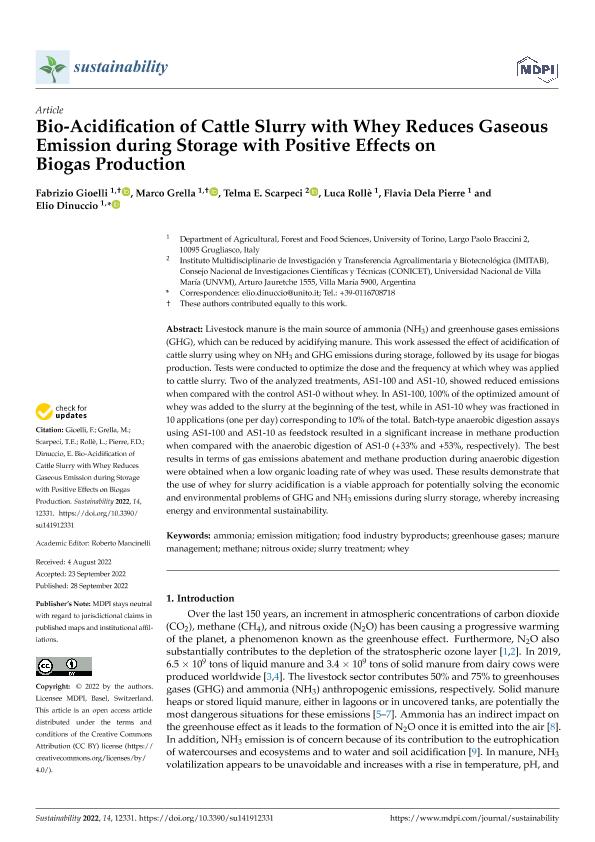
Livestock manure is the main source of ammonia (NH3) and greenhouse gases emissions (GHG), which can be reduced by acidifying manure. This work assessed the effect of acidification of cattle slurry using whey on NH3 and GHG emissions during storage, followed by its usage for biogas production. Tests were conducted to optimize the dose and the frequency at which whey was applied to cattle slurry. Two of the analyzed treatments, AS1-100 and AS1-10, showed reduced emissions when compared with the control AS1-0 without whey. In AS1-100, 100% of the optimized amount of whey was added to the slurry at the beginning of the test, while in AS1-10 whey was fractioned in 10 applications (one per day) corresponding to 10% of the total. Batch-type anaerobic digestion assays using AS1-100 and AS1-10 as feedstock resulted in a significant increase in methane production when compared with the anaerobic digestion of AS1-0 (+33% and +53%, respectively). The best results in terms of gas emissions abatement and methane production during anaerobic digestion were obtained when a low organic loading rate of whey was used. These results demonstrate that the use of whey for slurry acidification is a viable approach for potentially solving the economic and environmental problems of GHG and NH3 emissions during slurry storage, whereby increasing energy and environmental sustainability.
Archivos asociados

Tamaño:
1.955Mb
Formato:
PDF
Licencia
 Excepto donde se diga explícitamente, este item se publica bajo la siguiente descripción:
Creative Commons Attribution 2.5 Unported (CC BY 2.5)
Excepto donde se diga explícitamente, este item se publica bajo la siguiente descripción:
Creative Commons Attribution 2.5 Unported (CC BY 2.5)
Identificadores
Colecciones
Articulos (IMITAB)
Articulos de INSTITUTO MULTIDISCIPLINARIO DE INVESTIGACIÓN Y TRANSFERENCIA AGROALIMENTARIA Y BIOTECNOLÓGICA
Articulos de INSTITUTO MULTIDISCIPLINARIO DE INVESTIGACIÓN Y TRANSFERENCIA AGROALIMENTARIA Y BIOTECNOLÓGICA
Articulos(CCT - CORDOBA)
Articulos de CTRO.CIENTIFICO TECNOL.CONICET - CORDOBA
Articulos de CTRO.CIENTIFICO TECNOL.CONICET - CORDOBA
Citación
Gioelli, Fabrizio; Grella, Marco; Scarpeci, Telma Eleonora; Rollè, Luca; Dela Pierre, Flavia; et al.; Bio-Acidification of Cattle Slurry with Whey Reduces Gaseous Emission during Storage with Positive Effects on Biogas Production; MDPI; Sustainability; 14; 19; 9-2022; 1-13
Compartir


Altmétricas