Artículo
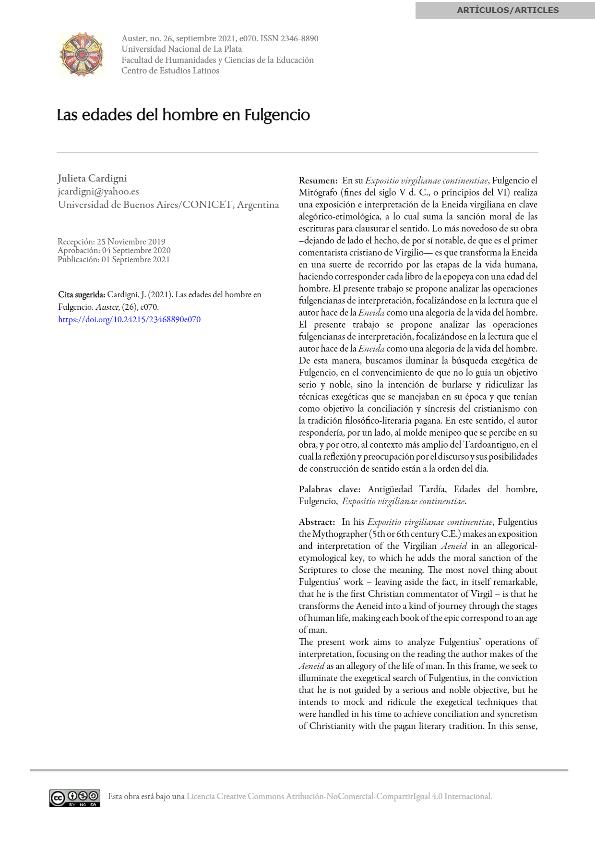
En su Expositio virgilianae continentiae, Fulgencio el Mitógrafo (fines del siglo V d. C., o principios del VI) realiza una exposición e interpretación de la Eneida virgiliana en clave alegórico-etimológica, a lo cual suma la sanción moral de las escrituras para clausurar el sentido. Lo más novedoso de su obra –dejando de lado el hecho, de por sí notable, de que es el primer comentarista cristiano de Virgilio— es que transforma la Eneida en una suerte de recorrido por las etapas de la vida humana, haciendo corresponder cada libro de la epopeya con una edad del hombre. El presente trabajo se propone analizar las operaciones fulgencianas de interpretación, focalizándose en la lectura que el autor hace de la Eneida como una alegoría de la vida del hombre. El presente trabajo se propone analizar las operaciones fulgencianas de interpretación, focalizándose en la lectura que el autor hace de la Eneida como una alegoría de la vida del hombre. De esta manera, buscamos iluminar la búsqueda exegética de Fulgencio, en el convencimiento de que no lo guía un objetivo serio y noble, sino la intención de burlarse y ridiculizar las técnicas exegéticas que se manejaban en su época y que tenían como objetivo la conciliación y síncresis del cristianismo con la tradición filosófico-literaria pagana. En este sentido, el autor respondería, por un lado, al molde menipeo que se percibe en su obra, y por otro, al contexto más amplio del Tardoantiguo, en el cual la reflexión y preocupación por el discurso y sus posibilidades de construcción de sentido están a la orden del día. In his Expositio virgilianae continentiae, Fulgentius the Mythographer (5th or 6th century C.E.) makes an exposition and interpretation of the Virgilian Aeneid in an allegorical-etymological key, to which he adds the moral sanction of the Scriptures to close the meaning. The most novel thing about Fulgentius’ work – leaving aside the fact, in itself remarkable, that he is the first Christian commentator of Virgil – is that he transforms the Aeneid into a kind of journey through the stages of human life, making each book of the epic correspond to an age of man. The present work aims to analyze Fulgentius’ operations of interpretation, focusing on the reading the author makes of the Aeneid as an allegory of the life of man. In this frame, we seek to illuminate the exegetical search of Fulgentius, in the conviction that he is not guided by a serious and noble objective, but he intends to mock and ridicule the exegetical techniques that were handled in his time to achieve conciliation and syncretism of Christianity with the pagan literary tradition. In this sense, the author would respond both to the menippean mold that is perceived in his work and to the broader context of Late Antiquity, in which reflection and concern for the discourse and its possibilities of construction of meaning are the order of the day.
Las edades del hombre en Fulgencio

Fecha de publicación:
09/2021
Editorial:
Universidad Nacional de La Plata. Facultad de Humanidades y Ciencias de la Educación. Centro de Estudios Latinos
Revista:
Auster
ISSN:
2346-8890
Idioma:
Español
Tipo de recurso:
Artículo publicado
Clasificación temática:
Resumen
Archivos asociados

Tamaño:
2.829Mb
Formato:
PDF
Licencia
 Excepto donde se diga explícitamente, este item se publica bajo la siguiente descripción:
Creative Commons Attribution-NonCommercial-ShareAlike 2.5 Unported (CC BY-NC-SA 2.5)
Excepto donde se diga explícitamente, este item se publica bajo la siguiente descripción:
Creative Commons Attribution-NonCommercial-ShareAlike 2.5 Unported (CC BY-NC-SA 2.5)
Identificadores
Colecciones
Articulos(SEDE CENTRAL)
Articulos de SEDE CENTRAL
Articulos de SEDE CENTRAL
Citación
Cardigni, Julieta; Las edades del hombre en Fulgencio; Universidad Nacional de La Plata. Facultad de Humanidades y Ciencias de la Educación. Centro de Estudios Latinos; Auster; 26; 9-2021; 1-9
Compartir


Altmétricas