Artículo
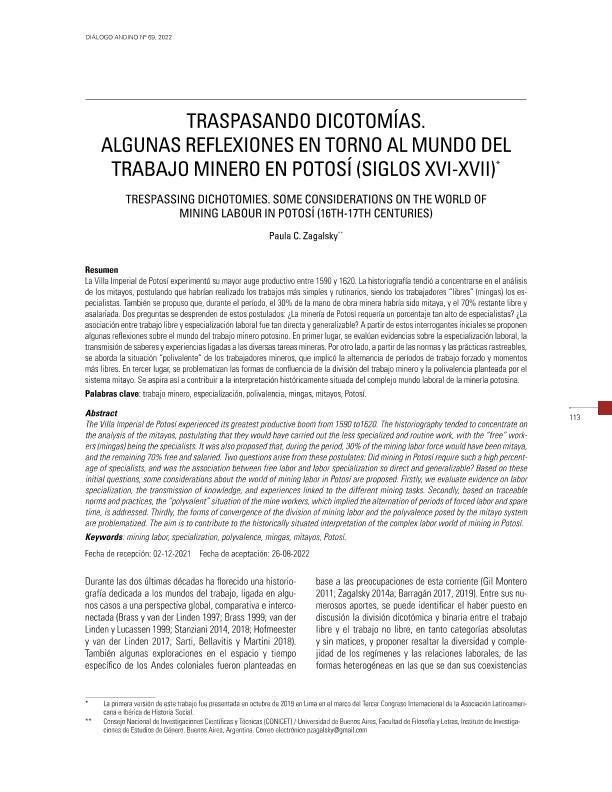
La Villa Imperial de Potosí experimentó su mayor auge productivo entre 1590 y 1620. La historiografía tendió a concentrarse en el análisis de los mitayos, postulando que habrían realizado los trabajos más simples y rutinarios, siendo los trabajadores “libres” (mingas) los especialistas. También se propuso que, durante el período, el 30% de la mano de obra minera habría sido mitaya, y el 70% restante libre y asalariada. Dos preguntas se desprenden de estos postulados: ¿La minería de Potosí requería un porcentaje tan alto de especialistas? ¿La asociación entre trabajo libre y especialización laboral fue tan directa y generalizable? A partir de estos interrogantes iniciales se proponen algunas reflexiones sobre el mundo del trabajo minero potosino. En primer lugar, se evalúan evidencias sobre la especialización laboral, la transmisión de saberes y experiencias ligadas a las diversas tareas mineras. Por otro lado, a partir de las normas y las prácticas rastreables, se aborda la situación “polivalente” de los trabajadores mineros, que implicó la alternancia de períodos de trabajo forzado y momentos más libres. En tercer lugar, se problematiza las formas de confluencia de la división del trabajo minero y la polivalencia planteada por el sistema mitayo. Se aspira así a contribuir a la interpretación históricamente situada del complejo mundo laboral de la minería potosina. The Villa Imperial de Potosí experienced its greatest productive boom from 1590 to1620. The historiography tended to concentrate on the analysis of the mitayos, postulating that they would have carried out the less specialized and routine work, with the “free” workers (mingas) being the specialists. It was also proposed that, during the period, 30% of the mining labor force would have been mitaya, and the remaining 70% free and salaried. Two questions arise from these postulates: Did mining in Potosí require such a high percentage of specialists, and was the association between free labor and labor specialization so direct and generalizable? Based on these initial questions, some considerations about the world of mining labor in Potosí are proposed. Firstly, we evaluate evidence on labor specialization, the transmission of knowledge, and experiences linked to the different mining tasks. Secondly, based on traceable norms and practices, the “polyvalent” situation of the mine workers, which implied the alternation of periods of forced labor and spare time, is addressed. Thirdly, the forms of convergence of the division of mining labor and the polyvalence posed by the mitayo system are problematized. The aim is to contribute to the historically situated interpretation of the complex labor world of mining in Potosí.
Traspasando dicotomías: algunas reflexiones en torno al mundo del trabajo minero en Potosí (siglos XVI-XVII)
Título:
Trespassing dichotomies: some considerations on the world of mining labour in Potosí (16th-17th centuries)

Fecha de publicación:
09/2022
Editorial:
Universidad de Tarapacá. Facultad de Educación y Humanidades. Departamento de Ciencias Históricas y Geográficas
Revista:
Dialogo Andino
ISSN:
0719-2681
Idioma:
Español
Tipo de recurso:
Artículo publicado
Clasificación temática:
Resumen
Palabras clave:
TRABAJO MINERO
,
ESPECIALIZACIÓN
,
POLIVALENCIA
,
POTOSI
Archivos asociados

Tamaño:
100.7Kb
Formato:
PDF
Licencia
 Excepto donde se diga explícitamente, este item se publica bajo la siguiente descripción:
Creative Commons Attribution-NonCommercial 2.5 Unported (CC BY-NC 2.5)
Excepto donde se diga explícitamente, este item se publica bajo la siguiente descripción:
Creative Commons Attribution-NonCommercial 2.5 Unported (CC BY-NC 2.5)
Identificadores
Colecciones
Articulos(SEDE CENTRAL)
Articulos de SEDE CENTRAL
Articulos de SEDE CENTRAL
Citación
Zagalsky, Paula Cecilia; Traspasando dicotomías: algunas reflexiones en torno al mundo del trabajo minero en Potosí (siglos XVI-XVII); Universidad de Tarapacá. Facultad de Educación y Humanidades. Departamento de Ciencias Históricas y Geográficas; Dialogo Andino; 69; 9-2022; 113-121
Compartir


Altmétricas