Mostrar el registro sencillo del ítem
dc.contributor.author
Bre, Facundo
dc.contributor.author
Caggiano, Antonio
dc.contributor.author
Koenders, Eduardus A. B.
dc.date.available
2023-07-20T12:08:42Z
dc.date.issued
2022-07
dc.identifier.citation
Bre, Facundo; Caggiano, Antonio; Koenders, Eduardus A. B.; Multiobjective Optimization of Cement-Based Panels Enhanced with Microencapsulated Phase Change Materials for Building Energy Applications; Multidisciplinary Digital Publishing Institute; Energies; 15; 14; 7-2022; 5192
dc.identifier.issn
1996-1073
dc.identifier.uri
http://hdl.handle.net/11336/204564
dc.description.abstract
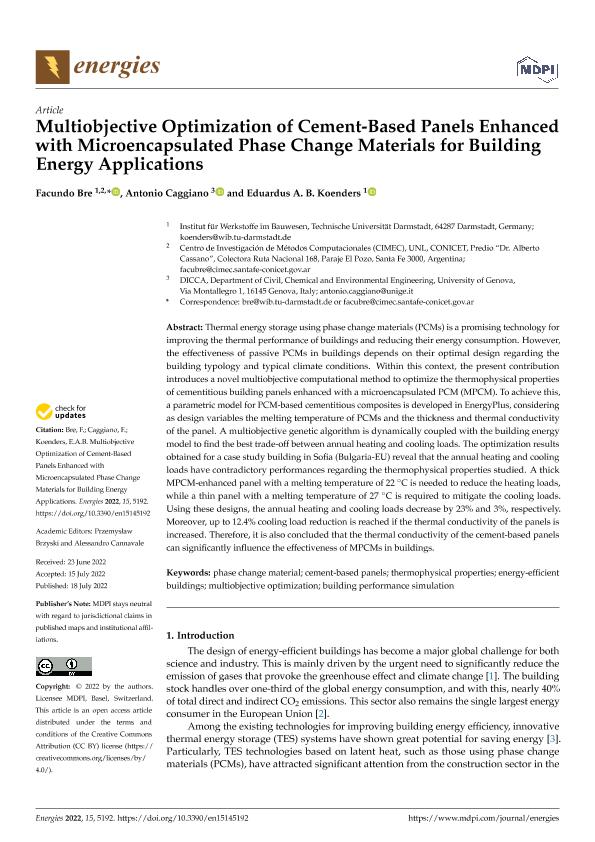
Thermal energy storage using phase change materials (PCMs) is a promising technology for improving the thermal performance of buildings and reducing their energy consumption. However, the effectiveness of passive PCMs in buildings depends on their optimal design regarding the building typology and typical climate conditions. Within this context, the present contribution introduces a novel multiobjective computational method to optimize the thermophysical properties of cementitious building panels enhanced with a microencapsulated PCM (MPCM). To achieve this, a parametric model for PCM-based cementitious composites is developed in EnergyPlus, considering as design variables the melting temperature of PCMs and the thickness and thermal conductivity of the panel. A multiobjective genetic algorithm is dynamically coupled with the building energy model to find the best trade-off between annual heating and cooling loads. The optimization results obtained for a case study building in Sofia (Bulgaria-EU) reveal that the annual heating and cooling loads have contradictory performances regarding the thermophysical properties studied. A thick MPCM-enhanced panel with a melting temperature of 22 (Formula presented.) C is needed to reduce the heating loads, while a thin panel with a melting temperature of 27 (Formula presented.) C is required to mitigate the cooling loads. Using these designs, the annual heating and cooling loads decrease by 23% and 3%, respectively. Moreover, up to 12.4% cooling load reduction is reached if the thermal conductivity of the panels is increased. Therefore, it is also concluded that the thermal conductivity of the cement-based panels can significantly influence the effectiveness of MPCMs in buildings.
dc.format
application/pdf
dc.language.iso
eng
dc.publisher
Multidisciplinary Digital Publishing Institute
dc.rights
info:eu-repo/semantics/openAccess
dc.rights.uri
https://creativecommons.org/licenses/by/2.5/ar/
dc.subject
BUILDING PERFORMANCE SIMULATION
dc.subject
CEMENT-BASED PANELS
dc.subject
ENERGY-EFFICIENT BUILDINGS
dc.subject
MULTIOBJECTIVE OPTIMIZATION
dc.subject
PHASE CHANGE MATERIAL
dc.subject
THERMOPHYSICAL PROPERTIES
dc.subject.classification
Otras Ingeniería Civil
dc.subject.classification
Ingeniería Civil
dc.subject.classification
INGENIERÍAS Y TECNOLOGÍAS
dc.subject.classification
Ingeniería Arquitectónica
dc.subject.classification
Ingeniería Civil
dc.subject.classification
INGENIERÍAS Y TECNOLOGÍAS
dc.title
Multiobjective Optimization of Cement-Based Panels Enhanced with Microencapsulated Phase Change Materials for Building Energy Applications
dc.type
info:eu-repo/semantics/article
dc.type
info:ar-repo/semantics/artículo
dc.type
info:eu-repo/semantics/publishedVersion
dc.date.updated
2023-07-07T20:58:16Z
dc.journal.volume
15
dc.journal.number
14
dc.journal.pagination
5192
dc.journal.pais
Suiza
dc.journal.ciudad
Basilea
dc.description.fil
Fil: Bre, Facundo. Universitat Technische Darmstadt; Alemania. Consejo Nacional de Investigaciones Científicas y Técnicas. Centro Científico Tecnológico Conicet - Santa Fe. Centro de Investigaciones en Métodos Computacionales. Universidad Nacional del Litoral. Centro de Investigaciones en Métodos Computacionales; Argentina
dc.description.fil
Fil: Caggiano, Antonio. Università degli Studi di Genova; Italia
dc.description.fil
Fil: Koenders, Eduardus A. B.. Universitat Technische Darmstadt; Alemania
dc.journal.title
Energies
dc.relation.alternativeid
info:eu-repo/semantics/altIdentifier/doi/https://doi.org/10.3390/en15145192
dc.relation.alternativeid
info:eu-repo/semantics/altIdentifier/url/https://www.mdpi.com/1996-1073/15/14/5192
Archivos asociados

Tamaño:
13.93Mb
Formato:
PDF