Artículo
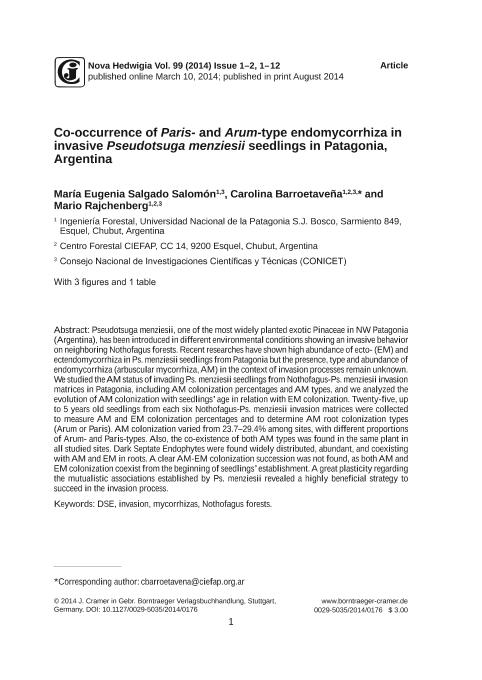
Co-occurrence of Paris- and Arum-type endomycorrhiza in invasive Pseudotsuga mensiezii (Mirb.) Blanco seedlings in Patagonia, Argentina.

Fecha de publicación:
10/03/2014
Editorial:
Gebruder Borntraeger
Revista:
Nova Hedwigia, Zeitschrift Fur Kryptogamenkunde
ISSN:
0029-5035
Idioma:
Inglés
Tipo de recurso:
Artículo publicado
Clasificación temática:
Resumen
Pseudotsuga menziesii, one of the most widely planted exotic Pinaceae in NW Patagonia (Argentina), has been introduced in different environmental conditions showing an invasive behavior on neighboring Nothofagus forests. Recent researches have shown high abundance of ecto- (EM) and ectendomycorrhiza in Ps. menziesii seedlings from Patagonia but the presence, type and abundance of endomycorrhiza (arbuscular mycorrhiza, AM) in the context of invasion processes remain unknown. We studied the AM status of invading Ps. menziesii seedlings from Nothofagus-Ps. menziesii invasion matrices in Patagonia, including AM colonization percentages and AM types, and we analyzed the evolution of AM colonization with seedlings' age in relation with EM colonization. Twenty-five, up to 5 years old seedlings from each six Nothofagus-Ps. menziesii invasion matrices were collected to measure AM and EM colonization percentages and to determine AM root colonization types (Arum or Paris). AM colonization varied from 23.7?29.4% among sites, with different proportions of Arum - and Paris-types. Also, the co-existence of both AM types was found in the same plant in all studied sites. Dark Septate Endophytes were found widely distributed, abundant, and coexisting with AM and EM in roots. A clear AM-EM colonization succession was not found, as both AM and EM colonization coexist from the beginning of seedlings' establishment. A great plasticity regarding the mutualistic associations established by Ps. menziesii revealed a highly beneficial strategy to succeed in the invasion process.
Palabras clave:
Invasion
,
Dark Septate Endophyte
,
Mycorrhiza
,
Nothofagus Forest
Archivos asociados

Tamaño:
568.4Kb
Formato:
PDF
Licencia
 Excepto donde se diga explícitamente, este item se publica bajo la siguiente descripción:
Creative Commons Attribution-NonCommercial-ShareAlike 2.5 Unported (CC BY-NC-SA 2.5)
Excepto donde se diga explícitamente, este item se publica bajo la siguiente descripción:
Creative Commons Attribution-NonCommercial-ShareAlike 2.5 Unported (CC BY-NC-SA 2.5)
Identificadores
Colecciones
Articulos(SEDE CENTRAL)
Articulos de SEDE CENTRAL
Articulos de SEDE CENTRAL
Citación
Salgado Salomón, María Eugenia; Barroetaveña, Carolina; Rajchenberg, Mario; Co-occurrence of Paris- and Arum-type endomycorrhiza in invasive Pseudotsuga mensiezii (Mirb.) Blanco seedlings in Patagonia, Argentina.; Gebruder Borntraeger; Nova Hedwigia, Zeitschrift Fur Kryptogamenkunde; 99; 2; 10-3-2014; 1-12
Compartir

