Artículo
Biochemical regulatory processes in the control of oxidants and antioxidants production in the brain of rats with iron and copper chronic overloads
Saporito Magriñá, Christian Martín ; Lairion, Fabiana Norma; Musacco Sebio, Rosario Natalia
; Fuda, Julián Andrés; Torti, Horacio Emilio; Repetto, Marisa Gabriela
; Lairion, Fabiana Norma; Musacco Sebio, Rosario Natalia
; Fuda, Julián Andrés; Torti, Horacio Emilio; Repetto, Marisa Gabriela
; Lairion, Fabiana Norma; Musacco Sebio, Rosario Natalia
; Fuda, Julián Andrés; Torti, Horacio Emilio; Repetto, Marisa Gabriela
Fecha de publicación:
09/2022
Editorial:
Springer
Revista:
Journal of Biological Inorganic Chemistry
ISSN:
0949-8257
Idioma:
Inglés
Tipo de recurso:
Artículo publicado
Clasificación temática:
Resumen
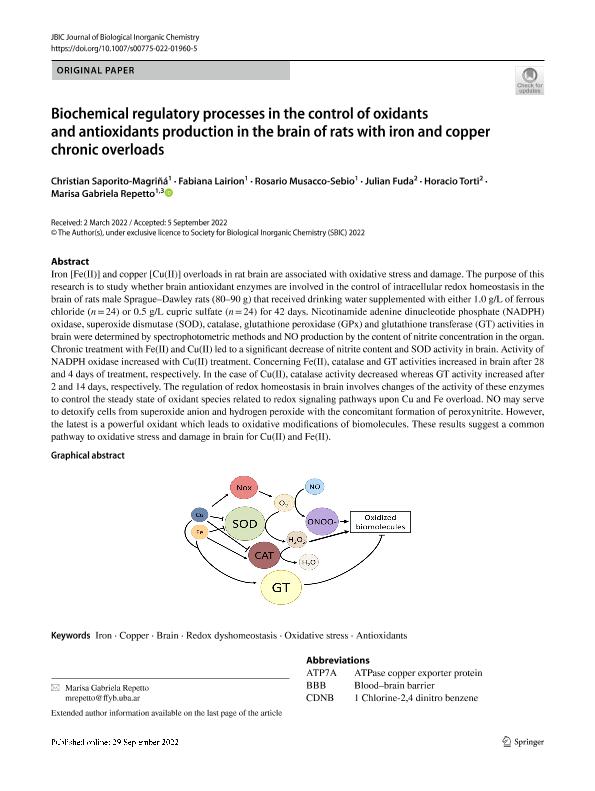
Iron [Fe(II)] and copper [Cu(II)] overloads in rat brain are associated with oxidative stress and damage. The purpose of this research is to study whether brain antioxidant enzymes are involved in the control of intracellular redox homeostasis in the brain of rats male Sprague-Dawley rats (80-90 g) that received drinking water supplemented with either 1.0 g/L of ferrous chloride (n=24) or 0.5 g/L cupric sulfate (n=24) for 42 days. Nicotinamide adenine dinucleotide phosphate (NADPH) oxidase, superoxide dismutase (SOD), catalase, glutathione peroxidase (GPx) and glutathione transferase (GT) activities in brain were determined by spectrophotometric methods and NO production by the content of nitrite concentration in the organ. Chronic treatment with Fe(II) and Cu(II) led to a significant decrease of nitrite content and SOD activity in brain. Activity of NADPH oxidase increased with Cu(II) treatment. Concerning Fe(II), catalase and GT activities increased in brain after 28 and 4 days of treatment, respectively. In the case of Cu(II), catalase activity decreased whereas GT activitiy increased after 2 and 14 days, respectively. The regulation of redox homeostasis in brain involves changes of the activity of these enzymes to control the steady state of oxidant species related to redox signaling pathways upon Cu and Fe overload. NO may serve to detoxify cells from superoxide anion and hydrogen peroxide with the concomitant formation of peroxynitrite. However, the latest is a powerful oxidant which leads to oxidative modifications of biomolecules. These results suggest a common pathway to oxidative stress and damage in brain for Cu(II) and Fe(II).
Palabras clave:
ANTIOXIDANTS
,
BRAIN
,
COPPER
,
IRON
,
OXIDATIVE STRESS
,
REDOX DYSHOMEOSTASIS
Archivos asociados

Tamaño:
1.046Mb
Formato:
PDF
Licencia
 Excepto donde se diga explícitamente, este item se publica bajo la siguiente descripción:
Creative Commons Attribution-NonCommercial-ShareAlike 2.5 Unported (CC BY-NC-SA 2.5)
Excepto donde se diga explícitamente, este item se publica bajo la siguiente descripción:
Creative Commons Attribution-NonCommercial-ShareAlike 2.5 Unported (CC BY-NC-SA 2.5)
Identificadores
Colecciones
Articulos(IBIMOL)
Articulos de INSTITUTO DE BIOQUIMICA Y MEDICINA MOLECULAR
Articulos de INSTITUTO DE BIOQUIMICA Y MEDICINA MOLECULAR
Citación
Saporito Magriñá, Christian Martín; Lairion, Fabiana Norma; Musacco Sebio, Rosario Natalia; Fuda, Julián Andrés; Torti, Horacio Emilio; et al.; Biochemical regulatory processes in the control of oxidants and antioxidants production in the brain of rats with iron and copper chronic overloads; Springer; Journal of Biological Inorganic Chemistry; 27; 7; 9-2022; 665-677
Compartir


Altmétricas