Mostrar el registro sencillo del ítem
dc.contributor.author
Zandivarez, Arnaldo Ariel
dc.contributor.author
Diaz, Maria Eugenia
dc.contributor.author
Taverna, Maria Antonela
dc.date.available
2023-07-07T14:00:58Z
dc.date.issued
2022-07
dc.identifier.citation
Zandivarez, Arnaldo Ariel; Diaz, Maria Eugenia; Taverna, Maria Antonela; The influence of Hickson-like compact group environment on galaxy luminosities; Oxford University Press; Monthly Notices of the Royal Astronomical Society; 514; 1; 7-2022; 1231-1248
dc.identifier.issn
0035-8711
dc.identifier.uri
http://hdl.handle.net/11336/202715
dc.description.abstract
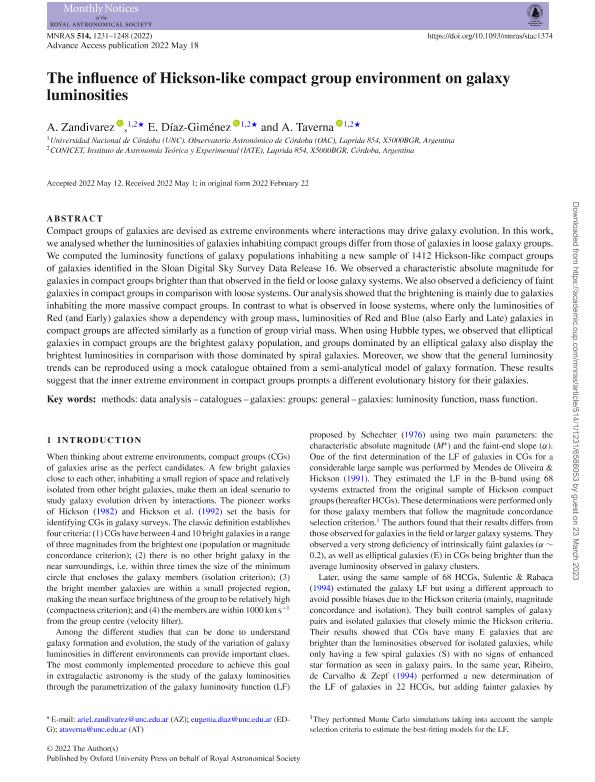
Compact groups of galaxies are devised as extreme environments where interactions may drive galaxy evolution. In this work, we analysed whether the luminosities of galaxies inhabiting compact groups differ from those of galaxies in loose galaxy groups. We computed the luminosity functions of galaxy populations inhabiting a new sample of 1412 Hickson-like compact groups of galaxies identified in the Sloan Digital Sky Survey Data Release 16. We observed a characteristic absolute magnitude for galaxies in compact groups brighter than that observed in the field or loose galaxy systems. We also observed a deficiency of faint galaxies in compact groups in comparison with loose systems. Our analysis showed that the brightening is mainly due to galaxies inhabiting the more massive compact groups. In contrast to what is observed in loose systems, where only the luminosities of Red (and Early) galaxies show a dependency with group mass, luminosities of Red and Blue (also Early and Late) galaxies in compact groups are affected similarly as a function of group virial mass. When using Hubble types, we observed that elliptical galaxies in compact groups are the brightest galaxy population, and groups dominated by an elliptical galaxy also display the brightest luminosities in comparison with those dominated by spiral galaxies. Moreover, we show that the general luminosity trends can be reproduced using a mock catalogue obtained from a semi-analytical model of galaxy formation. These results suggest that the inner extreme environment in compact groups prompts a different evolutionary history for their galaxies.
dc.format
application/pdf
dc.language.iso
eng
dc.publisher
Oxford University Press
dc.relation
https://ri.conicet.gov.ar/handle/11336/254063
dc.rights
info:eu-repo/semantics/openAccess
dc.rights.uri
https://creativecommons.org/licenses/by-nc-sa/2.5/ar/
dc.subject
CATALOGUES
dc.subject
GALAXIES: GROUPS: GENERAL
dc.subject
GALAXIES: LUMINOSITY FUNCTION, MASS FUNCTION
dc.subject
METHODS: DATA ANALYSIS
dc.subject.classification
Astronomía
dc.subject.classification
Ciencias Físicas
dc.subject.classification
CIENCIAS NATURALES Y EXACTAS
dc.title
The influence of Hickson-like compact group environment on galaxy luminosities
dc.type
info:eu-repo/semantics/article
dc.type
info:ar-repo/semantics/artículo
dc.type
info:eu-repo/semantics/publishedVersion
dc.date.updated
2023-07-06T11:20:14Z
dc.journal.volume
514
dc.journal.number
1
dc.journal.pagination
1231-1248
dc.journal.pais
Reino Unido
dc.journal.ciudad
Oxford
dc.description.fil
Fil: Zandivarez, Arnaldo Ariel. Consejo Nacional de Investigaciones Científicas y Técnicas. Centro Científico Tecnológico Conicet - Córdoba. Instituto de Astronomía Teórica y Experimental. Universidad Nacional de Córdoba. Observatorio Astronómico de Córdoba. Instituto de Astronomía Teórica y Experimental; Argentina. Universidad Nacional de Córdoba. Observatorio Astronómico de Córdoba; Argentina
dc.description.fil
Fil: Diaz, Maria Eugenia. Consejo Nacional de Investigaciones Científicas y Técnicas. Centro Científico Tecnológico Conicet - Córdoba. Instituto de Astronomía Teórica y Experimental. Universidad Nacional de Córdoba. Observatorio Astronómico de Córdoba. Instituto de Astronomía Teórica y Experimental; Argentina. Universidad Nacional de Córdoba. Observatorio Astronómico de Córdoba; Argentina
dc.description.fil
Fil: Taverna, Maria Antonela. Consejo Nacional de Investigaciones Científicas y Técnicas. Centro Científico Tecnológico Conicet - Córdoba. Instituto de Astronomía Teórica y Experimental. Universidad Nacional de Córdoba. Observatorio Astronómico de Córdoba. Instituto de Astronomía Teórica y Experimental; Argentina. Universidad Nacional de Córdoba. Observatorio Astronómico de Córdoba; Argentina
dc.journal.title
Monthly Notices of the Royal Astronomical Society
dc.relation.alternativeid
info:eu-repo/semantics/altIdentifier/url/https://academic.oup.com/mnras/article-abstract/514/1/1231/6588053
dc.relation.alternativeid
info:eu-repo/semantics/altIdentifier/doi/http://dx.doi.org/10.1093/mnras/stac1374
Archivos asociados

Tamaño:
2.542Mb
Formato:
PDF