Artículo
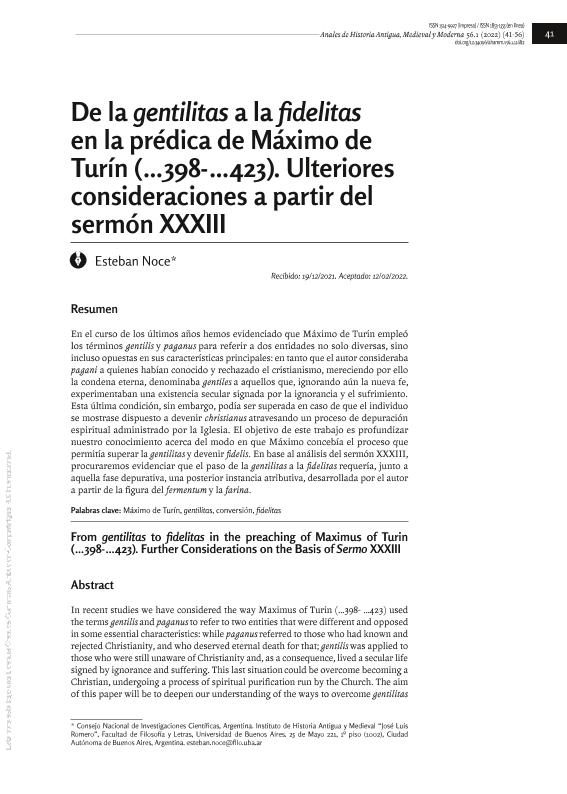
En el curso de los últimos años hemos evidenciado que Máximode Turín empleó los términos gentilis ypaganus para referir a dos entidadesno solo diversas, sino incluso opuestas en sus características principales: entanto que el autor consideraba pagania quienes habían conocido y rechazado el cristianismo, mereciendo por ello lacondena eterna, denominaba gentiles aaquellos que, ignorando aún la nueva fe, experimentaban una existencia secular signadapor la ignorancia y el sufrimiento. Esta última condición, sin embargo, podíaser superada en caso de que el individuo se mostrase dispuesto a devenir christianus atravesando un proceso de depuraciónespiritual administrado por la Iglesia. El objetivo de este trabajo esprofundizar nuestro conocimiento acerca del modo en que Máximo concebía elproceso que permitía superar la gentilitasy devenir fidelis. En base alanálisis del sermón XXXIII, procuraremos evidenciar que el paso de la gentilitas a la fidelitas requería, junto a aquella fase depurativa, una posteriorinstancia atributiva, desarrollada por el autor a partir de la figura del fermentum y la farina. In recent studies we have considered the way Maximus of Turin (…398- …423) used the terms gentilis and paganus to refer to two entities that were different and opposed in some essential characteristics: while paganus referred to those who had known and rejected Christianity, and who deserved eternal death for that; gentilis was applied to those who were still unaware of Christianity and, as a consequence, lived a secular life signed by ignorance and suffering. This last situation could be overcome becoming a Christian, undergoing a process of spiritual purification run by the Church. The aim of this paper will be to deepen our understanding of the ways to overcome gentilitas and become fidelis according to Maximus. Based on the analysis of sermo XXXIII, we will try to demonstrate that moving from gentilitas to fidelitas not only required a purifying stage, but also a subsequent attributive phase addressed by the author through the image of fermentum and farina.
De la gentilitas a la fidelitas en la prédica de Máximo de Turín (…398-…423). Ulteriores consideraciones a partir del sermón XXXIII
Título:
From gentilitas to fidelitas in the preaching of Maximus of Turin (…398-…423). Further Considerations on the Basis of Sermo XXXIII

Fecha de publicación:
07/2022
Editorial:
Universidad de Buenos Aires. Facultad de Filosofía y Letras. Instituto de Historia Antigua y Medieval
Revista:
Anales de Historia Antigua, Medieval y Moderna
ISSN:
1514-9927
e-ISSN:
1853-1555
Idioma:
Español
Tipo de recurso:
Artículo publicado
Clasificación temática:
Resumen
Palabras clave:
MÁXIMO DE TURÍN
,
CRISTIANIZACIÓN
,
GENTILITAS
,
FIDELITAS
Archivos asociados

Tamaño:
319.1Kb
Formato:
PDF
Licencia
 Excepto donde se diga explícitamente, este item se publica bajo la siguiente descripción:
Creative Commons Attribution-ShareAlike 2.5 Unported (CC BY-SA 2.5)
Excepto donde se diga explícitamente, este item se publica bajo la siguiente descripción:
Creative Commons Attribution-ShareAlike 2.5 Unported (CC BY-SA 2.5)
Identificadores
Colecciones
Articulos(SEDE CENTRAL)
Articulos de SEDE CENTRAL
Articulos de SEDE CENTRAL
Citación
Noce, Esteban Leopoldo; De la gentilitas a la fidelitas en la prédica de Máximo de Turín (…398-…423). Ulteriores consideraciones a partir del sermón XXXIII; Universidad de Buenos Aires. Facultad de Filosofía y Letras. Instituto de Historia Antigua y Medieval ; Anales de Historia Antigua, Medieval y Moderna; 56; 1; 7-2022; 41-56
Compartir

