Artículo
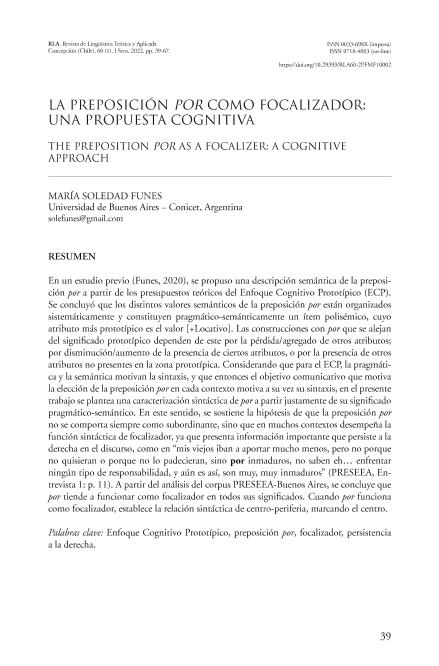
En un estudio previo, propuse una descripción semántica de la preposición por a partir de los presupuestos teóricos del Enfoque Cognitivo Prototípico (ECP). Concluí que los distintos valores semánticos de la preposición por están organizados sistemáticamente y constituyen pragmático-semánticamente un ítem polisémico, cuyo atributo más prototípico es el valor [+Locativo]. Las construcciones con por que se alejan del significado prototípico dependen de este por la pérdida/agregado de otros atributos; por disminución/aumento de la presencia de ciertos atributos, o por la presencia de otros atributos no presentes en la zona prototípica.Considerando que para el ECP, la pragmática y la semántica motivan la sintaxis, y que entonces el objetivo comunicativo que motiva la elección de la preposición por en cada contexto motiva a su vez su sintaxis, en el presente trabajo planteo una caracterización sintáctica de por a partir justamente de su significado pragmático-semántico. En este sentido, sostengo la hipótesis de que la preposición por no se comporta siempre como subordinante, sino que en muchos contextos, desempeña la función sintáctica de focalizador, ya que presenta información importante que persiste a la derecha en el discurso, como en “mis viejos iban a aportar mucho menos, pero no porque no quisieran o porque no lo padecieran, sino por inmaduros, no saben eh… enfrentar ningún tipo de responsabilidad, y aún es así, son muy, muy inmaduros” (PRESEEA, Entrevista 1: p. 11). A partir del análisis del corpus PRESEEA-Buenos Aires, concluyo que por tiende a funcionar como focalizador en todos sus significados. Cuando por funciona como focalizador, establece la relación sintáctica de centro-periferia, marcando el centro. In a previous work, I presented a semantic description of the preposition por based on the theoretical framework of the Prototypical Cognitive Approach (PCA). In this way, I came to the conclusion that the different semantic values of the preposition por are organized systematically and they constitute –in a pragmatic-semantic way– a polysemic item, whose most prototypical attribute is the [+Locative] value. Constructions with por that stray from their prototypical meaning depend on it due to the lack/adding of other attributes; the decrease/increase in the presence of attributes, or the presence of other attributes not included in the prototypical zone. Considering that, to PCT, pragmatics and semantics motivate syntax, and that the communicative objective that motivates the selection of the preposition por in each context at the same time motivates its syntax, in this work, I propose a syntactic characterization of por based on its pragmatic-semantic meaning. In this sense, my hypothesis is that the preposition por does not always work as a subordinating conjunction. In many contexts, it has the syntactic function of a focalizer because it presents important information that persists in subsequent discourse, as can be appreciated in the following example: “mis viejos iban a aportar mucho menos, pero no porque no quisieran o porque no lo padecieran, sino por inmaduros, no saben eh… enfrentar ningún tipo de responsabilidad, y aún es así, son muy, muy inmaduros” (PRESEEA, Entrevista 1: p. 11) [my folks were about to contribute much less, but not because they did not want to or because they did not suffer it, but because they were immature, they don’t know how to... err… face any kind of responsibility, and they are still like that, they are very, very immature]. From the analysis of the PRESEEA-Buenos Aires corpus, I conclude that por tends to function as a focalizer in all its meanings. When por is analyzed as a focalizer, it establishes the syntactic relation of centre-periphery, marking the centre.
La preposición por como focalizador: una propuesta cognitiva
Título:
The preposition por as a focalizer: a cognitive approach

Fecha de publicación:
07/2022
Editorial:
Universidad de Concepción
Revista:
Revista de Lingüística Teórica y Aplicada
ISSN:
0033-698X
Idioma:
Español
Tipo de recurso:
Artículo publicado
Clasificación temática:
Resumen
Archivos asociados

Tamaño:
521.2Kb
Formato:
PDF
Licencia
 Excepto donde se diga explícitamente, este item se publica bajo la siguiente descripción:
Creative Commons Attribution 2.5 Unported (CC BY 2.5)
Excepto donde se diga explícitamente, este item se publica bajo la siguiente descripción:
Creative Commons Attribution 2.5 Unported (CC BY 2.5)
Identificadores
Colecciones
Articulos(SEDE CENTRAL)
Articulos de SEDE CENTRAL
Articulos de SEDE CENTRAL
Citación
Funes, María Soledad; La preposición por como focalizador: una propuesta cognitiva; Universidad de Concepción; Revista de Lingüística Teórica y Aplicada; 60; 1; 7-2022; 39-67
Compartir


Altmétricas