Artículo
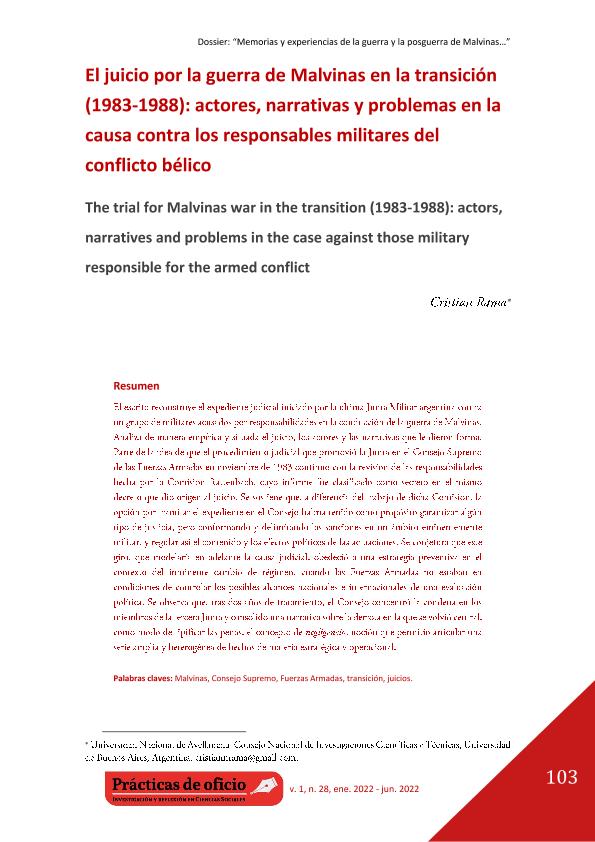
El escrito reconstruye el expediente judicial iniciado por la última Junta Militar argentina contra un grupo de militares acusados por responsabilidades en la conducción de la guerra de Malvinas. Analiza de manera empírica y situada el juicio, los actores y las narrativas que le dieron forma. Parte de la idea de que el procedimiento judicial que promovió la Junta en el Consejo Supremo de las Fuerzas Armadas en noviembre de 1983 continuó con la revisión de las responsabilidades hecha por la Comisión Rattenbach, cuyo informe fue clasificado como secreto en el mismo decreto que dio origen al juicio. Se sostiene que, a diferencia del trabajo de dicha Comisión, la opción por tramitar el expediente en el Consejo habría tenido como propósito garantizar algún tipo de justicia, pero conformando y delimitando las sanciones en un ámbito eminentemente militar, y regular así el contenido y los efectos políticos de las actuaciones. Se conjetura que este giro, que modelaría en adelante la causa judicial, obedeció a una estrategia preventiva en el contexto del inminente cambio de régimen, cuando las Fuerzas Armadas no estaban en condiciones de controlar los posibles alcances nacionales e internacionales de una evaluación política. Se observa que, tras dos años de tratamiento, el Consejo concentró la condena en los miembros de la tercera Junta y consolidó una narrativa sobre la derrota en la que se volvió central, como modo de tipificar las penas, el concepto de negligencia, noción que permitió articular una serie amplia y heterogénea de hechos de materia estratégica y operacional. This paper reconstructs the judicial proceedings initiated by the last Argentine Military Junta against a group of military personnel accused by responsibility in the conduct of the Malvinas war. It analyses, in an empirical and situational way, the trial, the actors and the narratives that shaped it. It starts from the idea that the judicial procedure promoted by the Junta in the Supreme Council in november 1983 continued with the review of responsibilities carried out by the Rattenbach Commission, whose report was classified as secret in the same decree that gave rise to the trial. It is argued that, in contrast to the work of this Commission, the choice to process a judicial file within the Council would have been the purpose of guaranteeing some kind of justice, but conforming and delimiting the sanctions in an eminently military field, thus regulating the content and political effects of the proceedings. It is conjectured that this shift, which would shape the court case, was a preventive strategy in the context of the imminent change of regime, when the Armed Forces were not in a position to control the possible national and international scope of a political evaluation. It is observed that, after two years of treatment, the Council concentrated the condemnation on the members of the third Junta and consolidated a narrative of defeat in which the concept of negligence became central as a way of typifying the penalties, a notion that made it possible to articulate a wide and heterogeneous series of strategic and operational developments.
El juicio por la guerra de Malvinas en la transición (1983-1988): Actores, narrativas y problemas en la causa contra los responsables militares del conflicto bélico
Título:
The trial for Malvinas war in the transition (1983-1988): Actors, narratives and problems in the case against those military responsible for the armed conflict

Fecha de publicación:
07/2022
Editorial:
Universidad Nacional de General Sarmiento. Programa de Posgrado en Ciencias Sociales; Instituto de Desarrollo Económico y Social
Revista:
Prácticas de oficio
ISSN:
1851-6076
Idioma:
Español
Tipo de recurso:
Artículo publicado
Clasificación temática:
Resumen
Palabras clave:
MALVINAS
,
CONSEJO SUPREMO
,
FUERZAS ARMADAS
,
TRANSICIÓN
Archivos asociados

Tamaño:
6.035Mb
Formato:
PDF
Licencia
 Excepto donde se diga explícitamente, este item se publica bajo la siguiente descripción:
Atribución-NoComercial-SinDerivadas 2.5 Argentina (CC BY-NC-ND 2.5 AR)
Excepto donde se diga explícitamente, este item se publica bajo la siguiente descripción:
Atribución-NoComercial-SinDerivadas 2.5 Argentina (CC BY-NC-ND 2.5 AR)
Identificadores
Colecciones
Articulos(SEDE CENTRAL)
Articulos de SEDE CENTRAL
Articulos de SEDE CENTRAL
Citación
Rama, Cristian Nahuel; El juicio por la guerra de Malvinas en la transición (1983-1988): Actores, narrativas y problemas en la causa contra los responsables militares del conflicto bélico; Universidad Nacional de General Sarmiento. Programa de Posgrado en Ciencias Sociales; Instituto de Desarrollo Económico y Social; Prácticas de oficio; 1; 28; 7-2022; 103-121
Compartir

