Artículo
Caveolae couple mechanical stress to integrin recycling and activation
Lolo, Fidel Nicolás; Pavón, Dácil M.; Grande García, Araceli; Elósegui Artola, Alberto; Segatori, Valeria Inés ; Sánchez Perales, Sara; Trepat, Xavier; Roca Cusachs, Pere; Del Pozo, Miguel A.
; Sánchez Perales, Sara; Trepat, Xavier; Roca Cusachs, Pere; Del Pozo, Miguel A.
Fecha de publicación:
10/2022
Editorial:
eLife Sciences Publications
Revista:
eLife
ISSN:
2050-084X
Idioma:
Inglés
Tipo de recurso:
Artículo publicado
Clasificación temática:
Resumen
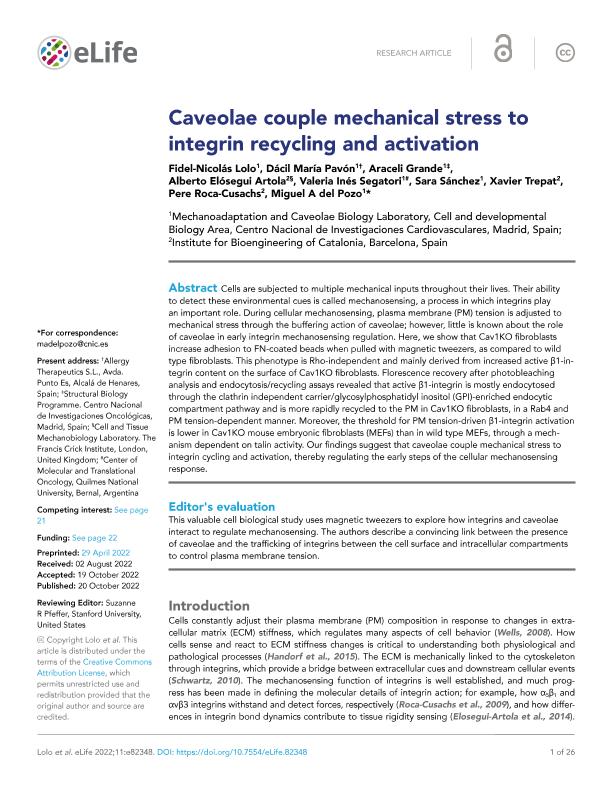
Cells are subjected to multiple mechanical inputs throughout their lives. Their ability to detect these environmental cues is called mechanosensing, a process in which integrins play an important role. During cellular mechanosensing, plasma membrane (PM) tension is adjusted to mechanical stress through the buffering action of caveolae; however, little is known about the role of caveolae in early integrin mechanosensing regulation. Here, we show that Cav1KO fibroblasts increase adhesion to FN-coated beads when pulled with magnetic tweezers, as compared to wild type fibroblasts. This phenotype is Rho-independent and mainly derived from increased active β1-integrin content on the surface of Cav1KO fibroblasts. FRAP analysis and endocytosis/recycling assays revealed that active β1-integrin is mostly endocytosed through the CLIC/GEEC pathway and is more rapidly recycled to the PM in Cav1KO fibroblasts, in a Rab4 and PM tension-dependent manner. Moreover, the threshold for PM tension-driven β1-integrin activation is lower in Cav1KO MEFs than in wild type MEFs, through a mechanism dependent on talin activity. Our findings suggest that caveolae couple mechanical stress to integrin cycling and activation, thereby regulating the early steps of the cellular mechanosensing response.
Palabras clave:
CAVEOLAE
,
INTEGRIN
,
MECHANICAL STRESS
Archivos asociados

Tamaño:
7.817Mb
Formato:
PDF
Licencia
 Excepto donde se diga explícitamente, este item se publica bajo la siguiente descripción:
Creative Commons Attribution 2.5 Unported (CC BY 2.5)
Excepto donde se diga explícitamente, este item se publica bajo la siguiente descripción:
Creative Commons Attribution 2.5 Unported (CC BY 2.5)
Identificadores
Colecciones
Articulos(SEDE CENTRAL)
Articulos de SEDE CENTRAL
Articulos de SEDE CENTRAL
Citación
Lolo, Fidel Nicolás; Pavón, Dácil M.; Grande García, Araceli; Elósegui Artola, Alberto; Segatori, Valeria Inés; et al.; Caveolae couple mechanical stress to integrin recycling and activation; eLife Sciences Publications; eLife; 11; 10-2022; 1-26
Compartir


Altmétricas