Artículo
Molecular Detection and Differentiation of Arthropod, Fungal, Protozoan, Bacterial and Viral Pathogens of Honeybees
Lannutti, Lucas ; Gonzales, Fernanda Noemi; Dus Santos, Maria Jose
; Florin Christensen, Mónica; Schnittger, Leonhard
; Gonzales, Fernanda Noemi; Dus Santos, Maria Jose
; Florin Christensen, Mónica; Schnittger, Leonhard
; Gonzales, Fernanda Noemi; Dus Santos, Maria Jose
; Florin Christensen, Mónica; Schnittger, Leonhard
Fecha de publicación:
05/2022
Editorial:
MDPI
Revista:
Veterinary Sciences
ISSN:
2306-7381
Idioma:
Inglés
Tipo de recurso:
Artículo publicado
Clasificación temática:
Resumen
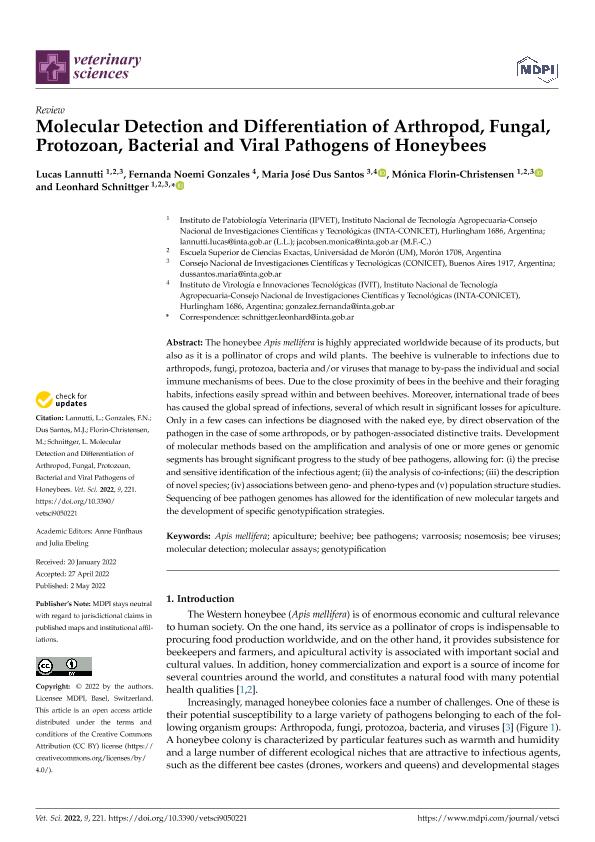
The honeybee Apis mellifera is highly appreciated worldwide because of its products, but also as it is a pollinator of crops and wild plants. The beehive is vulnerable to infections due to arthropods, fungi, protozoa, bacteria and/or viruses that manage to by-pass the individual and social immune mechanisms of bees. Due to the close proximity of bees in the beehive and their foraging habits, infections easily spread within and between beehives. Moreover, international trade of bees has caused the global spread of infections, several of which result in significant losses for apiculture. Only in a few cases can infections be diagnosed with the naked eye, by direct observation of the pathogen in the case of some arthropods, or by pathogen-associated distinctive traits. Development of molecular methods based on the amplification and analysis of one or more genes or genomic segments has brought significant progress to the study of bee pathogens, allowing for: (i) the precise and sensitive identification of the infectious agent; (ii) the analysis of co-infections; (iii) the description of novel species; (iv) associations between geno- and pheno-types and (v) population structure studies. Sequencing of bee pathogen genomes has allowed for the identification of new molecular targets and the development of specific genotypification strategies.
Archivos asociados

Tamaño:
1.526Mb
Formato:
PDF
Licencia
 Excepto donde se diga explícitamente, este item se publica bajo la siguiente descripción:
Creative Commons Attribution 2.5 Unported (CC BY 2.5)
Excepto donde se diga explícitamente, este item se publica bajo la siguiente descripción:
Creative Commons Attribution 2.5 Unported (CC BY 2.5)
Identificadores
Colecciones
Articulos (IPVET)
Articulos de INSTITUTO DE PATOBIOLOGIA VETERINARIA
Articulos de INSTITUTO DE PATOBIOLOGIA VETERINARIA
Articulos(SEDE CENTRAL)
Articulos de SEDE CENTRAL
Articulos de SEDE CENTRAL
Citación
Lannutti, Lucas; Gonzales, Fernanda Noemi; Dus Santos, Maria Jose; Florin Christensen, Mónica; Schnittger, Leonhard; Molecular Detection and Differentiation of Arthropod, Fungal, Protozoan, Bacterial and Viral Pathogens of Honeybees; MDPI; Veterinary Sciences; 9; 5; 5-2022; 1-52
Compartir


Altmétricas