Artículo
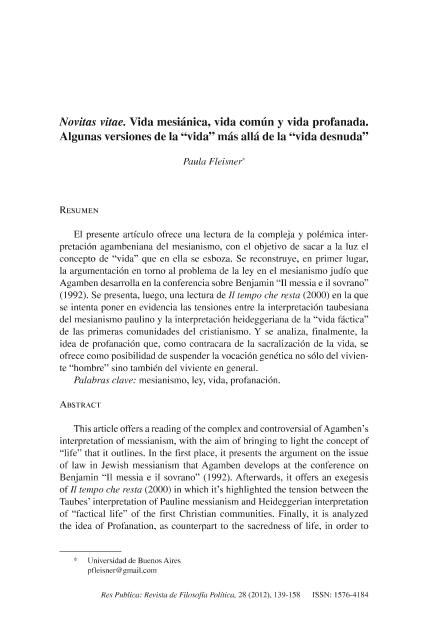
El presente artículo ofrece una lectura de la compleja y polémica interpretación agambeniana del mesianismo, con el objetivo de sacar a la luz el concepto de “vida” que en ella se esboza. Se reconstruye, en primer lugar, la argumentación en torno al problema de la ley en el mesianismo judío que Agamben desarrolla en la conferencia sobre Benjamin “Il messia e il sovrano” (1992). Se presenta, luego, una lectura de Il tempo che resta (2000) en la que se intenta poner en evidencia las tensiones entre la interpretación taubesiana del mesianismo paulino y la interpretación heideggeriana de la “vida fáctica” de las primeras comunidades del cristianismo. Y se analiza, finalmente, la idea de profanación que, como contracara de la sacralización de la vida, se ofrece como posibilidad de suspender la vocación genética no sólo del viviente “hombre” sino también del viviente en general. This article offers a reading of the complex and controversial of Agamben’s interpretation of messianism, with the aim of bringing to light the concept of “life” that it outlines. In the first place, it presents the argument on the issue of law in Jewish messianism that Agamben develops at the conference on Benjamin “Il messia e il sovrano” (1992). Afterwards, it offers an exegesis of Il tempo che resta (2000) in which it’s highlighted the tension between the Taubes’ interpretation of Pauline messianism and Heideggerian interpretation of “factical life” of the first Christian communities. Finally, it is analyzed the idea of Profanation, as counterpart to the sacredness of life, in order to consider it as a possibility to suspend the genetic vocation not only the living “man” but also of living in general.
Novitas vitae: Vida mesiánica, vida común y vida profanada. Algunas versiones de la “vida” más allá de la “vida desnuda”

Fecha de publicación:
12/2012
Editorial:
Universidad de Murcia
Revista:
Res Publica
ISSN:
1576-4184
e-ISSN:
1989-6115
Idioma:
Español
Tipo de recurso:
Artículo publicado
Clasificación temática:
Resumen
Palabras clave:
MESIANISMO
,
LEY
,
VIDA
,
PROFANACIÓN
Archivos asociados

Tamaño:
134.5Kb
Formato:
PDF
Licencia
 Excepto donde se diga explícitamente, este item se publica bajo la siguiente descripción:
Creative Commons Attribution 2.5 Unported (CC BY 2.5)
Excepto donde se diga explícitamente, este item se publica bajo la siguiente descripción:
Creative Commons Attribution 2.5 Unported (CC BY 2.5)
Identificadores
Colecciones
Articulos(SEDE CENTRAL)
Articulos de SEDE CENTRAL
Articulos de SEDE CENTRAL
Citación
Fleisner, Paula; Novitas vitae: Vida mesiánica, vida común y vida profanada. Algunas versiones de la “vida” más allá de la “vida desnuda”; Universidad de Murcia; Res Publica; 28; 12-2012; 139-158
Compartir

