Artículo
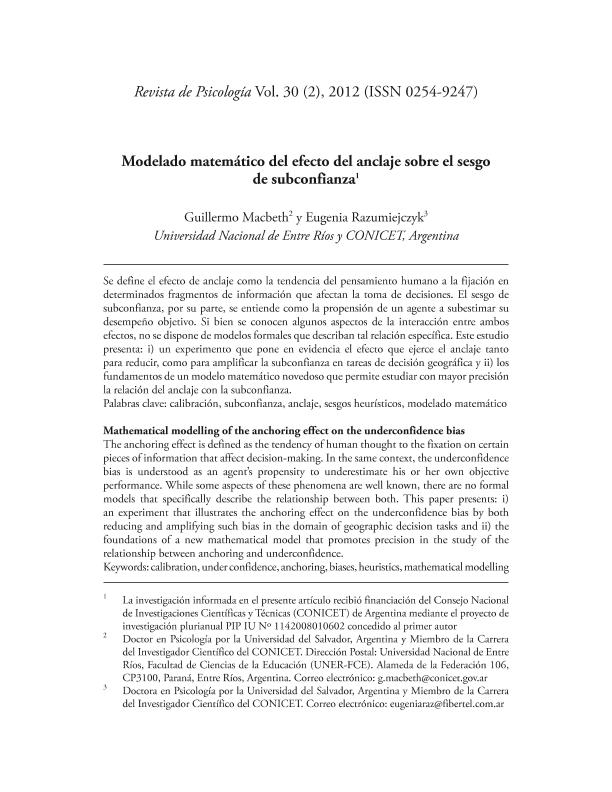
Se define el efecto de anclaje como la tendencia del pensamiento humano a la fijación en determinados fragmentos de información que afectan la toma de decisiones. El sesgo de subconfianza, por su parte, se entiende como la propensión de un agente a subestimar su desempeño objetivo. Si bien se conocen algunos aspectos de la interacción entre ambos efectos, no se dispone de modelos formales que describan tal relación específica. Este estudio presenta: i) un experimento que pone en evidencia el efecto que ejerce el anclaje tanto para reducir, como para amplificar la subconfianza en tareas de decisión geográfica y, ii) los fundamentos de un modelo matemático novedoso que permite estudiar con mayor precisión la relación del anclaje con la subconfianza. The anchoring effect is defined as the tendency of human thought to the fixation on certain pieces of information that affect decision-making. In the same context, the underconfidence bias is understood as an agent’s propensity to underestimate his or her own objective performance. While some aspects of these phenomena are well known, there are no formal models that specifically describe the relationship between both. This paper presents: i) an experiment that illustrates the anchoring effect on the underconfidence bias by both reducing and amplifying such bias in the domain of geographic decision tasks and ii) the foundations of a new mathematical model that promotes precision in the study of the relationship between anchoring and underconfidence.
Modelado matemático del efecto del anclaje sobre el sesgo de subconfianza
Título:
Mathematical modelling of the anchoring effect on the underconfidence bias

Fecha de publicación:
12/2012
Editorial:
Pontificia Universidad Católica del Perú
Revista:
Revista de Psicología
ISSN:
0254-9247
Idioma:
Español
Tipo de recurso:
Artículo publicado
Clasificación temática:
Resumen
Palabras clave:
CALIBRACIÓN
,
SUBCONFIANZA
,
ANCLAJE
,
SESGOS
,
HEURÍSTICOS
,
MODELADO
Archivos asociados

Tamaño:
202.9Kb
Formato:
PDF
Licencia
 Excepto donde se diga explícitamente, este item se publica bajo la siguiente descripción:
Creative Commons Attribution-NonCommercial-ShareAlike 2.5 Unported (CC BY-NC-SA 2.5)
Excepto donde se diga explícitamente, este item se publica bajo la siguiente descripción:
Creative Commons Attribution-NonCommercial-ShareAlike 2.5 Unported (CC BY-NC-SA 2.5)
Identificadores
Colecciones
Articulos(SEDE CENTRAL)
Articulos de SEDE CENTRAL
Articulos de SEDE CENTRAL
Citación
Macbeth, Guillermo Eduardo; Razumiejczyk, Eugenia; Modelado matemático del efecto del anclaje sobre el sesgo de subconfianza; Pontificia Universidad Católica del Perú; Revista de Psicología; 30; 2; 12-2012; 223-248
Compartir

