Artículo
Ultra-sensitive electrochemical immunosensor using analyte peptidomimetics selected from phage display peptide libraries
Arevalo, Fernando Javier ; González Techera, Andrés; Zon, María Alicia
; González Sapienza, Gualberto; Fernández, Héctor
; González Techera, Andrés; Zon, María Alicia
; González Sapienza, Gualberto; Fernández, Héctor
; González Techera, Andrés; Zon, María Alicia
; González Sapienza, Gualberto; Fernández, Héctor
Fecha de publicación:
02/2012
Editorial:
Elsevier Advanced Technology
Revista:
Biosensors & Bioelectronics
ISSN:
0956-5663
Idioma:
Inglés
Tipo de recurso:
Artículo publicado
Clasificación temática:
Resumen
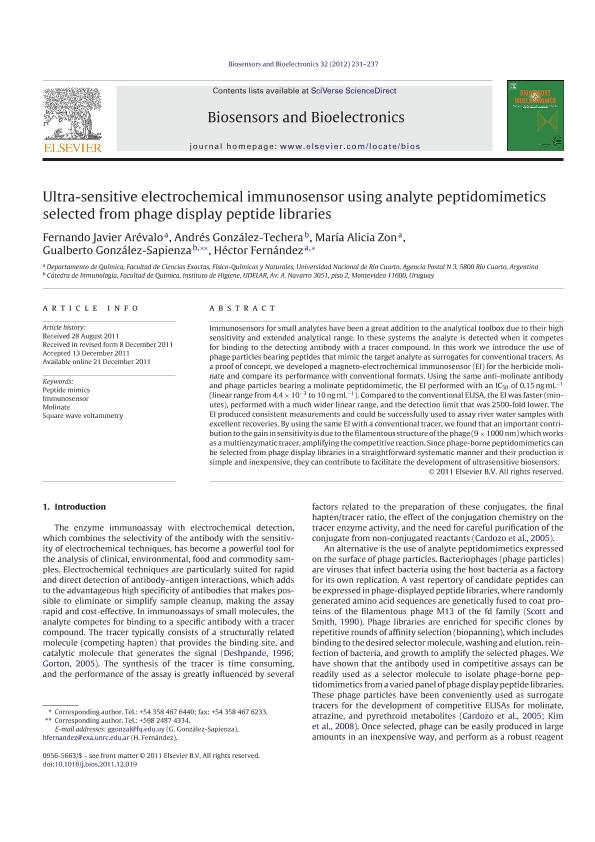
Immunosensors for small analytes have been a great addition to the analytical toolbox due to their high sensitivity and extended analytical range. In these systems the analyte is detected when it competes for binding to the detecting antibody with a tracer compound. In this work we introduce the use of phage particles bearing peptides that mimic the target analyte as surrogates for conventional tracers. As a proof of concept, we developed a magneto-electrochemical immunosensor (EI) for the herbicide molinate and compare its performance with conventional formats. Using the same anti-molinate antibody and phage particles bearing a molinate peptidomimetic, the EI performed with an IC 50 of 0.15ngmL -1 (linear range from 4.4×10 -3 to 10ngmL -1). Compared to the conventional ELISA, the EI was faster (minutes), performed with a much wider linear range, and the detection limit that was 2500-fold lower. The EI produced consistent measurements and could be successfully used to assay river water samples with excellent recoveries. By using the same EI with a conventional tracer, we found that an important contribution to the gain in sensitivity is due to the filamentous structure of the phage (9×1000nm) which works as a multienzymatic tracer, amplifying the competitive reaction. Since phage-borne peptidomimetics can be selected from phage display libraries in a straightforward systematic manner and their production is simple and inexpensive, they can contribute to facilitate the development of ultrasensitive biosensors.
Palabras clave:
IMMUNOSENSOR
,
MOLINATE
,
PEPTIDE MIMICS
,
SQUARE WAVE VOLTAMMETRY
Archivos asociados

Tamaño:
359.2Kb
Formato:
PDF
Licencia
 Excepto donde se diga explícitamente, este item se publica bajo la siguiente descripción:
Creative Commons Attribution-NonCommercial-ShareAlike 2.5 Unported (CC BY-NC-SA 2.5)
Excepto donde se diga explícitamente, este item se publica bajo la siguiente descripción:
Creative Commons Attribution-NonCommercial-ShareAlike 2.5 Unported (CC BY-NC-SA 2.5)
Identificadores
Colecciones
Articulos(CCT - CORDOBA)
Articulos de CTRO.CIENTIFICO TECNOL.CONICET - CORDOBA
Articulos de CTRO.CIENTIFICO TECNOL.CONICET - CORDOBA
Citación
Arevalo, Fernando Javier; González Techera, Andrés; Zon, María Alicia; González Sapienza, Gualberto; Fernández, Héctor; Ultra-sensitive electrochemical immunosensor using analyte peptidomimetics selected from phage display peptide libraries; Elsevier Advanced Technology; Biosensors & Bioelectronics; 32; 1; 2-2012; 231-237
Compartir


Altmétricas