Mostrar el registro sencillo del ítem
dc.contributor.author
Heidari, Azad
dc.contributor.author
Watkins, David
dc.contributor.author
Mayer, Alex
dc.contributor.author
Propato, Tamara Sofía
dc.contributor.author
Verón, Santiago Ramón
dc.contributor.author
de Abelleyra, Diego
dc.date.available
2023-05-18T18:09:01Z
dc.date.issued
2021-05
dc.identifier.citation
Heidari, Azad; Watkins, David; Mayer, Alex; Propato, Tamara Sofía; Verón, Santiago Ramón; et al.; Spatially variable hydrologic impact and biomass production tradeoffs associated with Eucalyptus (E. grandis) cultivation for biofuel production in Entre Rios, Argentina; Blackwell Publishing; GCB Bioenergy; 13; 5; 5-2021; 823-837
dc.identifier.issn
1757-1693
dc.identifier.uri
http://hdl.handle.net/11336/198060
dc.description.abstract
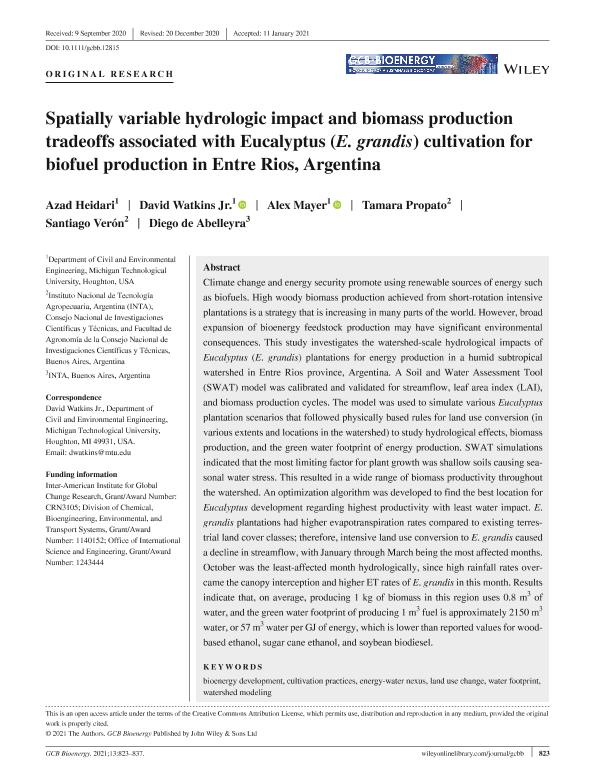
Climate change and energy security promote using renewable sources of energy such as biofuels. High woody biomass production achieved from short-rotation intensive plantations is a strategy that is increasing in many parts of the world. However, broad expansion of bioenergy feedstock production may have significant environmental consequences. This study investigates the watershed-scale hydrological impacts of Eucalyptus (E. grandis) plantations for energy production in a humid subtropical watershed in Entre Rios province, Argentina. A Soil and Water Assessment Tool (SWAT) model was calibrated and validated for streamflow, leaf area index (LAI), and biomass production cycles. The model was used to simulate various Eucalyptus plantation scenarios that followed physically based rules for land use conversion (in various extents and locations in the watershed) to study hydrological effects, biomass production, and the green water footprint of energy production. SWAT simulations indicated that the most limiting factor for plant growth was shallow soils causing seasonal water stress. This resulted in a wide range of biomass productivity throughout the watershed. An optimization algorithm was developed to find the best location for Eucalyptus development regarding highest productivity with least water impact. E. grandis plantations had higher evapotranspiration rates compared to existing terrestrial land cover classes; therefore, intensive land use conversion to E. grandis caused a decline in streamflow, with January through March being the most affected months. October was the least-affected month hydrologically, since high rainfall rates overcame the canopy interception and higher ET rates of E. grandis in this month. Results indicate that, on average, producing 1 kg of biomass in this region uses 0.8 m3 of water, and the green water footprint of producing 1 m3 fuel is approximately 2150 m3 water, or 57 m3 water per GJ of energy, which is lower than reported values for wood-based ethanol, sugar cane ethanol, and soybean biodiesel.
dc.format
application/pdf
dc.language.iso
eng
dc.publisher
Blackwell Publishing
dc.rights
info:eu-repo/semantics/openAccess
dc.rights.uri
https://creativecommons.org/licenses/by/2.5/ar/
dc.subject
BIOENERGY DEVELOPMENT
dc.subject
CULTIVATION PRACTICES
dc.subject
ENERGY-WATER NEXUS
dc.subject
LAND USE CHANGE
dc.subject
WATER FOOTPRINT
dc.subject
WATERSHED MODELING
dc.subject.classification
Otras Ciencias de la Tierra y relacionadas con el Medio Ambiente
dc.subject.classification
Ciencias de la Tierra y relacionadas con el Medio Ambiente
dc.subject.classification
CIENCIAS NATURALES Y EXACTAS
dc.title
Spatially variable hydrologic impact and biomass production tradeoffs associated with Eucalyptus (E. grandis) cultivation for biofuel production in Entre Rios, Argentina
dc.type
info:eu-repo/semantics/article
dc.type
info:ar-repo/semantics/artículo
dc.type
info:eu-repo/semantics/publishedVersion
dc.date.updated
2023-05-18T16:27:49Z
dc.identifier.eissn
1757-1707
dc.journal.volume
13
dc.journal.number
5
dc.journal.pagination
823-837
dc.journal.pais
Estados Unidos
dc.description.fil
Fil: Heidari, Azad. Michigan Technological University; Estados Unidos
dc.description.fil
Fil: Watkins, David. Michigan Technological University; Estados Unidos
dc.description.fil
Fil: Mayer, Alex. Michigan Technological University; Estados Unidos
dc.description.fil
Fil: Propato, Tamara Sofía. Consejo Nacional de Investigaciones Científicas y Técnicas; Argentina. Instituto Nacional de Tecnología Agropecuaria; Argentina
dc.description.fil
Fil: Verón, Santiago Ramón. Instituto Nacional de Tecnología Agropecuaria; Argentina. Consejo Nacional de Investigaciones Científicas y Técnicas; Argentina
dc.description.fil
Fil: de Abelleyra, Diego. Instituto Nacional de Tecnología Agropecuaria; Argentina
dc.journal.title
GCB Bioenergy
dc.relation.alternativeid
info:eu-repo/semantics/altIdentifier/doi/http://dx.doi.org/10.1111/gcbb.12815
Archivos asociados

Tamaño:
941.1Kb
Formato:
PDF