Artículo
Developmental thermal plasticity among Drosophila melanogaster populations

Fecha de publicación:
03/2014
Editorial:
Wiley
Revista:
Journal Of Evolutionary Biology
ISSN:
1010-061X
Idioma:
Inglés
Tipo de recurso:
Artículo publicado
Clasificación temática:
Resumen
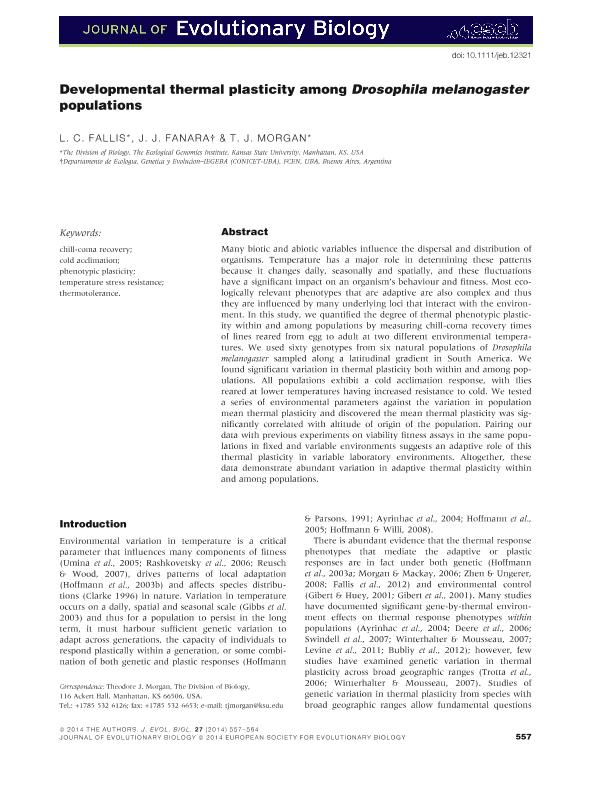
Many biotic and abiotic variables influence the dispersal and distribution of organisms. Temperature has a major role in determining these patterns because it changes daily, seasonally and spatially, and these fluctuations have a significant impact on an organism's behaviour and fitness. Most ecologically relevant phenotypes that are adaptive are also complex and thus they are influenced by many underlying loci that interact with the environment. In this study, we quantified the degree of thermal phenotypic plasticity within and among populations by measuring chill-coma recovery times of lines reared from egg to adult at two different environmental temperatures. We used sixty genotypes from six natural populations of Drosophila melanogaster sampled along a latitudinal gradient in South America. We found significant variation in thermal plasticity both within and among populations. All populations exhibit a cold acclimation response, with flies reared at lower temperatures having increased resistance to cold. We tested a series of environmental parameters against the variation in population mean thermal plasticity and discovered the mean thermal plasticity was significantly correlated with altitude of origin of the population. Pairing our data with previous experiments on viability fitness assays in the same populations in fixed and variable environments suggests an adaptive role of this thermal plasticity in variable laboratory environments. Altogether, these data demonstrate abundant variation in adaptive thermal plasticity within and among populations.
Palabras clave:
Phenotypic Plasticity
,
Chill-Coma Recovery
,
Thermotolerance
,
Adaptation
Archivos asociados

Tamaño:
414.3Kb
Formato:
PDF
Licencia
 Excepto donde se diga explícitamente, este item se publica bajo la siguiente descripción:
Creative Commons Attribution-NonCommercial-ShareAlike 2.5 Unported (CC BY-NC-SA 2.5)
Excepto donde se diga explícitamente, este item se publica bajo la siguiente descripción:
Creative Commons Attribution-NonCommercial-ShareAlike 2.5 Unported (CC BY-NC-SA 2.5)
Identificadores
Colecciones
Articulos(IEGEBA)
Articulos de INSTITUTO DE ECOLOGIA, GENETICA Y EVOLUCION DE BS. AS
Articulos de INSTITUTO DE ECOLOGIA, GENETICA Y EVOLUCION DE BS. AS
Citación
Fallis, L. C.; Fanara, Juan Jose; Morgan, T. J.; Developmental thermal plasticity among Drosophila melanogaster populations; Wiley; Journal Of Evolutionary Biology; 27; 3; 3-2014; 557-564
Compartir


Altmétricas