Artículo
Emerging analgesic drugs for Parkinson's disease
Perez Lloret, Santiago ; Rey, María Verónica; Dellapina, Estelle; Pellaprat, Jean; Brefel Courbon, Christine; Rascol, Olivier
; Rey, María Verónica; Dellapina, Estelle; Pellaprat, Jean; Brefel Courbon, Christine; Rascol, Olivier
Fecha de publicación:
06/2012
Editorial:
Informa Healthcare
Revista:
Expert Opinion on Emerging Drugs
ISSN:
1472-8214
Idioma:
Inglés
Tipo de recurso:
Artículo publicado
Clasificación temática:
Resumen
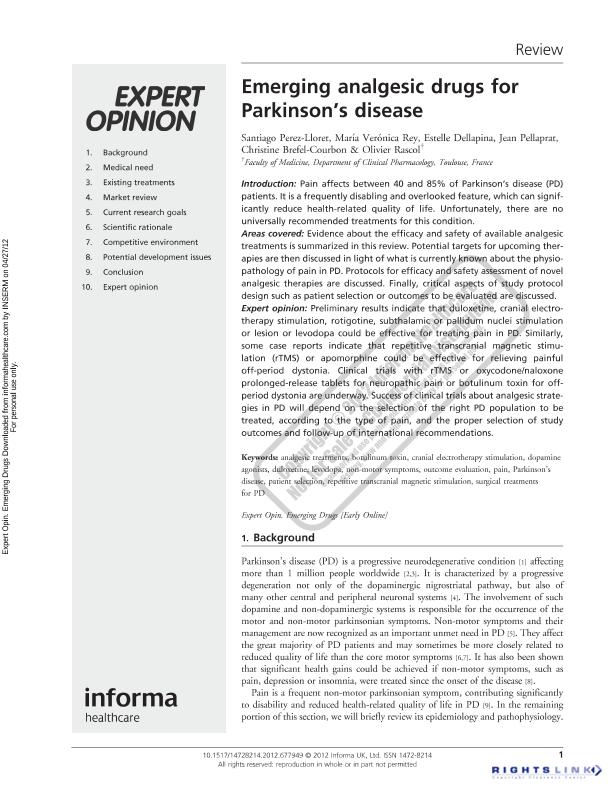
Introduction: Pain affects between 40 and 85% of Parkinson's disease (PD) patients. It is a frequently disabling and overlooked feature, which can significantly reduce health-related quality of life. Unfortunately, there are no universally recommended treatments for this condition. Areas covered: Evidence about the efficacy and safety of available analgesic treatments is summarized in this review. Potential targets for upcoming therapies are then discussed in light of what is currently known about the physiopathology of pain in PD. Protocols for efficacy and safety assessment of novel analgesic therapies are discussed. Finally, critical aspects of study protocol design such as patient selection or outcomes to be evaluated are discussed. Expert opinion: Preliminary results indicate that duloxetine, cranial electrotherapy stimulation, rotigotine, subthalamic or pallidum nuclei stimulation or lesion or levodopa could be effective for treating pain in PD. Similarly, some case reports indicate that repetitive transcranial magnetic stimulation (rTMS) or apomorphine could be effective for relieving painful off-period dystonia. Clinical trials with rTMS or oxycodone/naloxone prolonged-release tablets for neuropathic pain or botulinum toxin for off-period dystonia are underway. Success of clinical trials about analgesic strategies in PD will depend on the selection of the right PD population to be treated, according to the type of pain, and the proper selection of study outcomes and follow-up of international recommendations.
Palabras clave:
ANALGESIC TREATMENTS
,
BOTULINUM TOXIN
,
CRANIAL ELECTROTHERAPY STIMULATION
,
DOPAMINE AGONISTS
,
DULOXETINE
,
LEVODOPA
,
NON-MOTOR SYMPTOMS
,
OUTCOME EVALUATION
,
PAIN
,
PARKINSON'S DISEASE
,
PATIENT SELECTION
,
REPETITIVE TRANSCRANIAL MAGNETIC STIMULATION
,
SURGICAL TREATMENTS FOR PD
Archivos asociados

Tamaño:
329.1Kb
Formato:
PDF
Licencia
 Excepto donde se diga explícitamente, este item se publica bajo la siguiente descripción:
Creative Commons Attribution-NonCommercial-ShareAlike 2.5 Unported (CC BY-NC-SA 2.5)
Excepto donde se diga explícitamente, este item se publica bajo la siguiente descripción:
Creative Commons Attribution-NonCommercial-ShareAlike 2.5 Unported (CC BY-NC-SA 2.5)
Identificadores
Colecciones
Articulos(SEDE CENTRAL)
Articulos de SEDE CENTRAL
Articulos de SEDE CENTRAL
Citación
Perez Lloret, Santiago; Rey, María Verónica; Dellapina, Estelle; Pellaprat, Jean; Brefel Courbon, Christine; et al.; Emerging analgesic drugs for Parkinson's disease; Informa Healthcare; Expert Opinion on Emerging Drugs; 17; 2; 6-2012; 1-15
Compartir


Altmétricas