Artículo
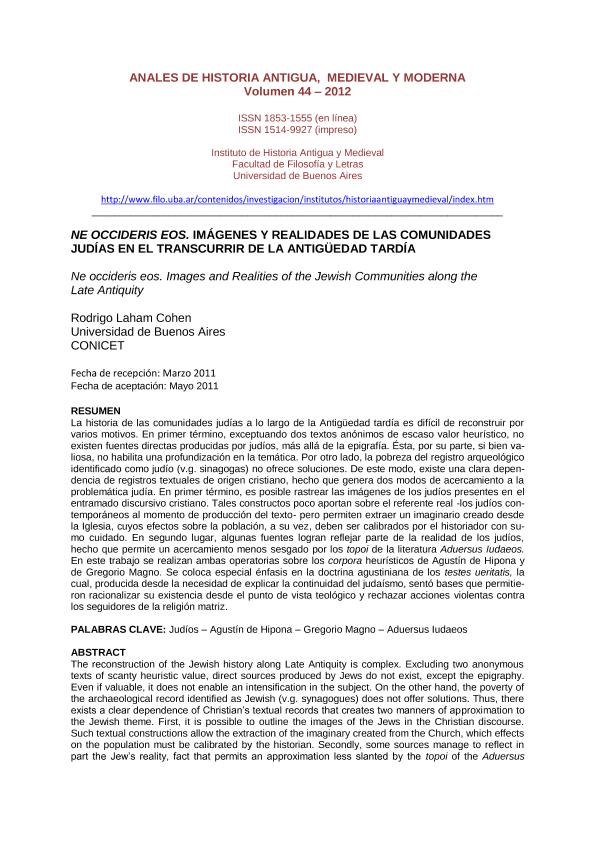
La historia de las comunidades judías a lo largo de la Antigüedad tardía es difícil de reconstruir por varios motivos. En primer término, exceptuando dos textos anónimos de escaso valor heurístico, no existen fuentes directas producidas por judíos, más allá de la epigrafía. Ésta, por su parte, si bien valiosa, no habilita una profundización en la temática. Por otro lado, la pobreza del registro arqueológico identificado como judío (v.g. sinagogas) no ofrece soluciones. De este modo, existe una clara dependencia de registros textuales de origen cristiano, hecho que genera dos modos de acercamiento a la problemática judía. En primer término, es posible rastrear las imágenes de los judíos presentes en el entramado discursivo cristiano. Tales constructos poco aportan sobre el referente real -los judíos contemporáneos al momento de producción del texto- pero permiten extraer un imaginario creado desde la Iglesia, cuyos efectos sobre la población, a su vez, deben ser calibrados por el historiador con sumo cuidado. En segundo lugar, algunas fuentes logran reflejar parte de la realidad de los judíos, hecho que permite un acercamiento menos sesgado por los topoi de la literatura Aduersus Iudaeos. En este trabajo se realizan ambas operatorias sobre los corpora heurísticos de Agustín de Hipona y de Gregorio Magno. Se coloca especial énfasis en la doctrina agustiniana de los testes ueritatis, la cual, producida desde la necesidad de explicar la continuidad del judaísmo, sentó bases que permitieron racionalizar su existencia desde el punto de vista teológico y rechazar acciones violentas contra los seguidores de la religión matriz. The reconstruction of the Jewish history along Late Antiquity is complex. Excluding two anonymous texts of scanty heuristic value, direct sources produced by Jews do not exist, except the epigraphy. Even if valuable, it does not enable an intensification in the subject. On the other hand, the poverty of the archaeological record identified as Jewish (v.g. synagogues) does not offer solutions. Thus, there exists a clear dependence of Christian’s textual records that creates two manners of approximation to the Jewish theme. First, it is possible to outline the images of the Jews in the Christian discourse. Such textual constructions allow the extraction of the imaginary created from the Church, which effects on the population must be calibrated by the historian. Secondly, some sources manage to reflect in part the Jew’s reality, fact that permits an approximation less slanted by the topoi of the Aduersus Iudaeos literature. In this work both actions are realized on the heuristic corpora of Agustín de Hipona and Gregorio Magno. We place special emphasis in the Augustinian doctrine of the testes ueritatis which sat the bases that allowed to rationalize the existence of Jewish communities from the theological point of view and also to reject violent actions against the followers of the Jewish religion.
Ne occideris eos: imágenes y realidades de las comunidades judías en el transcurrir de la Antigüedad Tardía
Título:
Ne occideris eos: images and Realities of the Jewish Communities along the Late Antiquity

Fecha de publicación:
06/2012
Editorial:
Universidad de Buenos Aires. Facultad de Filosofía y Letras
Revista:
Anales de Historia Antigua, Medieval y Moderna
ISSN:
1514-9927
Idioma:
Español
Tipo de recurso:
Artículo publicado
Clasificación temática:
Resumen
Palabras clave:
AGUSTÍN
,
ANTIJUDAÍSMO
,
CRISTIANISMO
,
JUDAÍSMO
Archivos asociados

Tamaño:
450.1Kb
Formato:
PDF
Licencia
 Excepto donde se diga explícitamente, este item se publica bajo la siguiente descripción:
Creative Commons Attribution-ShareAlike 2.5 Unported (CC BY-SA 2.5)
Excepto donde se diga explícitamente, este item se publica bajo la siguiente descripción:
Creative Commons Attribution-ShareAlike 2.5 Unported (CC BY-SA 2.5)
Identificadores
Colecciones
Articulos(SEDE CENTRAL)
Articulos de SEDE CENTRAL
Articulos de SEDE CENTRAL
Citación
Laham Cohen, Rodrigo Jaime; Ne occideris eos: imágenes y realidades de las comunidades judías en el transcurrir de la Antigüedad Tardía; Universidad de Buenos Aires. Facultad de Filosofía y Letras; Anales de Historia Antigua, Medieval y Moderna; 44; 6-2012; 1-18
Compartir

