Artículo
El presente artículo muestra los cambios en la fenomenología del tiempo y la filosofía de la historia entre Tiempo y narración y La memoria, la historia, el olvido. En la primera obra, se aceptaba la cesura entre tiempo de la vida y tiempo del mundo y se recurría a la huella para conectarlos. La segunda obra abandona el concepto heideggeriano del ser-para-la-muerte, haciendo desaparecer la brecha entre ambos tiempos. Con respecto a la historia, mientras Tiempo y narración defiende la existencia de un vínculo causal entre la huella y el pasado, la otra obra lo rechaza, pasando de una concepción continuista de la historia a otra discontinuista. s paper shows the changes in the phenomenology of time and the philosophy of history between Time and Narrative and Memory, History, Oblivion. In the first work, the gap between life´s time and world´s time is accepted and ‘trace’ was used to connect them. The later work leaves the Heidegger’s concept of being-towards-death aside, allowing the disappearance of the gap between both kinds of time. With respect to history, while Time and Narrative defends the existence of a causal link between the trace and the past, the other work rejects it, which makes Ricoeur to abandon a continuity conception of history to another discontinuist one.
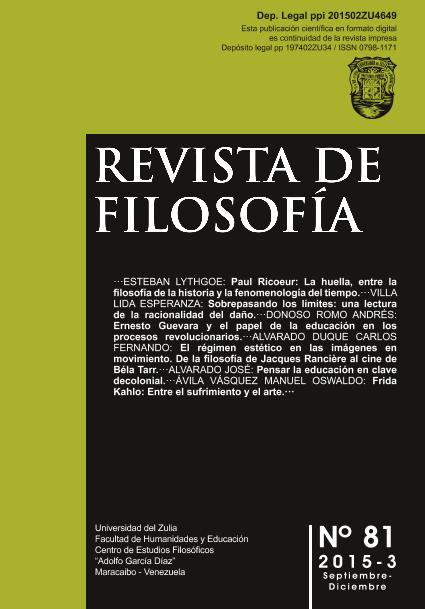
Paul Ricoeur: La huella, entre la filosofía de la historia y la fenomenologia del tiempo
Título:
Paul Ricoeur: The trace, between philosophy of history and phenomenology of time

Fecha de publicación:
08/2015
Editorial:
Universidad del Zulia
Revista:
Revista de filosofía
e-ISSN:
0798-1171
Idioma:
Español
Tipo de recurso:
Artículo publicado
Clasificación temática:
Resumen
Palabras clave:
deuda
,
representación
,
continuismo
,
discontinuismo
Archivos asociados

Tamaño:
699.3Kb
Formato:
PDF
Licencia
 Excepto donde se diga explícitamente, este item se publica bajo la siguiente descripción:
Creative Commons Attribution-NonCommercial-ShareAlike 2.5 Unported (CC BY-NC-SA 2.5)
Excepto donde se diga explícitamente, este item se publica bajo la siguiente descripción:
Creative Commons Attribution-NonCommercial-ShareAlike 2.5 Unported (CC BY-NC-SA 2.5)
Identificadores
Colecciones
Articulos(SEDE CENTRAL)
Articulos de SEDE CENTRAL
Articulos de SEDE CENTRAL
Citación
Lythgoe, Esteban; Paul Ricoeur: La huella, entre la filosofía de la historia y la fenomenologia del tiempo; Universidad del Zulia; Revista de filosofía; 32; 81; 8-2015; 1-20
Compartir

