Artículo
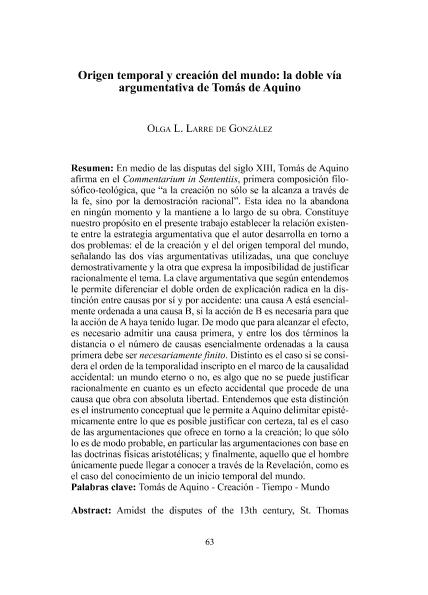
En medio de las disputas del siglo XIII, Tomás de Aquino afirma en el Commentarium in Sententiis, primera composición filosófico-teológica, que “a la creación no sólo se la alcanza a través de la fe, sino por la demostración racional”. Esta idea no la abandona en ningún momento y la mantiene a lo largo de su obra. Constituye nuestro propósito en el presente trabajo establecer la relación existente entre la estrategia argumentativa que el autor desarrolla en torno a dos problemas: el de la creación y el del origen temporal del mundo, señalando las dos vías argumentativas utilizadas, una que concluye demostrativamente y la otra que expresa la imposibilidad de justificar racionalmente el tema. La clave argumentativa que según entendemos le permite diferenciar el doble orden de explicación radica en la distinción entre causas por sí y por accidente: una causa A está esencialmente ordenada a una causa B, si la acción de B es necesaria para que la acción de A haya tenido lugar. De modo que para alcanzar el efecto, es necesario admitir una causa primera, y entre los dos términos la distancia o el número de causas esencialmente ordenadas a la causa primera debe ser necesariamente finito. Distinto es el caso si se considera el orden de la temporalidad inscrito en el marco de la causalidad accidental: un mundo eterno o no, es algo que no se puede justificar racionalmente en cuanto es un efecto accidental que procede de una causa que obra con absoluta libertad. Entendemos que esta distinción es el instrumento conceptual que le permite a Aquino delimitar epistémicamente entre: a) lo que es posible justificar con certeza, tal es el caso de las argumentaciones que ofrece en torno a la creación; b) lo que sólo lo es de modo probable, en particular las argumentaciones con base en las doctrinas físicas aristotélicas; y finalmente, c) aquello que el hombre únicamente puede llegar a conocer a través de la Revelación, como es el caso del conocimiento de un inicio temporal del mundo. Aquinas says in the Commentarium in Sententiis, first philosophical and theological composition that “the creation not only is reached through faith but by rational demonstration”. This idea not abandons her in no time and keeps it in his work. It is our purpose in the present work establishing the relationship between the strategy argumentative into the problem of creation and that another linked to the temporal beginning of the world, noting the two-way used argumentative, one argumentative and rational justification and the other that expresses the inability to rationally justify the topic. The argumentative strategy to understand lets you differentiate the double order of explanation lies distinction between essential and accidentally causes: A cause is essentially ordered to cause B, if B action is needed for A action has taken place. So to achieve the effect, it is necessary to admit a first cause, and between two terms the distance or the number of essentially ordered causes to the first cause must necessarily be finite. Different is the case concerning the order of temporality registered within the accidental causality: an eternal world or not, is something that cannot be justified rationally as soon as it is an accidental effect from a cause which work with absolute freedom. We understand that this distinction is the conceptual tool with which Aquinas defines what can be justified with certainty, such is the case of arguments offered in creation; what is only likely way, in particular the arguments based on the physical doctrines Aristotelian; and finally, what man only can know through revelation, as it is the case of knowledge of the temporal origin of the world.
Origen temporal y creación del mundo: la doble vía argumentativa de Tomás de Aquino

Fecha de publicación:
06/2012
Editorial:
Universidad Nacional de Cuyo. Facultad de Filosofía y Letras. Centro de Estudios Filosóficos Medievales
Revista:
Scripta Mediaevalia
ISSN:
1851-8753
e-ISSN:
2362-4868
Idioma:
Español
Tipo de recurso:
Artículo publicado
Clasificación temática:
Resumen
Palabras clave:
AQUINO
,
CREACION
,
TIEMPO
,
ETERNIDAD
Archivos asociados

Tamaño:
351.0Kb
Formato:
PDF
Licencia
 Excepto donde se diga explícitamente, este item se publica bajo la siguiente descripción:
Creative Commons Attribution-NonCommercial-ShareAlike 2.5 Unported (CC BY-NC-SA 2.5)
Excepto donde se diga explícitamente, este item se publica bajo la siguiente descripción:
Creative Commons Attribution-NonCommercial-ShareAlike 2.5 Unported (CC BY-NC-SA 2.5)
Identificadores
Colecciones
Articulos(SEDE CENTRAL)
Articulos de SEDE CENTRAL
Articulos de SEDE CENTRAL
Citación
Larre, Olga Lucia; Origen temporal y creación del mundo: la doble vía argumentativa de Tomás de Aquino; Universidad Nacional de Cuyo. Facultad de Filosofía y Letras. Centro de Estudios Filosóficos Medievales; Scripta Mediaevalia; 5; 1; 6-2012; 63-81
Compartir

