Artículo
The halo shape and evolution of polar disc galaxies
Snaith, O. N.; Gibson, B. K.; Brook, C. B.; Knebe, A.; Thacker, R. J.; Quinn, T. R.; Governato, F.; Tissera, Patricia Beatriz
Fecha de publicación:
21/09/2012
Editorial:
Oxford University Press
Revista:
Monthly Notices of the Royal Astronomical Society
ISSN:
0035-8711
Idioma:
Inglés
Tipo de recurso:
Artículo publicado
Clasificación temática:
Resumen
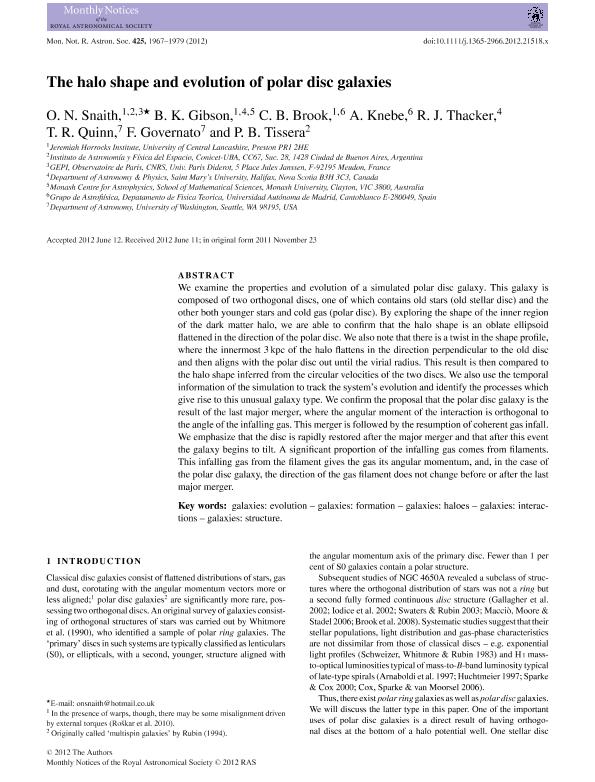
We examine the properties and evolution of a simulated polar disc galaxy. This galaxy is comprised of two orthogonal discs, one of which contains old stars (old stellar disc), and the other, containing both younger stars and the cold gas (polar disc) of the galaxy. By exploring the shape of the inner region of the dark matter halo, we are able to confirm that the halo shape is a oblate ellipsoid flattened in the direction of the polar disc. We also note that there is a twist in the shape profile, where the innermost 3 kpc of the halo flattens in the direction perpendicular to the old disc, and then aligns with the polar disc out until the virial radius. This result is then compared to the halo shape inferred from the circular velocities of the two discs. We also use the temporal information of the simulation to track the system’s evolution, and identify the processes which give rise to this unusual galaxy type. We confirm the proposal that the polar disc galaxy is the result of the last major merger, where the angular moment of the interaction is orthogonal to the angle of the infalling gas. This merger is followed by the resumption of coherent gas infall. We emphasis that the disc is rapidly restored after the major merger and that after this event the galaxy begins to tilt.A significant proportion of the infalling gas comes from filaments. This infalling gas from the filament gives the gas its angular momentum, and, in the case of the polar disc galaxy, the direction of the gas filament does not change before or after the last major merger.
Palabras clave:
Galaxy Formation
,
Galaxy Evolution
,
Cosmology
Archivos asociados

Tamaño:
791.4Kb
Formato:
PDF
Licencia
 Excepto donde se diga explícitamente, este item se publica bajo la siguiente descripción:
Creative Commons Attribution-NonCommercial-ShareAlike 2.5 Unported (CC BY-NC-SA 2.5)
Excepto donde se diga explícitamente, este item se publica bajo la siguiente descripción:
Creative Commons Attribution-NonCommercial-ShareAlike 2.5 Unported (CC BY-NC-SA 2.5)
Identificadores
Colecciones
Articulos(IAFE)
Articulos de INST.DE ASTRONOMIA Y FISICA DEL ESPACIO(I)
Articulos de INST.DE ASTRONOMIA Y FISICA DEL ESPACIO(I)
Citación
Snaith, O. N.; Gibson, B. K.; Brook, C. B.; Knebe, A.; Thacker, R. J.; et al.; The halo shape and evolution of polar disc galaxies; Oxford University Press; Monthly Notices of the Royal Astronomical Society; 425; 3; 21-9-2012; 1967-1979
Compartir


Altmétricas