Mostrar el registro sencillo del ítem
dc.contributor.author
Katz, Marcelo E.
dc.contributor.author
Margulis, Fernando
dc.contributor.author
Schiavelli, Rubén
dc.contributor.author
Arias, Pablo
dc.contributor.author
Head, Geoffrey A.
dc.contributor.author
Golombek, Diego Andres
dc.date.available
2023-04-20T13:36:19Z
dc.date.issued
2012-03
dc.identifier.citation
Katz, Marcelo E.; Margulis, Fernando; Schiavelli, Rubén; Arias, Pablo; Head, Geoffrey A.; et al.; Disruption of transitional stages in 24-h blood pressure recording in renal transplant recipients; Frontiers Media; Frontiers in Neurology; 3; 3-2012; 35-43
dc.identifier.issn
1664-2295
dc.identifier.uri
http://hdl.handle.net/11336/194719
dc.description.abstract
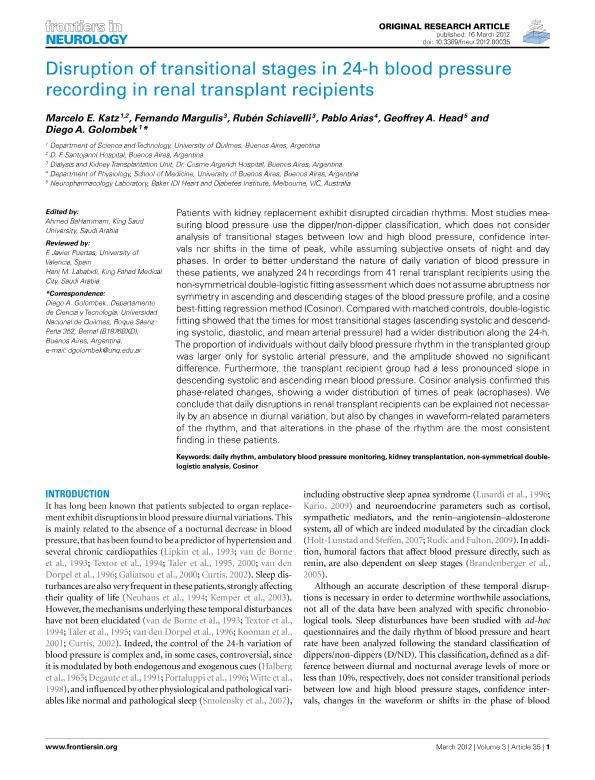
Patients with kidney replacement exhibit disrupted circadian rhythms. Most studies measuring blood pressure use the dipper/non-dipper classification, which does not consider analysis of transitional stages between low and high blood pressure, confidence intervals nor shifts in the time of peak, while assuming subjective onsets of night and day phases. In order to better understand the nature of daily variation of blood pressure in these patients, we analyzed 24 h recordings from 41 renal transplant recipients using the non-symmetrical double-logistic fitting assessment which does not assume abruptness nor symmetry in ascending and descending stages of the blood pressure profile, and a cosine best-fitting regression method (Cosinor). Compared with matched controls, double-logistic fitting showed that the times for most transitional stages (ascending systolic and descending systolic, diastolic, and mean arterial pressure) had a wider distribution along the 24-h. The proportion of individuals without daily blood pressure rhythm in the transplanted group was larger only for systolic arterial pressure, and the amplitude showed no significant difference. Furthermore, the transplant recipient group had a less pronounced slope in descending systolic and ascending mean blood pressure. Cosinor analysis confirmed this phase-related changes, showing a wider distribution of times of peak (acrophases). We conclude that daily disruptions in renal transplant recipients can be explained not necessarily by an absence in diurnal variation, but also by changes in waveform-related parameters of the rhythm, and that alterations in the phase of the rhythm are the most consistent finding in these patients.
dc.format
application/pdf
dc.language.iso
eng
dc.publisher
Frontiers Media
dc.rights
info:eu-repo/semantics/openAccess
dc.rights.uri
https://creativecommons.org/licenses/by-nc-sa/2.5/ar/
dc.subject
AMBULATORY BLOOD PRESSURE MONITORING
dc.subject
COSINOR
dc.subject
DAILY RHYTHM
dc.subject
KIDNEY TRANSPLANTATION
dc.subject
NON-SYMMETRICAL DOUBLE-LOGISTIC ANALYSIS
dc.subject.classification
Sistemas Cardíaco y Cardiovascular
dc.subject.classification
Medicina Clínica
dc.subject.classification
CIENCIAS MÉDICAS Y DE LA SALUD
dc.title
Disruption of transitional stages in 24-h blood pressure recording in renal transplant recipients
dc.type
info:eu-repo/semantics/article
dc.type
info:ar-repo/semantics/artículo
dc.type
info:eu-repo/semantics/publishedVersion
dc.date.updated
2023-04-19T15:08:33Z
dc.journal.volume
3
dc.journal.pagination
35-43
dc.journal.pais
Estados Unidos
dc.description.fil
Fil: Katz, Marcelo E.. Universidad Nacional de Quilmes; Argentina
dc.description.fil
Fil: Margulis, Fernando. Gobierno de la Ciudad Autónoma de Buenos Aires. Hospital General de Agudos Doctor Cosme Argerich; Argentina
dc.description.fil
Fil: Schiavelli, Rubén. Gobierno de la Ciudad Autónoma de Buenos Aires. Hospital General de Agudos Doctor Cosme Argerich; Argentina
dc.description.fil
Fil: Arias, Pablo. Universidad de Buenos Aires; Argentina
dc.description.fil
Fil: Head, Geoffrey A.. No especifíca;
dc.description.fil
Fil: Golombek, Diego Andres. Universidad Nacional de Quilmes; Argentina. Consejo Nacional de Investigaciones Científicas y Técnicas; Argentina
dc.journal.title
Frontiers in Neurology
dc.relation.alternativeid
info:eu-repo/semantics/altIdentifier/url/https://www.frontiersin.org/articles/10.3389/fneur.2012.00035/full
dc.relation.alternativeid
info:eu-repo/semantics/altIdentifier/doi/http://dx.doi.org/10.3389/fneur.2012.00035
Archivos asociados

Tamaño:
1.389Mb
Formato:
PDF