Artículo
The use of chronobiotics in the resynchronization of the sleep/wake cycle. Therapeutical application in the early phases of Alzheimer´s disease

Fecha de publicación:
11/2011
Editorial:
Bentham Science Publishers
Revista:
Recent Patents on Endocrine, Metabolic & Immune Drug Discovery
ISSN:
1872-2148
Idioma:
Inglés
Tipo de recurso:
Artículo publicado
Clasificación temática:
Resumen
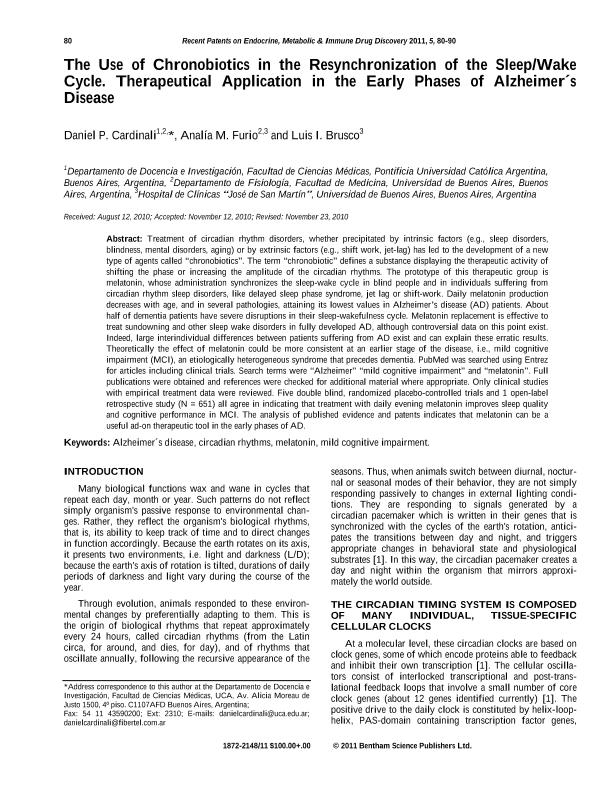
Treatment of circadian rhythm disorders, whether precipitated by intrinsic factors (e.g., sleep disorders, blindness, mental disorders, aging) or by extrinsic factors (e.g., shift work, jet-lag) has led to the development of a new type of agents called "chronobiotics". The term "chronobiotic" defines a substance displaying the therapeutic activity of shifting the phase or increasing the amplitude of the circadian rhythms. The prototype of this therapeutic group is melatonin, whose administration synchronizes the sleep-wake cycle in blind people and in individuals suffering from circadian rhythm sleep disorders, like delayed sleep phase syndrome, jet lag or shift-work. Daily melatonin production decreases with age, and in several pathologies, attaining its lowest values in Alzheimer's disease (AD) patients. About half of dementia patients have severe disruptions in their sleep-wakefulness cycle. Melatonin replacement is effective to treat sundowning and other sleep wake disorders in fully developed AD, although controversial data on this point exist. Indeed, large interindividual differences between patients suffering from AD exist and can explain these erratic results. Theoretically the effect of melatonin could be more consistent at an earlier stage of the disease, i.e., mild cognitive impairment (MCI), an etiologically heterogeneous syndrome that precedes dementia. PubMed was searched using Entrez for articles including clinical trials. Search terms were "Alzheimer" "mild cognitive impairment" and "melatonin". Full publications were obtained and references were checked for additional material where appropriate. Only clinical studies with empirical treatment data were reviewed. Five double blind, randomized placebo-controlled trials and 1 open-label retrospective study (N = 651) all agree in indicating that treatment with daily evening melatonin improves sleep quality and cognitive performance in MCI. The analysis of published evidence and patents indicates that melatonin can be a useful ad-on therapeutic tool in the early phases of AD.
Palabras clave:
ALZHEIMER'S DISEASE
,
CIRCADIAN RHYTHMS
,
MELATONIN
,
MILD COGNITIVE IMPAIRMENT
Archivos asociados

Tamaño:
930.4Kb
Formato:
PDF
Licencia
 Excepto donde se diga explícitamente, este item se publica bajo la siguiente descripción:
Creative Commons Attribution-NonCommercial-ShareAlike 2.5 Unported (CC BY-NC-SA 2.5)
Excepto donde se diga explícitamente, este item se publica bajo la siguiente descripción:
Creative Commons Attribution-NonCommercial-ShareAlike 2.5 Unported (CC BY-NC-SA 2.5)
Identificadores
Colecciones
Articulos(SEDE CENTRAL)
Articulos de SEDE CENTRAL
Articulos de SEDE CENTRAL
Citación
Cardinali, Daniel Pedro; Furio, Analía Mabel; Brusco, Luis Ignacio; The use of chronobiotics in the resynchronization of the sleep/wake cycle. Therapeutical application in the early phases of Alzheimer´s disease; Bentham Science Publishers; Recent Patents on Endocrine, Metabolic & Immune Drug Discovery; 5; 2; 11-2011; 80-90
Compartir


Altmétricas