Artículo
Pectoral girdle and forelimb variation in extant Crocodylia: the coracoid–humerus pair as an evolutionary module

Fecha de publicación:
2013
Editorial:
Wiley Blackwell Publishing, Inc
Revista:
Biological Journal Of The Linnean Society
ISSN:
0024-4066
Idioma:
Inglés
Tipo de recurso:
Artículo publicado
Clasificación temática:
Resumen
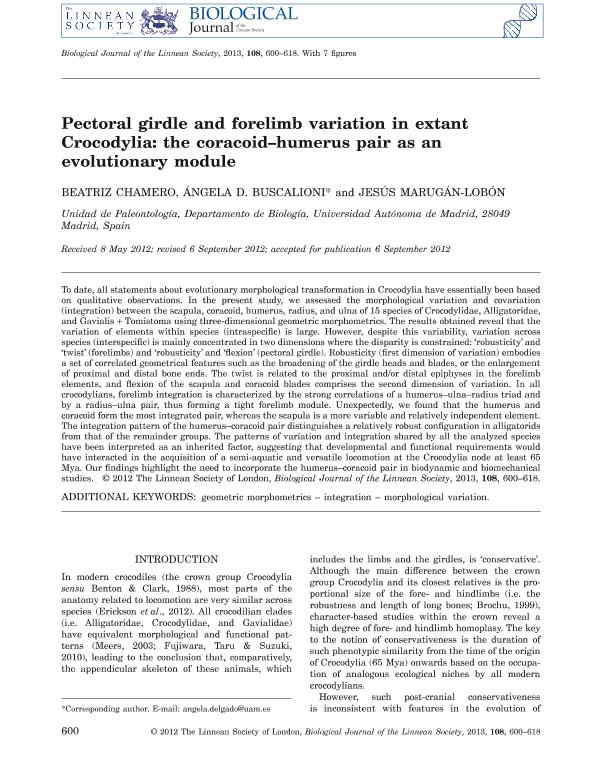
To date, all statements about evolutionary morphological transformation in Crocodylia have essentially been based on qualitative observations. In the present study, we assessed the morphological variation and covariation (integration) between the scapula, coracoid, humerus, radius, and ulna of 15 species of Crocodylidae, Alligatoridae, and Gavialis + Tomistoma using three-dimensional geometric morphometrics. The results obtained reveal that the variation of elements within species (intraspecific) is large. However, despite this variability, variation across species (interspecific) is mainly concentrated in two dimensions where the disparity is constrained: ‘robusticity’ and ‘twist’ (forelimbs) and ‘robusticity’ and ‘flexion’ (pectoral girdle). Robusticity (first dimension of variation) embodies a set of correlated geometrical features such as the broadening of the girdle heads and blades, or the enlargement of proximal and distal bone ends. The twist is related to the proximal and/or distal epiphyses in the forelimb elements, and flexion of the scapula and coracoid blades comprises the second dimension of variation. In all crocodylians, forelimb integration is characterized by the strong correlations of a humerus–ulna–radius triad and by a radius–ulna pair, thus forming a tight forelimb module. Unexpectedly, we found that the humerus and coracoid form the most integrated pair, whereas the scapula is a more variable and relatively independent element. The integration pattern of the humerus–coracoid pair distinguishes a relatively robust configuration in alligatorids from that of the remainder groups. The patterns of variation and integration shared by all the analyzed species have been interpreted as an inherited factor, suggesting that developmental and functional requirements would have interacted in the acquisition of a semi-aquatic and versatile locomotion at the Crocodylia node at least 65 Mya. Our findings highlight the need to incorporate the humerus–coracoid pair in biodynamic and biomechanical studies.
Archivos asociados

Tamaño:
1.690Mb
Formato:
PDF
Licencia
 Excepto donde se diga explícitamente, este item se publica bajo la siguiente descripción:
Creative Commons Attribution-NonCommercial-ShareAlike 2.5 Unported (CC BY-NC-SA 2.5)
Excepto donde se diga explícitamente, este item se publica bajo la siguiente descripción:
Creative Commons Attribution-NonCommercial-ShareAlike 2.5 Unported (CC BY-NC-SA 2.5)
Identificadores
Colecciones
Articulos(CCT-CENPAT)
Articulos de CTRO.CIENTIFICO TECNOL.CONICET - CENPAT
Articulos de CTRO.CIENTIFICO TECNOL.CONICET - CENPAT
Citación
Chamero Macho, Beatriz; Marugán Lobón, Jesús; Buscalioni, Ángela D.; Pectoral girdle and forelimb variation in extant Crocodylia: the coracoid–humerus pair as an evolutionary module; Wiley Blackwell Publishing, Inc; Biological Journal Of The Linnean Society; 108; 3; -1-2013; 600-618
Compartir


Altmétricas