Artículo
Stemming Epigenetics in Marine Stramenopiles

Fecha de publicación:
08/2011
Editorial:
Bentham Science Publishers
Revista:
Current Genomics
ISSN:
1389-2029
Idioma:
Inglés
Tipo de recurso:
Artículo publicado
Clasificación temática:
Resumen
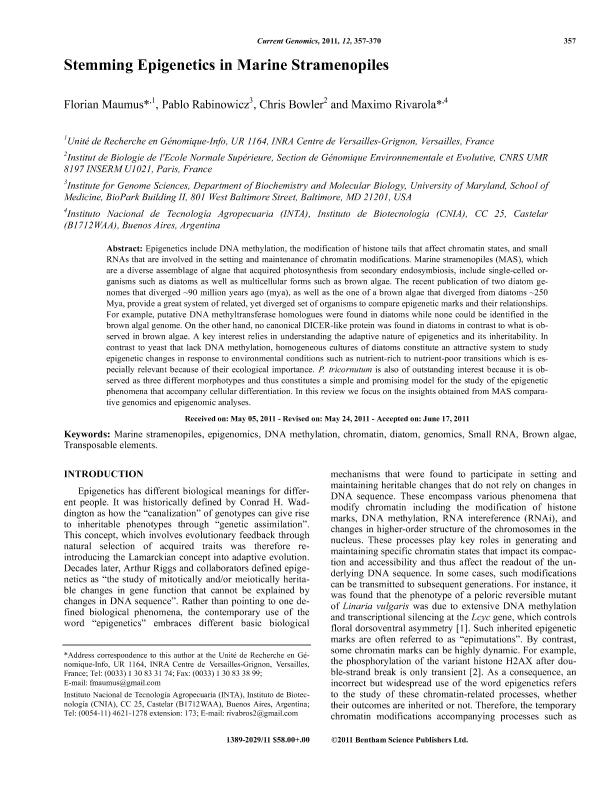
Epigenetics include DNA methylation, the modification of histone tails that affect chromatin states, and small RNAs that are involved in the setting and maintenance of chromatin modifications. Marine stramenopiles (MAS), which are a diverse assemblage of algae that acquired photosynthesis from secondary endosymbiosis, include single-celled organisms such as diatoms as well as multicellular forms such as brown algae. The recent publication of two diatom genomes that diverged ~90 million years ago (mya), as well as the one of a brown algae that diverged from diatoms ~250 Mya, provide a great system of related, yet diverged set of organisms to compare epigenetic marks and their relationships. For example, putative DNA methyltransferase homologues were found in diatoms while none could be identified in the brown algal genome. On the other hand, no canonical DICER-like protein was found in diatoms in contrast to what is observed in brown algae. A key interest relies in understanding the adaptive nature of epigenetics and its inheritability. In contrast to yeast that lack DNA methylation, homogeneous cultures of diatoms constitute an attractive system to study epigenetic changes in response to environmental conditions such as nutrient-rich to nutrient-poor transitions which is especially relevant because of their ecological importance. P. tricornutum is also of outstanding interest because it is observed as three different morphotypes and thus constitutes a simple and promising model for the study of the epigenetic phenomena that accompany cellular differentiation. In this review we focus on the insights obtained from MAS comparative genomics and epigenomic analyses.
Archivos asociados

Tamaño:
601.9Kb
Formato:
PDF
Licencia
 Excepto donde se diga explícitamente, este item se publica bajo la siguiente descripción:
Creative Commons Attribution-NonCommercial-ShareAlike 2.5 Unported (CC BY-NC-SA 2.5)
Excepto donde se diga explícitamente, este item se publica bajo la siguiente descripción:
Creative Commons Attribution-NonCommercial-ShareAlike 2.5 Unported (CC BY-NC-SA 2.5)
Identificadores
Colecciones
Articulos(SEDE CENTRAL)
Articulos de SEDE CENTRAL
Articulos de SEDE CENTRAL
Citación
Maumus, Florian; Rabinowicz, Pablo; Bowler, Chris; Rivarola, Maximo Lisandro; Stemming Epigenetics in Marine Stramenopiles; Bentham Science Publishers; Current Genomics; 12; 5; 8-2011; 357-370
Compartir


Altmétricas