Artículo
AFLP variability, toxin production, and pathogenicity of Alternaria species from Argentinean tomato fruits and puree
Somma, Stefania; Pose, Graciela Noemi ; Pardo, Alejandro Guillermo
; Mulè, Giuseppina; Fernández Pinto, Virginia Elena; Moretti, Antonio; Logrieco, Antonio Francesco
; Pardo, Alejandro Guillermo
; Mulè, Giuseppina; Fernández Pinto, Virginia Elena; Moretti, Antonio; Logrieco, Antonio Francesco
; Pardo, Alejandro Guillermo
; Mulè, Giuseppina; Fernández Pinto, Virginia Elena; Moretti, Antonio; Logrieco, Antonio Francesco
Fecha de publicación:
02/2011
Editorial:
Elsevier Science
Revista:
International Journal of Food Microbiology
ISSN:
0168-1605
Idioma:
Inglés
Tipo de recurso:
Artículo publicado
Clasificación temática:
Resumen
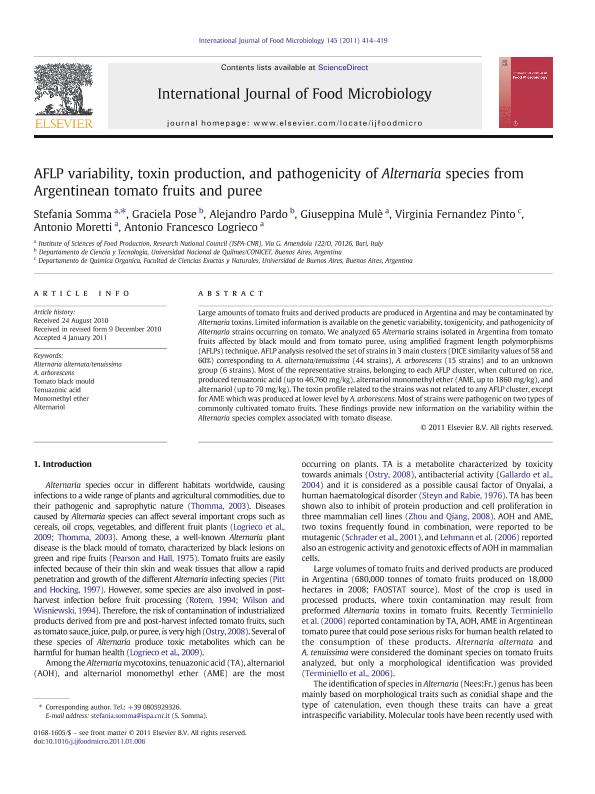
Large amounts of tomato fruits and derived products are produced in Argentina and may be contaminated by Alternaria toxins. Limited information is available on the genetic variability, toxigenicity, and pathogenicity of Alternaria strains occurring on tomato. We analyzed 65 Alternaria strains isolated in Argentina from tomato fruits affected by black mould and from tomato puree, using amplified fragment length polymorphisms (AFLPs) technique. AFLP analysis resolved the set of strains in 3 main clusters (DICE similarity values of 58 and 60%) corresponding to A. alternata/tenuissima (44 strains), A. arborescens (15 strains) and to an unknown group (6 strains). Most of the representative strains, belonging to each AFLP cluster, when cultured on rice, produced tenuazonic acid (up to 46,760. mg/kg), alternariol monomethyl ether (AME, up to 1860. mg/kg), and alternariol (up to 70. mg/kg). The toxin profile related to the strains was not related to any AFLP cluster, except for AME which was produced at lower level by A. arborescens. Most of strains were pathogenic on two types of commonly cultivated tomato fruits. These findings provide new information on the variability within the Alternaria species complex associated with tomato disease.
Archivos asociados

Tamaño:
211.4Kb
Formato:
PDF
Licencia
 Excepto donde se diga explícitamente, este item se publica bajo la siguiente descripción:
Creative Commons Attribution-NonCommercial-ShareAlike 2.5 Unported (CC BY-NC-SA 2.5)
Excepto donde se diga explícitamente, este item se publica bajo la siguiente descripción:
Creative Commons Attribution-NonCommercial-ShareAlike 2.5 Unported (CC BY-NC-SA 2.5)
Identificadores
Colecciones
Articulos(CCT - PATAGONIA NORTE)
Articulos de CTRO.CIENTIFICO TECNOL.CONICET - PATAGONIA NORTE
Articulos de CTRO.CIENTIFICO TECNOL.CONICET - PATAGONIA NORTE
Articulos(SEDE CENTRAL)
Articulos de SEDE CENTRAL
Articulos de SEDE CENTRAL
Citación
Somma, Stefania; Pose, Graciela Noemi; Pardo, Alejandro Guillermo; Mulè, Giuseppina; Fernández Pinto, Virginia Elena; et al.; AFLP variability, toxin production, and pathogenicity of Alternaria species from Argentinean tomato fruits and puree; Elsevier Science; International Journal of Food Microbiology; 145; 2-3; 2-2011; 414-419
Compartir


Altmétricas