Artículo
Concordance of CCR5 genotypes that influence cell-mediated immunity and HIV-1 disease progression rates
Catano, Gabriel; Chykarenko, Zoya A.; Mangano, Andrea María Mercedes ; Anaya, J. M.; He, Weijing; Smith, Alison; Bologna, Rosa; Sen, Luisa
; Clark, Robert A.; Lloyd, Andrew; Shostakovich Koretskaya, Ludmila; Ahuja, Sunil K.
; Anaya, J. M.; He, Weijing; Smith, Alison; Bologna, Rosa; Sen, Luisa
; Clark, Robert A.; Lloyd, Andrew; Shostakovich Koretskaya, Ludmila; Ahuja, Sunil K.
; Anaya, J. M.; He, Weijing; Smith, Alison; Bologna, Rosa; Sen, Luisa
; Clark, Robert A.; Lloyd, Andrew; Shostakovich Koretskaya, Ludmila; Ahuja, Sunil K.
Fecha de publicación:
01/2011
Editorial:
Oxford University Press
Revista:
Journal Of Infectious Diseases
ISSN:
0022-1899
e-ISSN:
1537-6613
Idioma:
Inglés
Tipo de recurso:
Artículo publicado
Clasificación temática:
Resumen
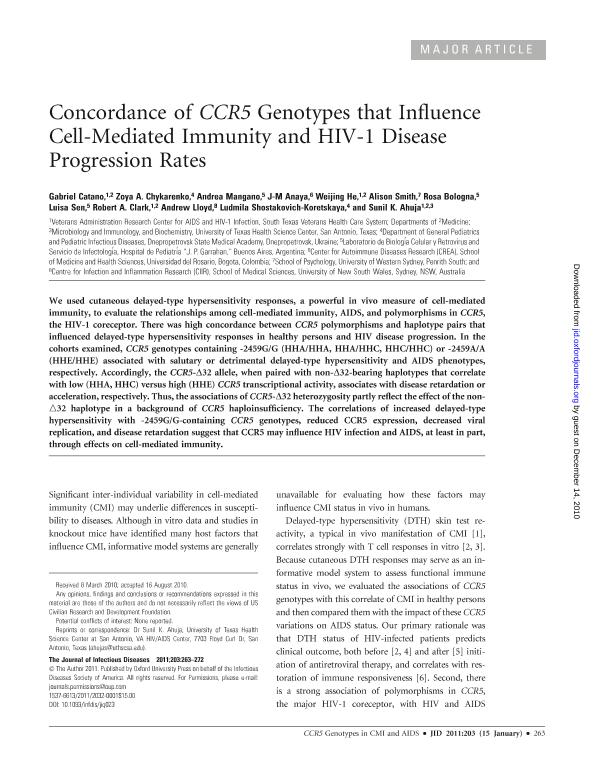
We used cutaneous delayed-type hypersensitivity responses, a powerful in vivo measure of cell-mediated immunity, to evaluate the relationships among cell-mediated immunity, AIDS, and polymorphisms in CCR5, the HIV-1 coreceptor. There was high concordance between CCR5 polymorphisms and haplotype pairs that influenced delayed-type hypersensitivity responses in healthy persons and HIV disease progression. In the cohorts examined, CCR5 genotypes containing -2459G/G (HHA/HHA, HHA/HHC, HHC/HHC) or -2459A/A (HHE/HHE) associated with salutary or detrimental delayed-type hypersensitivity and AIDS phenotypes, respectively. Accordingly, the CCR5-D32 allele, when paired with non-Δ32-bearing haplotypes that correlate with low (HHA, HHC) versus high (HHE) CCR5 transcriptional activity, associates with disease retardation or acceleration, respectively. Thus, the associations of CCR5-Δ32 heterozygosity partly reflect the effect of the non-Δ32 haplotype in a background of CCR5 haploinsufficiency. The correlations of increased delayed-type hypersensitivity with -2459G/G-containing CCR5 genotypes, reduced CCR5 expression, decreased viral replication, and disease retardation suggest that CCR5 may influence HIV infection and AIDS, at least in part, through effects on cell-mediated immunity.
Palabras clave:
CCR5 GENOTYPES
,
HIV-I
,
IMMUNITY
Archivos asociados

Tamaño:
721.0Kb
Formato:
PDF
Licencia
 Excepto donde se diga explícitamente, este item se publica bajo la siguiente descripción:
Creative Commons Attribution-NonCommercial-ShareAlike 2.5 Unported (CC BY-NC-SA 2.5)
Excepto donde se diga explícitamente, este item se publica bajo la siguiente descripción:
Creative Commons Attribution-NonCommercial-ShareAlike 2.5 Unported (CC BY-NC-SA 2.5)
Identificadores
Colecciones
Articulos(SEDE CENTRAL)
Articulos de SEDE CENTRAL
Articulos de SEDE CENTRAL
Citación
Catano, Gabriel; Chykarenko, Zoya A.; Mangano, Andrea María Mercedes; Anaya, J. M.; He, Weijing; et al.; Concordance of CCR5 genotypes that influence cell-mediated immunity and HIV-1 disease progression rates; Oxford University Press; Journal Of Infectious Diseases; 203; 2; 1-2011; 263-272
Compartir


Altmétricas