Artículo
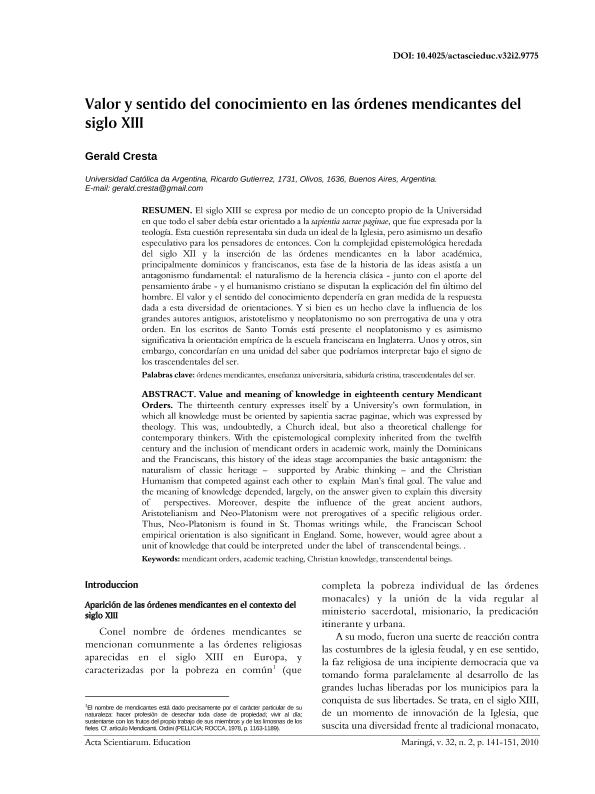
El Siglo XIII se expresa por medio de un concepto propio de la Universidad en que todo el saber debía estar orientado a la sapientia sacrae paginae, que fue expresada por la teología. Esta cuestión representaba sin duda un ideal de la Iglesia, pero asimismo un desafío especulativo para los pensadores de entonces. Con la complejidad epistemológica heredada del siglo XII y la inserción de las órdenes mendicantes en la labor académica, principalmente dominicos y franciscanos, esta fase de la historia de las ideas asistía a un antagonismo fundamental: el naturalismo de la herencia clásica -junto con el aporte del pensamiento árabe- y el humanismo cristiano se disputan la explicación del fin último del hombre. El valor y el sentido del conocimiento dependería en gran medida de la respuesta dada a esta diversidad de orientaciones. Y si bien es un hecho clave la influencia de los grandes autores antiguos, aristotelismo y neoplatonismo no son prerrogativa de una y otra orden. En los escritos de Santo Tomás está presente el neoplatonismo y es asimismo significativa la orientación empírica de la escuela franciscana en Inglaterra. Unos y otros, sin embargo, concordarían en una unidad del saber que podríamos interpretar bajo el signo de los trascendentales del ser. The thirteenth century expresses itself by a University’s own formulation, in which all knowledge must be oriented by sapientia sacrae paginae, which was expressed by theology. This was, undoubtedly, a Church ideal, but also a theoretical challenge for contemporary thinkers. With the epistemological complexity inherited from the twelfth century and the inclusion of mendicant orders in academic work, mainly the Dominicans and the Franciscans, this history of the ideas stage accompanies the basic antagonism: the naturalism of classic heritage – supported by Arabic thinking – and the Christian Humanism that competed against each other to explain Man’s final goal. The value and the meaning of knowledge depended, largely, on the answer given to explain this diversity of perspectives. Moreover, despite the influence of the great ancient authors, Aristotelianism and Neo-Platonism were not prerogatives of a specific religious order. Thus, Neo-Platonism is found in St. Thomas writings while, the Franciscan School empirical orientation is also significant in England. Some, however, would agree about a unit of knowledge that could be interpreted under the label of transcendental beings.
Valor y sentido del conocimiento en las Ordenes Mendicantes del Siglo XIII
Título:
Value and meaning of knowledge in eighteenth century Mendicant Orders

Fecha de publicación:
12/2010
Editorial:
Universidade Estadual de Maringá
Revista:
Acta Scientiarum: Education
ISSN:
2178-5198
e-ISSN:
2178-5201
Idioma:
Español
Tipo de recurso:
Artículo publicado
Clasificación temática:
Resumen
Palabras clave:
ORDENES MENDICANTES
,
ENSEÑANZA
,
ARISTOTELISMO
,
TRASCENDENTALES
Archivos asociados

Tamaño:
141.2Kb
Formato:
PDF
Licencia
 Excepto donde se diga explícitamente, este item se publica bajo la siguiente descripción:
Creative Commons Attribution-NonCommercial-ShareAlike 2.5 Unported (CC BY-NC-SA 2.5)
Excepto donde se diga explícitamente, este item se publica bajo la siguiente descripción:
Creative Commons Attribution-NonCommercial-ShareAlike 2.5 Unported (CC BY-NC-SA 2.5)
Identificadores
Colecciones
Articulos(SEDE CENTRAL)
Articulos de SEDE CENTRAL
Articulos de SEDE CENTRAL
Citación
Cresta, Norberto Gerald; Valor y sentido del conocimiento en las Ordenes Mendicantes del Siglo XIII; Universidade Estadual de Maringá; Acta Scientiarum: Education; 32; 2; 12-2010; 141-151
Compartir


Altmétricas