Artículo
Enhanced Context-Dependent Repeated Learning in Male Offspring After Prenatal Stress Alone or in Conjunction with Lead Exposure

Fecha de publicación:
07/2012
Editorial:
Elsevier Science
Revista:
Neurotoxicology
ISSN:
0161-813X
Idioma:
Inglés
Tipo de recurso:
Artículo publicado
Clasificación temática:
Resumen
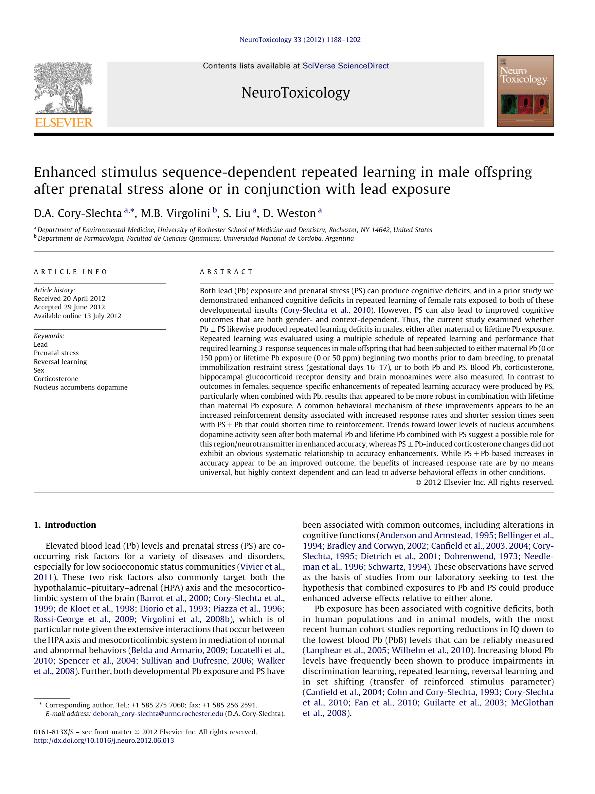
Both lead (Pb) exposure and prenatal stress (PS) can produce cognitive deficits, and in a prior study we demonstrated enhanced cognitive deficits in repeated learning of female rats exposed to both of these developmental insults (Cory-Slechta et al., 2010). However, PS can also lead to improved cognitive outcomes that are both gender- and context-dependent. Thus, the current study examined whether Pb ± PS likewise produced repeated learning deficits in males, either after maternal or lifetime Pb exposure. Repeated learning was evaluated using a multiple schedule of repeated learning and performance that required learning 3-response sequences in male offspring that had been subjected to either maternal Pb (0 or 150. ppm) or lifetime Pb exposure (0 or 50. ppm) beginning two months prior to dam breeding, to prenatal immobilization restraint stress (gestational days 16-17), or to both Pb and PS. Blood Pb, corticosterone, hippocampal glucocorticoid receptor density and brain monoamines were also measured. In contrast to outcomes in females, sequence-specific enhancements of repeated learning accuracy were produced by PS, particularly when combined with Pb, results that appeared to be more robust in combination with lifetime than maternal Pb exposure. A common behavioral mechanism of these improvements appears to be an increased reinforcement density associated with increased response rates and shorter session times seen with PS ± Pb that could shorten time to reinforcement. Trends toward lower levels of nucleus accumbens dopamine activity seen after both maternal Pb and lifetime Pb combined with PS suggest a possible role for this region/neurotransmitter in enhanced accuracy, whereas PS ± Pb-induced corticosterone changes did not exhibit an obvious systematic relationship to accuracy enhancements. While PS ± Pb-based increases in accuracy appear to be an improved outcome, the benefits of increased response rate are by no means universal, but highly context-dependent and can lead to adverse behavioral effects in other conditions. © 2012 Elsevier Inc.
Archivos asociados

Tamaño:
8.940Mb
Formato:
PDF
Licencia
 Excepto donde se diga explícitamente, este item se publica bajo la siguiente descripción:
Creative Commons Attribution-NonCommercial-ShareAlike 2.5 Unported (CC BY-NC-SA 2.5)
Excepto donde se diga explícitamente, este item se publica bajo la siguiente descripción:
Creative Commons Attribution-NonCommercial-ShareAlike 2.5 Unported (CC BY-NC-SA 2.5)
Identificadores
Colecciones
Articulos(IFEC)
Articulos de INST. DE FARMACOLOGIA EXPERIMENTAL DE CORDOBA
Articulos de INST. DE FARMACOLOGIA EXPERIMENTAL DE CORDOBA
Citación
Cory Slechta, D. A.; Virgolini, Miriam Beatriz; Liu, S.; Weston, D.; Enhanced Context-Dependent Repeated Learning in Male Offspring After Prenatal Stress Alone or in Conjunction with Lead Exposure; Elsevier Science; Neurotoxicology; 33; 5; 7-2012; 1188-1202
Compartir


Altmétricas